
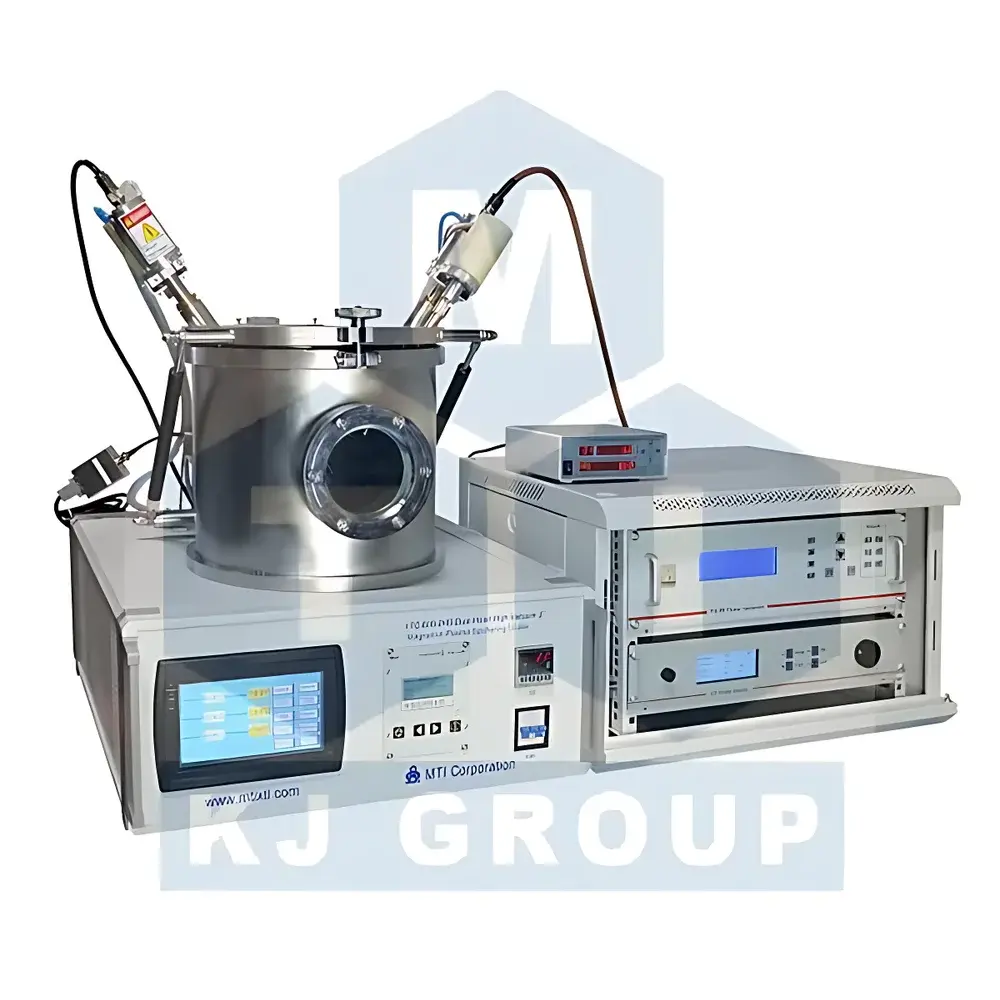
Kojin VTC-600-2HD Dual-Target Magnetron Sputtering System
| Brand | Kojin |
|---|---|
| Origin | Anhui, China |
| Model | VTC-600-2HD |
| Power Supply | 220 VAC, 50/60 Hz, single-phase, 2000 W (including vacuum pump) |
| DC Sputter Power | 500 W |
| RF Sputter Power | 600 W (optional 300 W RF module available) |
| Chamber Dimensions | Ø300 mm × 300 mm H, stainless steel |
| Viewport Diameter | 100 mm |
| Chamber Opening | Top-hinged lid |
| Substrate Holder | Ø140 mm, rotatable (1–20 rpm), heated up to 500 °C (±1.0 °C stability) |
| Target Size | 50 mm diameter |
| Cooling Water Flow | 10 mL/min (integrated chiller: 16 mL/min) |
| MFC Range | 0–200 sccm (dual-channel) |
| Thickness Monitor | Quartz crystal microbalance (QCM), resolution: 0.10 Å, LED display |
| Vacuum System | Integrated German-made turbomolecular pump with one-touch operation |
| Overall Dimensions | 1300 mm (L) × 660 mm (W) × 1200 mm (H) |
| Weight | 160 kg |
| Warranty | 1 year standard, lifetime technical support |
Overview
The Kojin VTC-600-2HD Dual-Target Magnetron Sputtering System is a compact, benchtop-scale physical vapor deposition (PVD) platform engineered for precise, reproducible thin-film synthesis in academic, R&D, and quality control laboratories. It operates on the principle of magnetron-enhanced sputtering—where plasma confinement via permanent magnets increases ion density near the target surface, enabling efficient material ejection at relatively low operating pressures (typically 0.1–10 mTorr). The system integrates two independently controlled magnetron sources: one DC-powered for conductive targets (e.g., Au, Pt, Cr, Al), and one RF-powered for insulating or semi-insulating materials (e.g., Al2O3, SiO2, ITO, PZT, LiCoO2). This dual-mode architecture supports co-sputtering, sequential layering, and compositional gradient fabrication without breaking vacuum—critical for multilayer heterostructures in ferroelectric, optoelectronic, and energy storage research. Designed for high repeatability and operator safety, the VTC-600-2HD conforms to IEC 61000-6-3 (EMC) and IEC 61010-1 (electrical safety) standards for laboratory equipment.
Key Features
- Dual independent magnetron heads—DC (500 W) and RF (600 W)—each equipped with water-cooled backing plates and adjustable tilt angles for uniform film coverage.
- Integrated quartz crystal microbalance (QCM) thickness monitor with 0.10 Å resolution and real-time feedback, synchronized with process parameters via embedded controller.
- Rotatable, temperature-controlled substrate stage (1–20 rpm, up to 500 °C ±1.0 °C) enabling enhanced film crystallinity, stress management, and interfacial diffusion control.
- Top-hinged stainless-steel vacuum chamber (Ø300 × 300 mm) with 100 mm borosilicate viewport and quick-access door mechanism—reducing target exchange time by >40% versus side-loading systems.
- Dual mass flow controllers (0–200 sccm range) for precise Ar, O2, N2, or reactive gas blending; all setpoints managed via intuitive 6-inch capacitive touchscreen interface.
- Integrated German turbomolecular pumping system with automatic pressure sequencing and oil-free operation—achieving base pressures <5×10⁻⁷ Torr and process pressures stable within ±0.05 mTorr.
Sample Compatibility & Compliance
The VTC-600-2HD accommodates substrates up to 4-inch (100 mm) diameter—including silicon wafers, glass slides, TEM grids, flexible polymer foils, and ceramic discs. Its dual-power architecture enables deposition of metallic (Cu, Ni, Ti), oxide (TiO2, ZnO, HfO2), nitride (Si3N4, TiN), fluoropolymer (PTFE), and complex perovskite films without requiring target replacement. All wetted components comply with ASTM F86 (surface preparation of titanium implants) and ISO 14644-1 Class 5 cleanroom compatibility when operated in controlled environments. The system supports GLP-compliant documentation through optional timestamped log export (CSV/Excel), meeting traceability requirements under FDA 21 CFR Part 11 when paired with validated software modules.
Software & Data Management
The embedded control firmware provides full recipe-based automation: users define gas composition, power ramp profiles, rotation speed, substrate temperature ramps, and QCM endpoint thresholds in advance. Process logs—including real-time pressure, voltage/current waveforms, thickness accumulation, and error flags—are stored internally (16 GB flash memory) and exportable via USB or Ethernet. Optional PC-hosted software (Kojin SputterSuite™ v3.2) adds multi-user role management, audit trail generation, electronic signature support, and integration with LIMS platforms via OPC UA. All data fields are timestamped with UTC synchronization and include checksum validation to ensure integrity during regulatory audits.
Applications
This system serves as a foundational tool across disciplines:
- Materials Science: Fabrication of epitaxial oxide heterostructures (e.g., LaAlO3/SrTiO3 interfaces), transparent conductive oxides for photovoltaics, and solid-state electrolyte layers for solid-state batteries.
- Electron Microscopy: High-conductivity, ultra-thin (<5 nm) Au/Pd or Cr coatings for SEM/TEM sample preparation—minimizing charging artifacts while preserving nanoscale topography.
- Sensor Development: Deposition of gas-sensitive metal-oxide thin films (WO3, SnO2) with controlled stoichiometry via reactive sputtering in Ar/O2 mixtures.
- Optics & Photonics: Alternating dielectric stacks (e.g., SiO2/TiO2) for anti-reflection or high-reflectance coatings, calibrated via in situ QCM and ex situ ellipsometry correlation.
- Ferroelectric & Piezoelectric Research: Growth of Pb(Zr,Ti)O3 (PZT) and BaTiO3 thin films with tunable c-axis orientation using substrate heating and oxygen partial pressure control.
FAQ
Can the VTC-600-2HD be upgraded to three RF magnetrons?
Yes—custom configurations with three RF heads are available upon factory order; contact Kojin engineering support to review mechanical integration, power supply redundancy, and chamber port allocation.
Is the QCM sensor compatible with high-temperature depositions above 300 °C?
The standard quartz crystal is rated for continuous operation up to 250 °C; for processes exceeding this, we recommend the optional high-temp QCM kit (rated to 450 °C) with thermally compensated oscillator circuitry.
Does the system meet electromagnetic compatibility requirements for use in shielded labs?
Yes—the entire RF subsystem is fully shielded and certified to CISPR 11 Group 1, Class B limits; additional mu-metal shielding can be added for ultra-low-noise electron microscopy facilities.
What vacuum certifications accompany the turbomolecular pump?
The integrated pump carries CE marking, ISO 9001 manufacturing certification, and full test reports including ultimate vacuum performance, vibration spectra, and helium leak rate (<5×10⁻¹⁰ mbar·L/s).
How is process reproducibility validated across multiple instruments?
Kojin provides factory calibration certificates traceable to NIST standards for MFCs, thermocouples, and QCM sensors; inter-instrument correlation studies are included in the installation qualification (IQ) package.



