
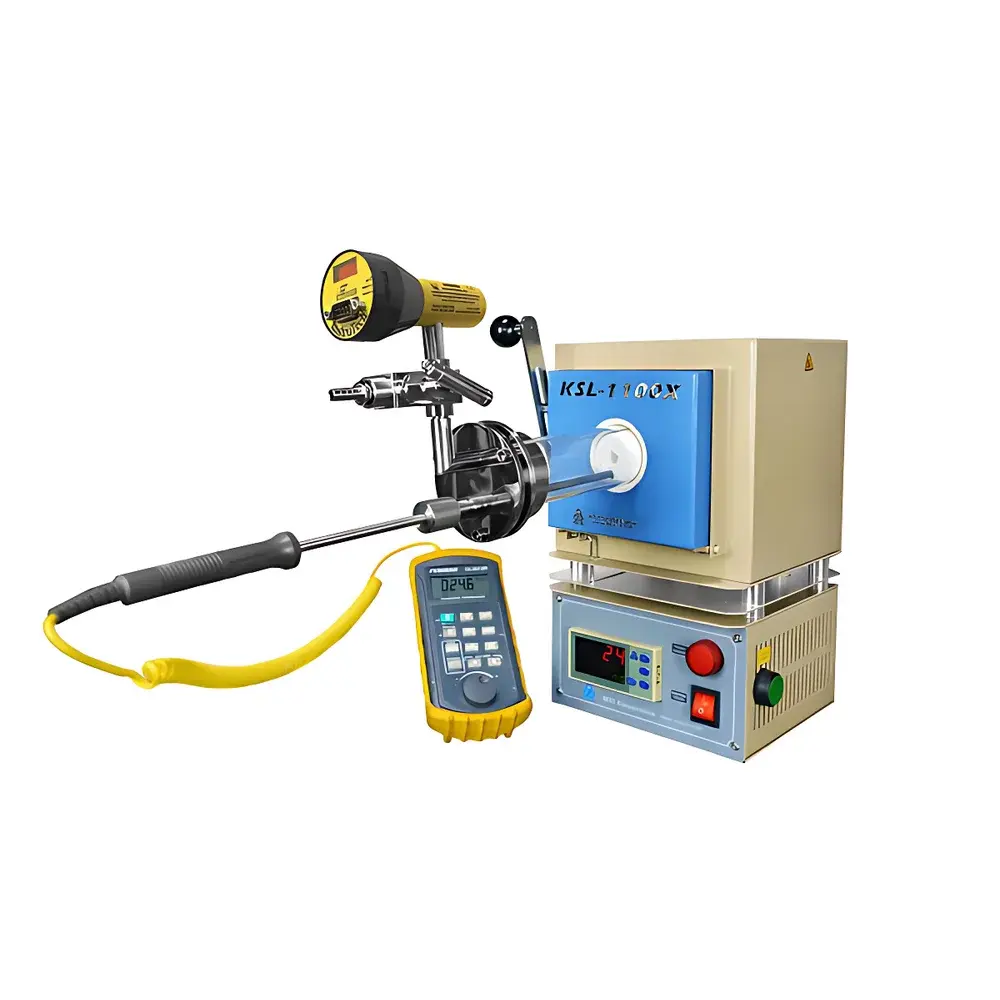
Hefei Kejing KSL-1100X-S-H Compact Hybrid Tube/Box Furnace
| Brand | Hefei Kejing |
|---|---|
| Origin | Anhui, China |
| Model | KSL-1100X-S-H |
| Furnace Type | Box Furnace |
| Max Temperature | 1100 °C |
| Temperature Uniformity | ±1 °C |
| Max Power | 700 W |
| Heating Rate (to max temp) | 20 °C/min |
| Internal Chamber Dimensions | 100 × 100 × 100 mm |
| Voltage | 220 V, 50/60 Hz, Single Phase |
| Continuous Operating Temp | 1000 °C |
| Intermittent Max Temp | 1200 °C (<30 min) |
| Thermocouple Type | K |
| Heating Element | Mo-doped Fe–Cr–Al Alloy |
| Insulation | High-purity Al₂O₃ Fiber with High-temp Al₂O₃ Coating |
| Door Mechanism | Top-hinged downward-opening with auto power cutoff |
| Vacuum Compatibility | Yes (with quartz tube & SS flange) |
| Vacuum Gauge | Digital display gauge included |
| Temperature Controller | PID-based with auto-tuning, 30-segment programmable ramp/soak profile |
| Safety Features | Over-temperature protection, thermocouple break detection |
| Certifications | CE, UL/MET/CSA compliant (>24 V components), NIST-traceable portable thermometer (USB/RS232) |
Overview
The Hefei Kejing KSL-1100X-S-H is a compact, dual-mode hybrid furnace engineered for precision thermal processing in constrained laboratory environments. Its architecture integrates the functional flexibility of both box-type and tube-type configurations within a single, space-efficient unit (200 × 230 × 360 mm footprint, ~8 kg net weight). The furnace operates on resistive heating via Mo-doped Fe–Cr–Al alloy elements embedded in high-purity alumina fiber insulation—coated with a high-emissivity alumina surface layer to enhance thermal efficiency and radial temperature uniformity across its 100 × 100 × 100 mm isothermal chamber. It achieves a maximum rated temperature of 1100 °C (short-term up to 1200 °C for ≤30 min), with continuous operation certified at 1000 °C. The system employs a K-type thermocouple paired with a digital PID controller featuring auto-tuning and 30-segment programmable ramp/soak profiles—enabling reproducible thermal cycles critical for sintering, annealing, calcination, and pre-oxidation protocols under ambient, inert, reducing, or vacuum atmospheres.
Key Features
- Hybrid configuration: Functions as a standard air-atmosphere box furnace or converts to a sealed tube furnace using the supplied fused quartz tube (OD 60 mm, L 300 mm) and stainless-steel vacuum flange assembly.
- Integrated vacuum interface: Includes a digital vacuum gauge (range: 10⁻³ to 10⁵ Pa) for real-time monitoring during low-pressure or inert-gas purging operations.
- Enhanced safety architecture: Downward-swinging door with mechanical interlock ensures automatic power cutoff upon opening; over-temperature cutout and thermocouple failure detection provide redundant thermal protection.
- High-efficiency thermal design: Alumina fiber insulation (≥1400 °C rating) minimizes standby heat loss and enables rapid heating rates up to 20 °C/min without compromising long-term stability or repeatability.
- Lab-integrated form factor: Compact dimensions and low power draw (≤700 W) allow safe installation inside gloveboxes (Ar/N₂ atmosphere) or fume hoods—eliminating external venting requirements for low-risk thermal treatments.
- NIST-traceable temperature verification: Supplied portable digital thermometer supports USB and RS232 data logging for calibration validation and audit-ready documentation per GLP/GMP guidelines.
Sample Compatibility & Compliance
The KSL-1100X-S-H accommodates ceramic crucibles (alumina, quartz), metal substrates (Ni, Fe, Cu alloys), powder compacts, thin-film wafers, and small-volume catalyst beds—provided samples remain within the 100 mm cubic volume and avoid direct contact with heating elements. Its construction complies with CE Directive 2014/35/EU (Low Voltage Directive) and 2014/30/EU (EMC Directive); all internal electrical components rated >24 V meet UL 61010-1, MET-L, and CSA C22.2 No. 61010-1 safety standards. Optional third-party certification—including TÜV Rheinland or CSA Group testing—is available upon client request to support ISO/IEC 17025-accredited lab audits or FDA-regulated R&D workflows requiring documented equipment qualification (IQ/OQ/PQ).
Software & Data Management
While the furnace operates via standalone front-panel control, its integrated NIST-traceable thermometer provides full digital connectivity (USB virtual COM port and RS232) for time-stamped temperature logging into spreadsheet or LIMS platforms. The PID controller stores up to 10 user-defined 30-segment programs with soak dwell, ramp rate, and alarm threshold parameters. All thermal profiles are exportable for traceability; raw sensor data may be archived for retrospective analysis in compliance with 21 CFR Part 11 requirements when paired with validated software environments. Firmware updates are delivered via USB stick to maintain compatibility with evolving laboratory informatics infrastructure.
Applications
- Low-mass ceramic sintering (e.g., LiCoO₂ cathode precursors, ZnO varistors) under controlled O₂ partial pressure.
- Inert-atmosphere annealing of graphene oxide films on Si/SiO₂ substrates to tune defect density and sheet resistance.
- Thermal gravimetric pre-treatment of MOF powders prior to BET surface area analysis.
- Rapid thermal processing (RTP) of printed electronics in nitrogen-purged quartz tubes to prevent oxidation of Ag nanoparticle inks.
- Calibration reference heating for thermocouple validation studies across 300–1100 °C ranges.
- Pre-conditioning of humidity sensors and MEMS packaging materials under accelerated aging protocols.
FAQ
Can this furnace operate continuously at 1100 °C?
No—1100 °C is the maximum short-term operating limit (≤1 hour). For extended use, the recommended continuous temperature is 1000 °C.
Is the quartz tube included with vacuum sealing capability?
Yes—the standard configuration includes a 300 mm-long, 60 mm-OD fused quartz tube with two Al₂O₃ end caps and a stainless-steel CF-35 compatible flange set.
Does the furnace support inert gas flow during tube-mode operation?
Yes—dual gas inlet/outlet ports (¼″ Swagelok) are pre-installed on the flange for continuous purge or dynamic atmosphere control.
What is the typical temperature uniformity across the chamber at 1000 °C?
Measured uniformity is ±1 °C within the central 60 × 60 × 60 mm zone under steady-state conditions, verified per ASTM E220-19 methodology.
Is remote monitoring or control possible via Ethernet or Wi-Fi?
Not natively—the controller lacks built-in network interfaces; however, the external thermometer’s USB/RS232 output enables integration with third-party SCADA or LabVIEW systems via serial-to-Ethernet gateways.



