
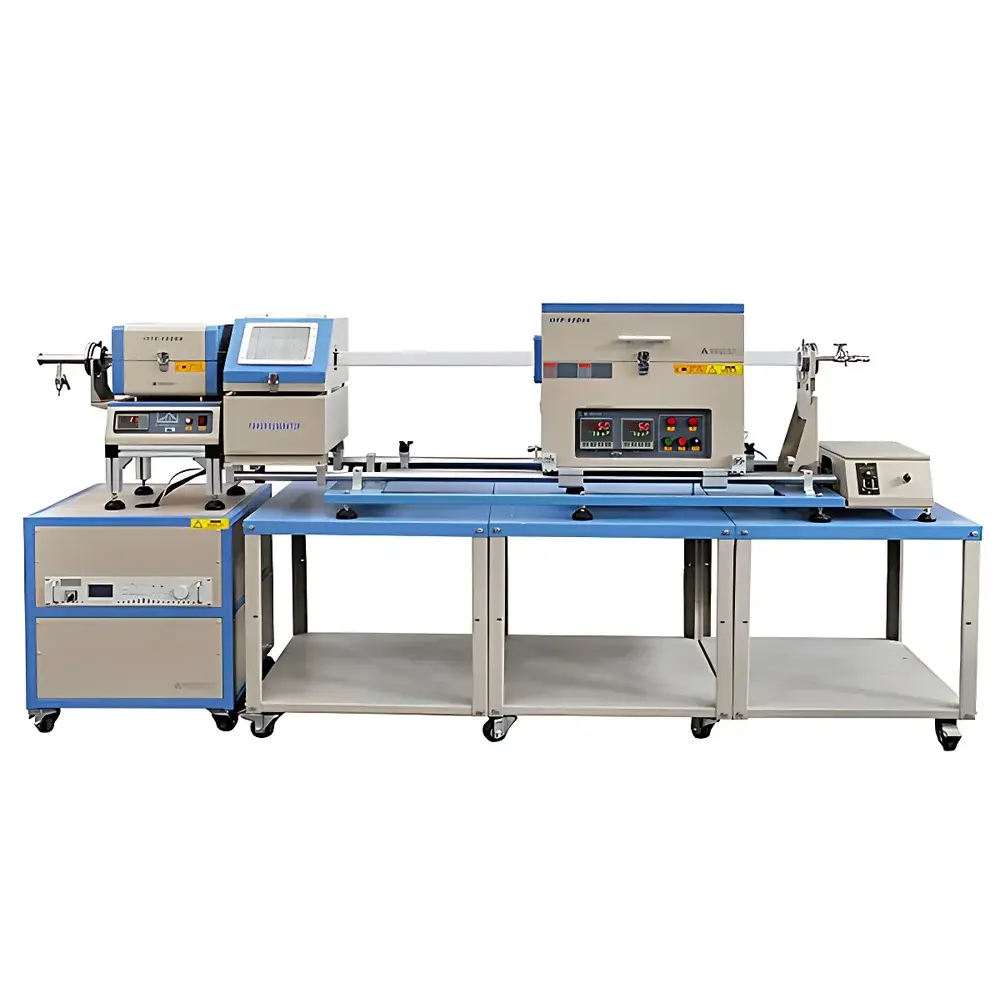
KJ-OTF-1200X-50-II-PE-MSL Dual-Zone Sliding Plasma-Enhanced Chemical Vapor Deposition (PE-CVD) Tube Furnace with Preheating System
| Brand | Hefei KJ |
|---|---|
| Origin | Anhui, China |
| Model | OTF-1200X-50-II-PE-MSL |
| Type | Dual-zone sliding tube furnace with integrated RF plasma and preheater |
| Max Operating Temperature | 1200 °C (tube), 1100 °C (preheater) |
| Temperature Uniformity | ±1 °C |
| Heating Rate (to max) | 20 °C/min |
| Cooling Rate (controlled slide) | up to 15 °C/sec (1000–950 °C) |
| Total Power | 4 kW |
| RF Generator | 5–500 W adjustable, 13.56 MHz, ±1% power stability, 50 Ω N-type output |
| Preheater Zone | 200 mm length, 1100 °C max |
| Main Tube Dimensions | OD 50 mm × ID 44 mm × L 2200 mm (high-purity quartz) |
| Insulation | High-purity alumina polycrystalline fiber + US-imported 1750 °C alumina reflective coating |
| Vacuum Gauge | Corrosion-resistant digital gauge, 3.8×10⁻⁵–1125 Torr |
| Sliding Speed | 0–70 mm/s (motorized rail) |
| Compliance | CE certified |
| Warranty | 1 year parts & labor (excl. consumables) |
Overview
The KJ-OTF-1200X-50-II-PE-MSL is a fully integrated dual-zone sliding plasma-enhanced chemical vapor deposition (PE-CVD) system engineered for low-temperature thin-film synthesis and nanomaterial growth under controlled reactive atmospheres. Unlike conventional thermal CVD systems, this configuration leverages radio-frequency (13.56 MHz) plasma excitation to dissociate precursor gases at significantly reduced substrate temperatures—typically 300–700 °C lower than thermally driven processes—thereby preserving temperature-sensitive substrates and enabling conformal deposition on polymers, flexible electronics, or pre-fabricated devices. The system’s core architecture comprises three thermally isolated zones: a high-stability dual-zone tube furnace (each 200 mm long, independently programmable), a dedicated preheating furnace (200 mm zone, 1100 °C max), and a motorized sliding rail assembly that enables rapid thermal transients via physical displacement of the hot zone relative to the sample position. This mechanical modulation supports precise kinetic control over nucleation, growth rate, and phase evolution—critical for reproducible synthesis of nanowires, 2D transition metal dichalcogenides (TMDs), silicon carbide films, and functional oxide coatings.
Key Features
- Dual independent temperature zones with 30-segment programmable ramp/soak profiles, supporting axial thermal gradients up to 400 °C across the 400 mm total heated length.
- Integrated 500 W RF plasma generator with ±1% power stability and active forward/reflected power monitoring, compliant with industrial RF safety standards (IEC 61000-6-4).
- Preheating furnace enables in-situ volatilization of solid precursors (e.g., MoO₃, WO₃) or controlled vaporization of liquid reagents (e.g., TEOS, TIP), ensuring homogeneous gas-phase mixing prior to plasma activation.
- Motorized sliding rail (0–70 mm/s) facilitates rapid thermal quenching or localized annealing—achieving heating rates up to 15 °C/sec (RT–150 °C) and cooling rates exceeding 10 °C/sec (1000–900 °C) without thermal shock to quartz components.
- High-purity quartz tube (OD 50 mm, ID 44 mm, L 2200 mm) housed within multi-layer insulation: alumina polycrystalline fiber + proprietary 1750 °C alumina reflective coating for enhanced thermal efficiency and extended service life.
- Corrosion-resistant vacuum measurement system (3.8×10⁻⁵–1125 Torr) with <30 ms response time and gas-independent calibration above 10 mbar—suitable for reactive mixtures containing Cl₂, NH₃, H₂S, or fluorinated precursors.
Sample Compatibility & Compliance
The system accommodates standard 1-inch-diameter substrates (Si wafers, sapphire, quartz, stainless steel foils) mounted on ceramic or graphite boats. Its design conforms to ASTM F1529-20 (Standard Guide for CVD Process Characterization) and supports GLP-compliant operation when paired with optional RS485-enabled data logging and audit-trail-capable software. All electrical subsystems meet CE marking requirements per EN 61000-6-2 (immunity) and EN 61000-6-3 (emission). Pressure safety protocols—including mandatory use of inline pressure regulators (0.01–0.1 MPa range), real-time vacuum monitoring, and automatic venting interlocks—are embedded in operational guidelines to prevent over-pressurization (>0.02 MPa) or vacuum-induced quartz fracture above 1000 °C. The furnace is not rated for explosive or pyrophoric gas handling without additional third-party hazard mitigation certification.
Software & Data Management
Temperature profiles are managed via dual PID controllers with RS485 interface (Modbus RTU protocol), compatible with industry-standard SCADA platforms (e.g., LabVIEW, MATLAB Data Acquisition Toolbox). Optional PC-based control software provides synchronized logging of furnace zone temperatures, RF forward/reflected power, vacuum pressure, and slide position—enabling full traceability for process validation. Data export is supported in CSV and Excel formats; time-stamped logs include operator ID, parameter setpoints, and alarm history—meeting minimum requirements for FDA 21 CFR Part 11 electronic record integrity when deployed in regulated environments. Firmware updates are delivered via secure USB interface; no cloud connectivity is included by default.
Applications
- Growth of vertically aligned ZnO or GaN nanowires via catalyst-assisted PE-CVD at ≤600 °C.
- Deposition of hydrogenated amorphous silicon (a-Si:H) and microcrystalline silicon (μc-Si) for photovoltaic device fabrication.
- Synthesis of MoS₂, WS₂, and h-BN monolayers on insulating substrates using sulfur or selenium vapor co-fed with metal-organic precursors.
- Low-temperature passivation of perovskite solar cells with SiNₓ or Al₂O₃ barrier layers.
- Controlled nitridation of titanium foils to form TiN diffusion barriers for MEMS packaging.
- In-situ annealing of spin-coated sol-gel films (e.g., TiO₂, Nb₂O₅) under forming gas (N₂/H₂) plasma to enhance crystallinity without substrate warping.
FAQ
What is the maximum allowable working pressure inside the quartz tube?
The system is rated for absolute pressures between 1×10⁻⁵ Torr and 0.02 MPa (≈150 Torr). Operation above 0.02 MPa requires custom pressure-rated flanges and third-party mechanical certification.
Can the preheater be used independently of the main furnace zones?
Yes—the preheater operates as a standalone single-zone furnace with its own 30-segment controller, enabling independent vapor generation and carrier gas conditioning prior to introduction into the plasma zone.
Is the RF generator compatible with impedance-matching networks for variable-pressure operation?
The standard unit includes a fixed 50 Ω output; external auto-matching networks (e.g., 1–1000 W range) can be integrated via N-type connectors but require separate calibration and safety interlocking.
What maintenance intervals are recommended for the quartz tube and heating elements?
Quartz tubes should be inspected visually after every 50 thermal cycles above 900 °C; replacement is advised if surface devitrification or microcracking is observed. Heating elements (Mo-doped FeCrAl alloy) typically last >2000 hours at 1100 °C continuous duty.
Does the system support reactive gas mixtures containing chlorine or fluorine compounds?
Yes—provided the corrosion-resistant vacuum gauge and all wetted seals (Viton or Kalrez) are specified at time of order; standard configurations include Viton O-rings rated for Cl₂ up to 200 °C.
Related Products



