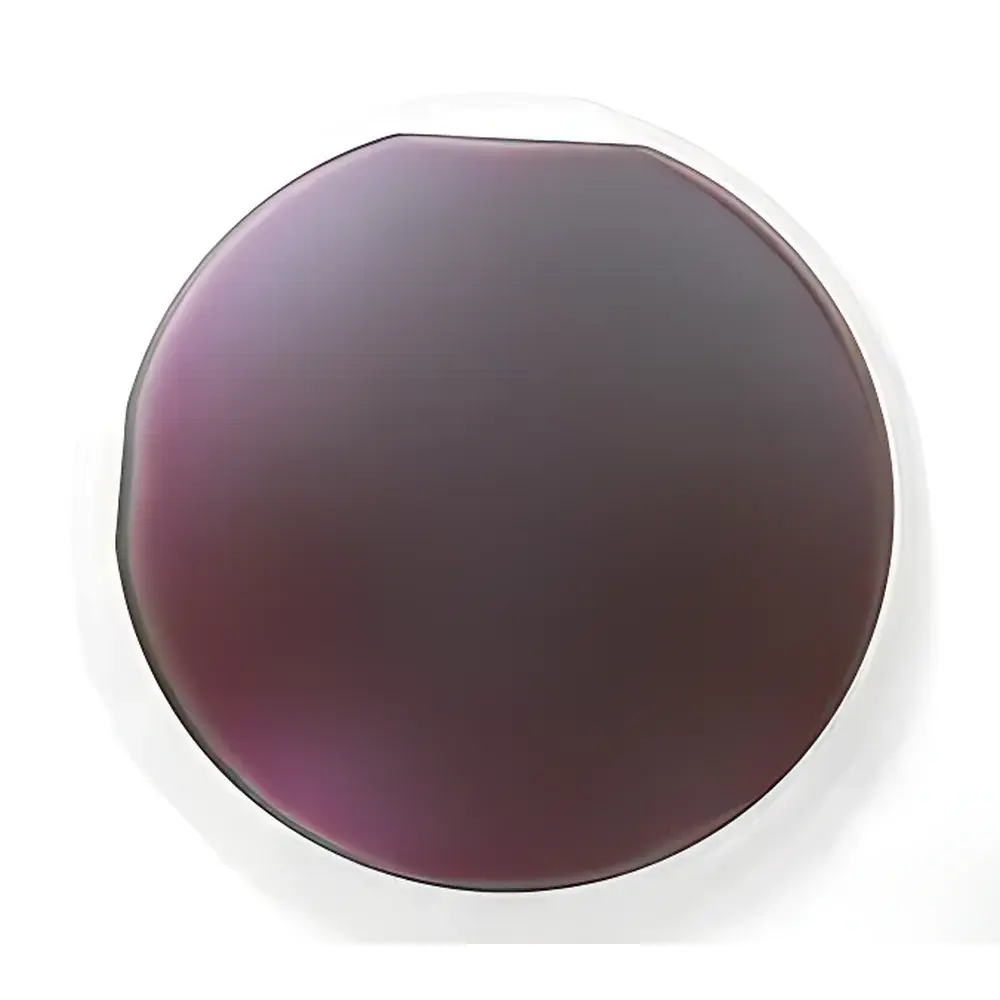
Diamond-on-Silicon (High-Resistivity DOS) Wafer
| Brand | 合肥科晶 |
|---|---|
| Origin | USA |
| Manufacturer Type | General Distributor |
| Origin Category | Imported |
| Model | Diamond-on-Silicon (High-Resistivity DOS) Wafer |
| Price | Upon Request |
| Diameter | 4" (101.6 mm) |
| Substrate Thickness | 0.5 mm |
| Silicon Crystal Orientation | <100> ± 0.5° |
| Diamond Film Thickness | ~2 µm (nominal) |
| Resistivity | 1×10³ – 1×10⁴ Ω·cm |
| Packaging | Vacuum-sealed in Class 100 cleanroom bags within Class 1000 cleanroom environment, or individual cassette packaging |
Overview
Diamond-on-Silicon (DOS) wafers represent a critical hybrid substrate platform engineered for high-performance electronic, photonic, and sensing applications where thermal management, electrical isolation, and mechanical robustness are simultaneously required. This particular variant—designated as high-resistivity DOS—is fabricated via microwave plasma chemical vapor deposition (MPCVD) on single-crystal silicon wafers with precise orientation (±0.5° tolerance), ensuring epitaxial compatibility and minimal lattice mismatch-induced stress. The diamond film—grown to a nominal thickness of 2 µm (with a 1 µm option available upon specification)—exhibits intrinsic wide-bandgap semiconductor properties and exceptionally low free-carrier concentration, yielding bulk resistivity in the range of 1×10³–1×10⁴ Ω·cm. Unlike doped or graphitized diamond films, this high-resistivity grade maintains structural integrity and dielectric stability under elevated temperature and high-voltage bias conditions, making it suitable for gate dielectrics, radiation-hardened sensor substrates, and RF-MEMS platforms.
Key Features
- High-purity, polycrystalline diamond film deposited on prime-grade silicon wafers (diameter: 101.6 mm / 4″, thickness: 0.5 mm)
- Tightly controlled crystallographic alignment: Si surface orientation certified to ± 0.5°, enabling reproducible interfacial strain engineering
- Uniform diamond thickness distribution across wafer surface (CV ≤ 5% measured by cross-sectional SEM and Raman depth profiling)
- High-volume resistivity (10³–10⁴ Ω·cm) achieved through optimized methane/hydrogen gas ratio and substrate temperature during MPCVD, minimizing sp² carbon content and defect-related conduction paths
- Low surface roughness (Ra < 10 nm, measured by AFM over 5×5 µm² area), compatible with subsequent lithography and metallization processes
- Thermal conductivity > 1000 W/m·K (in-plane, at 300 K), enabling efficient heat extraction from active devices integrated atop the diamond layer
Sample Compatibility & Compliance
These DOS wafers are supplied in strict adherence to semiconductor-grade handling protocols. All units undergo final inspection and packaging in ISO Class 4 (100-particle) cleanroom environments, followed by vacuum sealing in static-dissipative, low-outgassing cleanroom bags compliant with SEMI F78 standards. Each wafer is individually traceable via laser-etched lot ID and accompanied by a Certificate of Conformance specifying substrate orientation, thickness uniformity, surface particle count (<10 particles ≥0.3 µm per cm²), and resistivity verification data (four-point probe measurement per ASTM F84). The product meets baseline requirements for use in Class 1000 (ISO 6) fabrication environments and is compatible with standard front-end-of-line (FEOL) processing steps including sputtering, ALD, and e-beam evaporation.
Software & Data Management
While the DOS wafer itself is a passive substrate component, full traceability and process integration are supported through digital documentation. Each shipment includes a secure PDF datasheet containing metrology reports (XRD rocking curve FWHM, Raman peak position/intensity ratio at 1332 cm⁻¹, secondary ion mass spectrometry [SIMS] dopant depth profiles), along with a QR-coded label linking to an encrypted cloud repository. This repository stores raw measurement files, environmental log data from cleanroom packaging stations, and calibration records for all metrology tools used—ensuring compliance readiness for GLP, GMP, or ISO 9001 internal audits. No proprietary software installation is required; all documentation conforms to PDF/A-2u archival standards and supports automated parsing via LabVantage or Thermo Fisher SampleManager LIMS interfaces.
Applications
- High-power RF transistors and GaN-on-Diamond HEMT platforms requiring vertical thermal extraction
- Radiation-tolerant microdosimeters and solid-state neutron detectors leveraging diamond’s low atomic number and high displacement threshold energy
- MEMS resonators and acoustic wave sensors exploiting diamond’s high acoustic velocity and Q-factor stability over temperature
- UV-transparent optical windows and deep-UV photodetector substrates (bandgap ~5.5 eV)
- Gate dielectric layers in cryogenic CMOS circuits where leakage current suppression below 4 K is critical
- Reference substrates for calibrating nanoindentation hardness testers and scanning thermal microscopy (SThM) probes
FAQ
Is this diamond film homoepitaxial or heteroepitaxial?
It is heteroepitaxial diamond grown on silicon; no monocrystalline diamond layer is formed. The film is nanocrystalline-to-ultrananocrystalline, with grain sizes ranging from 5–50 nm.
Can the wafer be diced or bonded using standard semiconductor equipment?
Yes—compatible with diamond-blade dicing, plasma-assisted direct bonding (to SiO₂ or Si), and Au–Sn eutectic bonding at ≤300 °C. Thermal expansion mismatch (Si: 2.6 ppm/K, diamond: 1.0 ppm/K) must be accounted for in mechanical design.
What is the typical sp³/sp² carbon ratio measured by XPS?
XPS analysis shows >85% sp³ bonding fraction (C 1s peak deconvolution, pass-energy 20 eV, Al Kα source), confirming high-quality diamond phase with minimal graphitic interfacial carbon.
Are custom orientations or doping profiles available?
Custom or silicon substrates are available upon request; boron-doped (p-type) or nitrogen-doped (n-type) variants require minimum order quantities and extended lead times.
Does the product support FDA or IEC 60601 certification for medical device integration?
The wafer itself is not a finished medical device component; however, its material certifications (RoHS, REACH, ISO 10993-5 cytotoxicity screening on extracted leachables) support Class II/III device qualification pathways when incorporated into validated assemblies.