
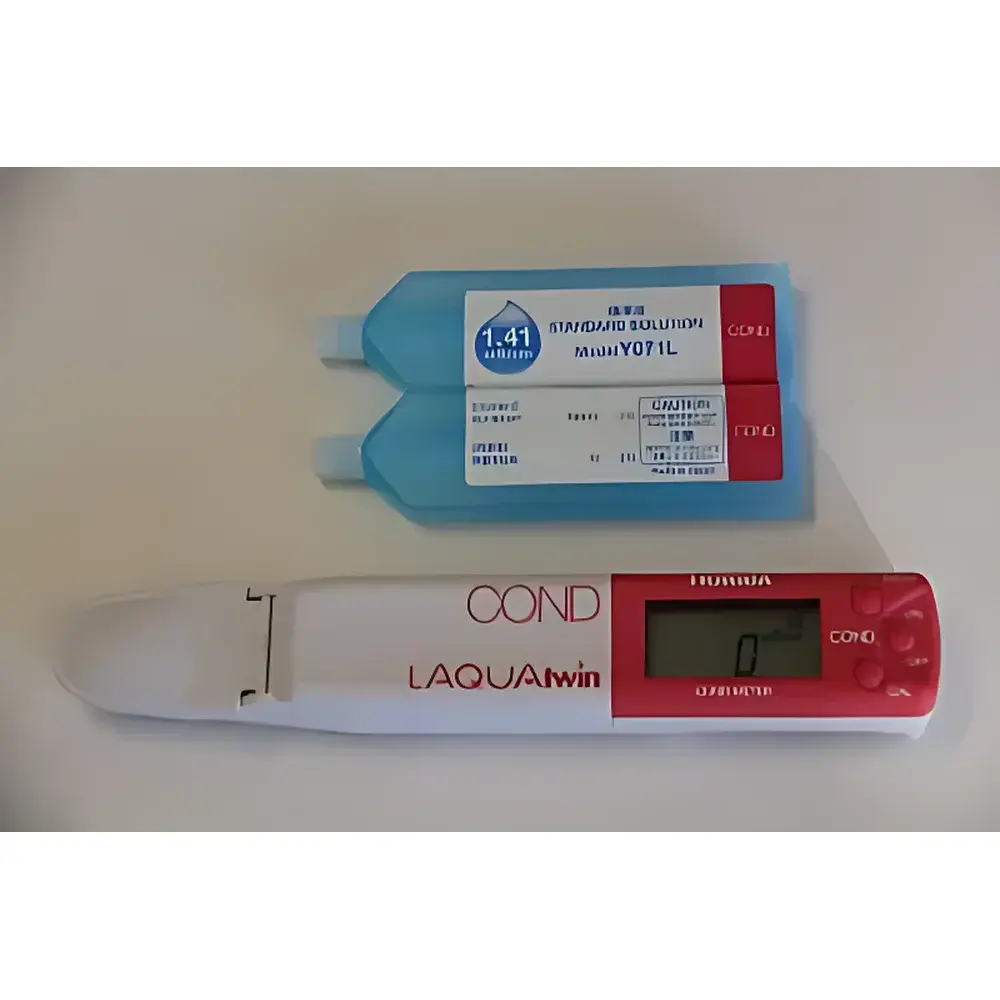
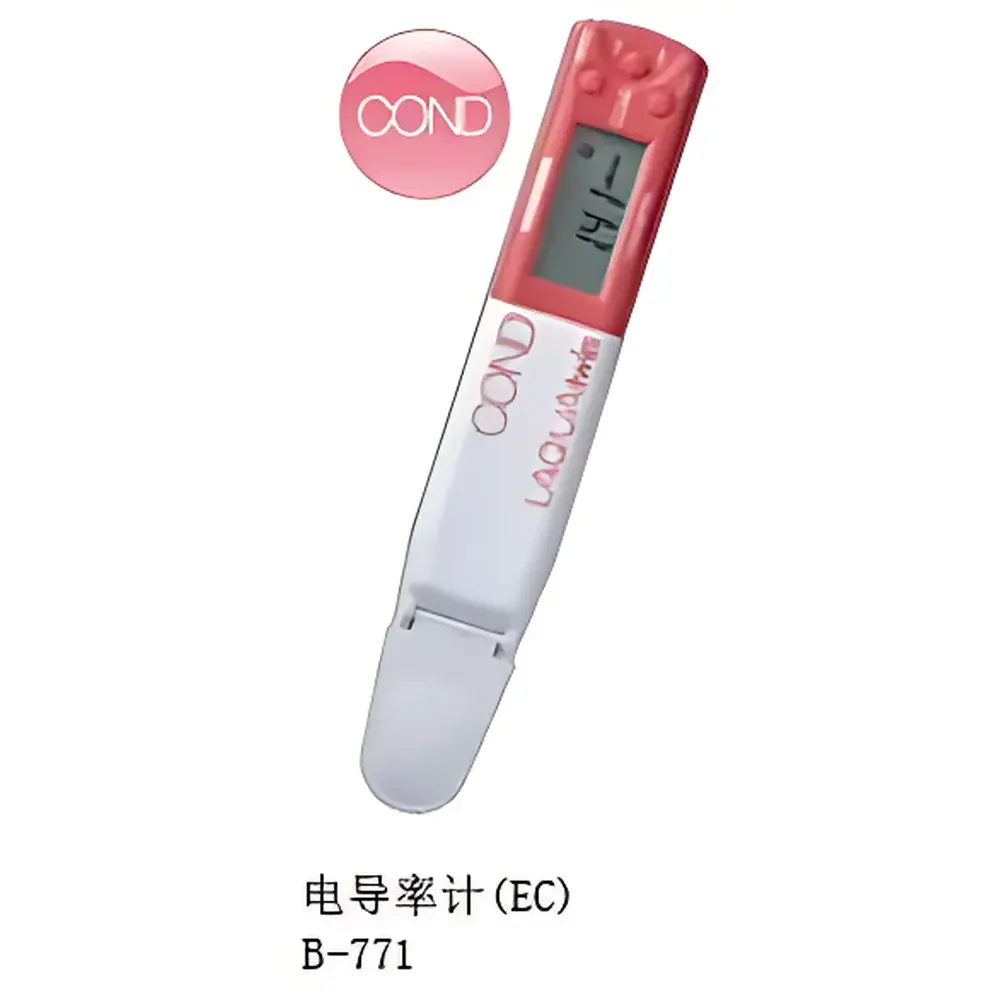
HORIBA B-771 Portable Conductivity/TDS/Salinity Pen Meter
| Brand | HORIBA |
|---|---|
| Origin | Japan |
| Model | B-771 |
| Detection Parameter | Single (Conductivity) |
| Portability | Pen-type |
| Conductivity Range | 0–19.9 mS/cm |
| TDS Range | 0–9900 ppm |
| Salinity Range | 0–1.1% NaCl |
| Temperature Range | 5–40 °C |
| Accuracy | ±2% F.S. ±1 digit |
| Resolution | 0.1 mS/cm, 0.1 ppm, 0.01% NaCl, 0.1 °C |
| Calibration | Two-point (KCl standard solutions) |
| IP Rating | IP67 |
| Power | Two CR2032 batteries |
| Dimensions | 164 × 29 × 20 mm (excl. probe protrusion) |
| Weight | ~45 g (instrument only) |
Overview
The HORIBA B-771 is a compact, field-deployable pen-type conductivity meter engineered for rapid, reliable measurement of electrical conductivity (EC), total dissolved solids (TDS), and salinity in aqueous samples. It employs a two-electrode AC excitation method—eliminating polarization effects and ensuring stable readings across variable ionic strengths. Unlike DC-based meters, the B-771 applies a low-frequency alternating current to the platinum electrodes, minimizing electrode fouling and enabling high reproducibility in routine water quality checks, hydroponic nutrient monitoring, aquarium maintenance, and environmental field surveys. Its measurement principle conforms to ASTM D1125–22 (Standard Test Methods for Electrical Conductivity and Resistivity of Water) and supports temperature-compensated conductivity reporting using a fixed 2%/°C coefficient—aligned with common industry practice for non-temperature-controlled handheld instruments. With a minimum sample volume of just 0.12 mL, the B-771 is optimized for micro-volume applications where sample conservation is critical.
Key Features
- Pen-form factor with ergonomic grip and integrated LCD display for one-handed operation
- IP67-rated enclosure—fully dust-tight and submersible up to 1 m for 30 minutes—suitable for humid, outdoor, or splash-prone environments
- Automatic endpoint hold function freezes stable readings on-screen for easy recording
- Fixed-temperature compensation (2%/°C) applied automatically during EC measurement; user-selectable TDS conversion factor (0.5–0.75) for customized salt equivalence
- Two-point calibration capability using standard KCl solutions (e.g., 1413 µS/cm and 12.88 mS/cm) to maintain traceable accuracy per ISO/IEC 17025 guidelines
- Low-power design powered by two replaceable CR2032 coin cells—providing >200 hours of continuous operation under typical usage
- Integrated temperature sensor (NTC thermistor) with ±0.5 °C accuracy over 5–40 °C operating range
Sample Compatibility & Compliance
The B-771 is validated for use with freshwater, brackish water, nutrient solutions, seawater dilutions, and process rinse waters—excluding highly viscous, suspended-laden, or strongly oxidizing media that may degrade the platinum electrodes. It meets IEC 60529 for IP67 ingress protection and complies with RoHS Directive 2011/65/EU for hazardous substance restrictions. While not designed for GLP/GMP-regulated production environments, its calibration traceability, documented accuracy specifications (±2% F.S. ±1 digit), and stable electrode response support data integrity in field QA/QC workflows. For regulatory submissions requiring audit trails, users are advised to pair the B-771 with external logbooks or validated LIMS integration via manual entry.
Software & Data Management
The B-771 operates as a standalone instrument with no onboard memory or USB/Bluetooth connectivity. All measurements are displayed in real time and must be manually recorded. This architecture ensures electromagnetic immunity in electrically noisy industrial settings and eliminates firmware update dependencies. For laboratories requiring digital data capture, HORIBA recommends pairing the B-771 with third-party spreadsheet templates or lightweight mobile logging apps that accept manual input of EC, TDS, salinity, and temperature values—including timestamp and operator ID fields. The absence of electronic storage also simplifies compliance with data retention policies where raw instrument output is not subject to FDA 21 CFR Part 11 requirements.
Applications
- Field assessment of irrigation water quality and soil leachate conductivity
- Routine monitoring of hydroponic reservoirs, aquaculture tanks, and recirculating systems
- Pre-shipment verification of deionized or reverse-osmosis water purity
- Educational laboratory exercises in general chemistry and environmental science curricula
- Quick-check validation of cleaning solution concentration in food processing facilities
- Baseline screening for wastewater influent characterization prior to lab-based ion chromatography or ICP-MS analysis
FAQ
What calibration standards are recommended for the B-771?
Use certified KCl reference solutions—typically 1413 µS/cm (0.01 mol/L) and 12.88 mS/cm (0.1 mol/L)—to perform two-point calibration. Avoid tap water or unbuffered saline solutions due to unknown ionic composition.
Does the B-771 support automatic temperature compensation (ATC) for all parameters?
Yes—conductivity, TDS, and salinity readings are automatically corrected using the built-in NTC sensor and a fixed 2%/°C coefficient per ISO 7888. No user adjustment of the β coefficient is possible.
Can the B-771 measure resistivity?
No—the instrument does not compute or display resistivity (Ω·cm). Conductivity values can be manually inverted using ρ = 1/σ, but no unit conversion is embedded in firmware.
Is electrode replacement possible?
The platinum electrodes are permanently sealed within the pen body. HORIBA does not offer field-replaceable sensor modules; units exhibiting drift beyond specification after proper cleaning and recalibration should be returned for service evaluation.
How often should calibration be performed?
Calibrate before each measurement session or when ambient temperature changes exceed ±5 °C. For high-precision tasks, verify calibration against a fresh standard prior to critical measurements.




