
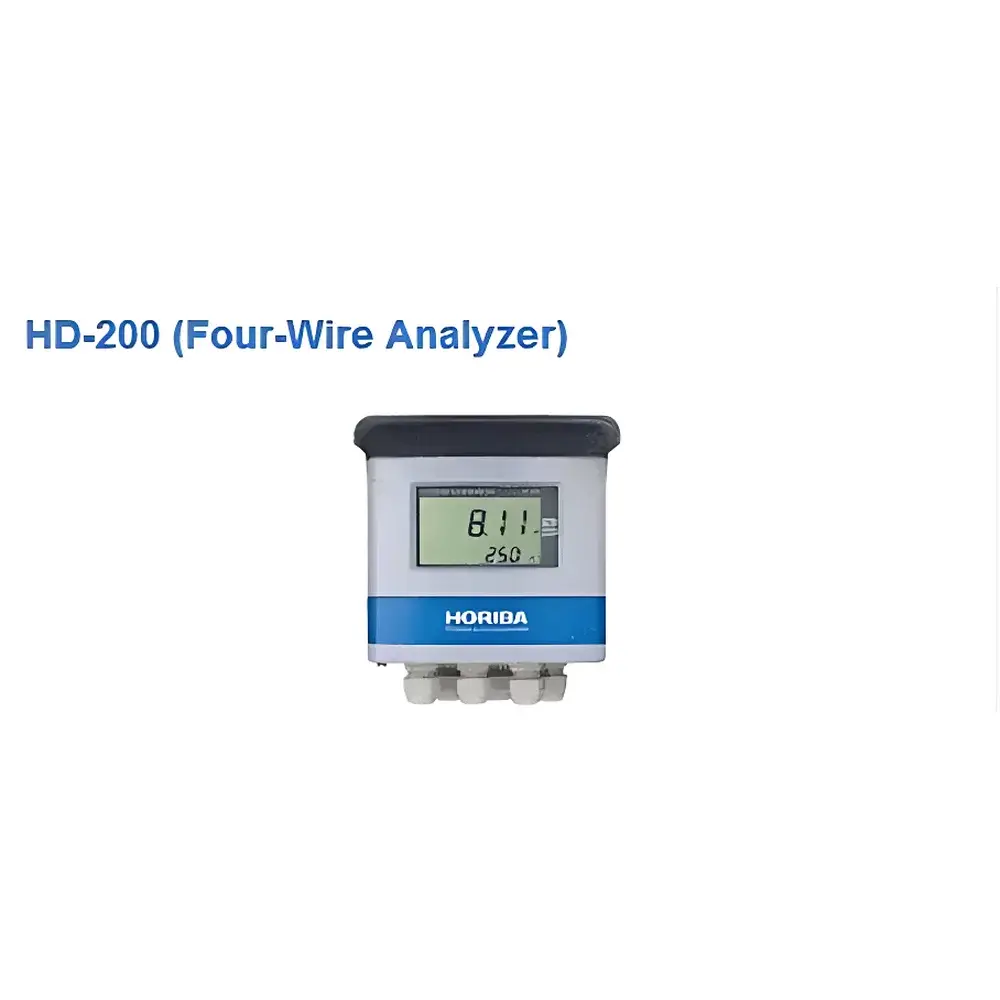
HORIBA HD-200 Industrial Dissolved Oxygen Monitor
| Brand | HORIBA |
|---|---|
| Origin | Japan |
| Model | HD-200 |
| Protection Rating | IP65 |
| Measurement Principle | Clark-type Polarographic Membrane Sensor |
| DO Range | 0–20 mg/L (Resolution: 0.01 mg/L) |
| Saturation Range | 0–200% (Resolution: 1%) |
| Temperature Range | 0–50 °C (Resolution: 0.1 °C) |
| Repeatability | ±0.5% FS (DO), ±0.5 °C (Temp) |
| Linearity | ±0.5% FS (DO), ±0.5 °C (Temp) |
| Output | Three isolated 4–20 mA analog channels (max load: 900 Ω), three SPDT relay outputs, one dry-contact input, RS-485 Modbus RTU interface |
| Power Supply | 90–264 V AC, 50/60 Hz, ≤15 VA |
| Operating Ambient | −20 to +55 °C |
| Enclosure Material | Anodized Aluminum |
| Weight | ~4.5 kg |
| Compliant | CE, FCC, RoHS, WEEE |
| Compatible Probes | DO-1100 (integrated Pt1000 temperature sensor), Electrodes: 5505, 5510 |
Overview
The HORIBA HD-200 is an industrial-grade, outdoor-rated dissolved oxygen (DO) monitor engineered for continuous, reliable operation in demanding water quality monitoring applications. Designed as part of HORIBA’s H-1 series of field-deployable analyzers, the HD-200 employs a Clark-type polarographic membrane sensor—based on electrochemical reduction of molecular oxygen at a noble metal cathode—to deliver stable, trace-level DO quantification in real time. Its measurement principle adheres to ISO 5814:2012 and ASTM D888 standards for electrochemical DO determination, ensuring regulatory alignment in wastewater treatment, industrial process effluent control, aquaculture systems, and surface water surveillance. The analyzer features a rugged, IP65-rated aluminum housing suitable for unsheltered installation on poles or walls, with operating ambient tolerance from −20 °C to +55 °C. Unlike benchtop or laboratory-based sensors, the HD-200 integrates temperature compensation via a built-in Pt1000 thermistor (per IEC 60751) within the DO-1100 probe assembly, enabling automatic correction across the full 0–50 °C aqueous temperature range.
Key Features
- Robust outdoor enclosure: Anodized aluminum body rated IP65 for dust-tight and water-jet resistant performance; compliant with CE and FCC electromagnetic compatibility directives.
- Polarographic DO sensing: Utilizes a replaceable membrane-covered electrode (models 5505/5510) with DO-1100 probe, featuring integrated Pt1000 temperature compensation for high accuracy under variable thermal conditions.
- Multi-parameter expandability: Though optimized for DO, the HD-200 platform supports modular integration with other H-1 series sensors—including pH, ORP, conductivity, turbidity, and free chlorine—via shared power, communication, and mounting infrastructure.
- Intuitive human-machine interface: Large-format LED display shows simultaneous DO concentration (mg/L), saturation (%), and temperature (°C); menu navigation enables rapid access to calibration history, diagnostic logs, and relay status.
- Comprehensive output architecture: Three isolated 4–20 mA analog outputs (configurable per parameter), three programmable SPDT relays (for alarm, control, or fault signaling), one dry-contact input (e.g., for probe cleaning activation), and RS-485 Modbus RTU for SCADA integration.
- Self-diagnostic capability: Real-time validation of electrode polarization stability, calibration validity, membrane integrity, and internal circuit health; error codes align with ISO/IEC 17025 traceability requirements for instrument qualification.
Sample Compatibility & Compliance
The HD-200 is validated for use in municipal wastewater streams, industrial cooling water circuits, activated sludge basins, and natural water bodies with suspended solids up to 5000 mg/L and chloride concentrations ≤10,000 mg/L. It meets EN 61326-1 (EMC for industrial environments), EN 61000-6-2/-4 (immunity and emissions), and RoHS/WEEE directives. While not certified for intrinsic safety (ATEX/IECEx), its design satisfies general-purpose hazardous location requirements per IEC 60079-0 when installed outside classified zones. Calibration protocols support both air-saturation (at local barometric pressure) and zero-oxygen (sodium sulfite) methods, with documented procedures traceable to NIST-traceable reference standards. Data integrity conforms to GLP principles through timestamped calibration records and non-volatile storage of ≥100 calibration events.
Software & Data Management
The HD-200 operates autonomously without proprietary software; however, its RS-485 Modbus RTU interface enables seamless integration into third-party SCADA, DCS, or cloud-based monitoring platforms (e.g., Ignition, Siemens Desigo, or AWS IoT Core). All analog and relay outputs include configurable hysteresis and delay timers to prevent nuisance alarms during transient flow or temperature shifts. Configuration parameters—including measurement units, alarm thresholds, relay logic (high/low/latching), and temperature compensation coefficients—are retained in EEPROM with battery-backed memory. Firmware updates are performed via serial terminal using standard ASCII command sets, eliminating dependency on vendor-specific utilities. Audit trails for configuration changes and calibration actions comply with FDA 21 CFR Part 11 requirements when deployed in regulated pharmaceutical or food-processing water systems.
Applications
- Wastewater treatment plants: Monitoring DO in aeration tanks to optimize blower energy consumption and ensure nitrification efficiency.
- Power plant cooling water systems: Preventing microbiologically influenced corrosion (MIC) by maintaining minimum DO thresholds in recirculating loops.
- Food & beverage processing: Verifying deaeration efficacy in CIP rinse water and validating low-oxygen conditions in packaging line rinse tanks.
- Aquaculture facilities: Sustaining dissolved oxygen above critical thresholds (>5 mg/L) in intensive fish farming ponds and raceways.
- Municipal drinking water reservoirs: Detecting early stratification-induced hypoxia events through fixed-station network deployment.
FAQ
What calibration methods does the HD-200 support?
The HD-200 supports two-point calibration: atmospheric air saturation (with optional barometric pressure input) and chemical zero (using sodium sulfite solution). Both methods are traceable to ISO 5814 procedures.
Can the HD-200 operate without external temperature compensation?
No—the DO-1100 probe includes a factory-calibrated Pt1000 sensor; temperature compensation is mandatory and fully automated. Manual offset adjustment is disabled to preserve metrological integrity.
Is the RS-485 interface galvanically isolated?
Yes—the RS-485 transceiver is optically isolated from internal circuitry, supporting noise-immune communication over distances up to 1200 meters in electrically noisy industrial environments.
What maintenance intervals are recommended for the polarographic sensor?
Electrolyte replenishment every 3 months and membrane replacement every 6 months are advised under continuous operation; extended intervals may apply in low-fouling applications with regular cleaning cycles.
Does the HD-200 meet US EPA Method 360.1 requirements?
While not EPA-certified as a standalone method-compliant analyzer, its polarographic measurement principle, calibration traceability, and performance specifications align with the technical criteria outlined in EPA Method 360.1 for field DO analysis.
Related Products







