
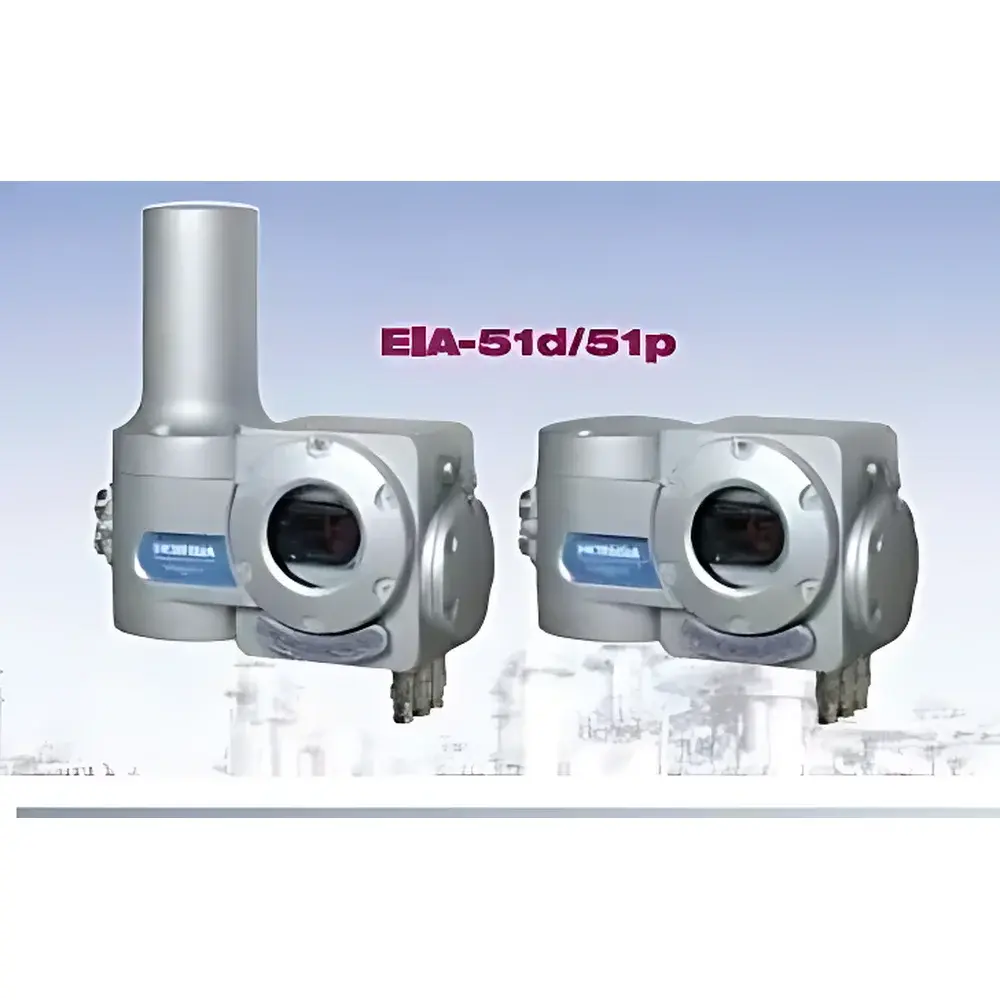
HORIBA EIA-51d / EIA-51p Intrinsically Safe and Explosion-Proof Infrared Gas Analyzer
| Brand | HORIBA |
|---|---|
| Origin | Japan |
| Model | EIA-51d / EIA-51p |
| Explosion Protection | Ex d IIB+H2 T4 (EIA-51d) / Ex p II T4X (EIA-51p) |
| Measurement Principle | Non-Dispersive Infrared (NDIR) with Interference Correction |
| Detectable Gases | CO, CO₂, CH₄ (configurable) |
| Range | 0–0.11 vol% to 0–100 vol% (gas-dependent) |
| Repeatability | ±0.5% F.S. (standard range) |
| Linearity | ±1.0% F.S. |
| Zero/Full-Scale Drift | ±2.0% F.S./week |
| Response Time (T90) | ≤20 s (standard), ≤40 s (optional range) |
| Sample Flow Rate | 500 mL/min |
| Operating Temperature | −5 to +40 °C |
| Analog Output | Isolated 4–20 mA (DC), optional voltage outputs |
| Communication | RS-485, Modbus-RTU (selectable baud rates: 1200–19200 bps) |
| Sample Gas Requirements | O₂ <21%, dust-free, dry, pressure ≥1.98 kPa |
| Wetted Materials | SUS304, SUS316, FKM, CaF₂, Au |
| Calibration | Manual standard |
Overview
The HORIBA EIA-51d and EIA-51p are certified explosion-proof infrared gas analyzers engineered for continuous, reliable measurement of combustible gases—including carbon monoxide (CO), carbon dioxide (CO₂), and methane (CH₄)—in hazardous industrial environments. Designed in compliance with IEC 60079 series standards, these analyzers employ non-dispersive infrared (NDIR) spectroscopy with proprietary interference-correction architecture. Unlike conventional single-detector NDIR systems, the EIA-51 series integrates dual parallel detectors within a shared optical path: one dedicated to primary gas absorption measurement and the other to real-time correction of spectral interference from co-existing gases, optical drift, and mechanical perturbations such as vibration or thermal aging. This design significantly enhances measurement fidelity under dynamic process conditions—particularly where sample matrices contain high concentrations of interfering species (e.g., water vapor, hydrocarbons, or background CO₂). The EIA-51d utilizes flameproof (Ex d) construction rated for Group IIB+H₂ atmospheres with temperature class T4 (maximum surface temperature ≤135 °C), while the EIA-51p adopts pressurized enclosure (Ex p) protection for Group II applications, also T4-rated with additional X-class special conditions for extended operational safety margins.
Key Features
- Explosion-proof certification per IEC 60079-1 (Ex d IIB+H₂ T4) for EIA-51d and IEC 60079-2 (Ex p II T4X) for EIA-51p—validated for use in Zone 1 and Zone 2 hazardous locations.
- Interference-corrected NDIR optical system delivering high selectivity and long-term stability, minimizing cross-sensitivity to humidity, CO₂, and other IR-active interferents.
- Robust wetted materials including SUS304/SUS316 stainless steel, fluorocarbon elastomer (FKM), calcium fluoride (CaF₂) windows, and gold-coated optical components—ensuring chemical compatibility and corrosion resistance in aggressive process streams.
- Configurable analog output (4–20 mA isolated, with optional 0–1 V / 0–5 V / 1–5 V / 0–10 V) supporting seamless integration into DCS, PLC, and SCADA systems.
- Modbus-RTU protocol over RS-485 interface enables remote configuration, diagnostics, and data logging—fully compatible with industrial automation infrastructure and audit-ready data management workflows.
- Optional automatic zero/span calibration system supports unattended operation in remote or hard-to-access installations, reducing maintenance frequency and human exposure risk.
Sample Compatibility & Compliance
The EIA-51 series is validated for use with dry, dust-free sample gases containing oxygen at concentrations below 21% (v/v), and operating at minimum inlet pressure of 1.98 kPa (absolute) and nominal flow rate of 500 mL/min. It is not intended for direct measurement of corrosive, condensing, or particulate-laden streams without appropriate pre-conditioning (e.g., filtration, drying, pressure regulation). All models comply with IEC 61000 electromagnetic compatibility (EMC) requirements and meet functional safety considerations aligned with IEC 61508 SIL 2 readiness. While not certified to FDA 21 CFR Part 11 out-of-the-box, the device’s audit-trail-capable communication interface and configurable alarm thresholds support validation pathways for regulated industries—including petrochemical, biogas, and landfill gas monitoring—where GLP/GMP-aligned documentation and traceability are required.
Software & Data Management
Configuration, calibration, and diagnostic functions are accessible via front-panel membrane keypad with intuitive menu navigation—designed for glove-compatible operation in field environments. Optional PC-based configuration software provides advanced setup capabilities, including multi-point span adjustment, alarm logic definition, and trend logging. When integrated with Modbus-RTU, the analyzer transmits real-time concentration values, status flags (e.g., sensor fault, low flow, calibration due), and diagnostic codes—enabling centralized monitoring platforms to trigger automated responses (e.g., ventilation activation, shutdown interlocks). Data integrity is preserved through timestamped event logging and non-volatile memory retention of calibration history, supporting regulatory review and root-cause analysis during incident investigations.
Applications
- Continuous emission monitoring (CEM) of CO and CO₂ in flare stacks, incinerators, and thermal oxidizers operating in classified zones.
- Biogas quality control in anaerobic digestion facilities—measuring CH₄ and CO₂ for energy recovery optimization and pipeline injection compliance.
- Confined space entry monitoring for hydrocarbon processing units, refineries, and chemical storage areas where explosive atmospheres may develop.
- Landfill gas extraction systems requiring real-time tracking of methane slip and combustion efficiency indicators.
- Hydrogen production and handling facilities (leveraging H₂ compatibility of IIB+H₂ rating) for leak detection and purge verification.
- Process safety instrumentation in syngas, reformer, and Fischer–Tropsch units where accurate combustible gas quantification is critical to furnace control and explosion prevention.
FAQ
What explosion protection standards does the EIA-51d meet?
The EIA-51d complies with IEC 60079-1 for flameproof (Ex d) enclosures and is certified for Group IIB+H₂, T4 temperature class—suitable for Zones 1 and 2 where ethylene, hydrogen, or similar gases may be present.
Can the EIA-51p operate in environments with higher explosion risk than IIB?
Yes—the EIA-51p’s Ex p II T4X rating includes special conditions permitting use in Group IIC atmospheres when installed per manufacturer-specified purging protocols and maintenance schedules.
Is automatic calibration available as a factory-installed option?
Yes—auto-calibration kits with solenoid valves, reference gas manifolds, and programmable timing logic are offered as optional configurations to support unattended operation.
Does the analyzer require carrier gas for operation?
No carrier gas is required for standard NDIR measurement; however, nitrogen sweep gas (10 L/min during purging, 0.5 L/min during standby) is recommended for optical chamber protection in high-dust or high-humidity installations.
How is measurement drift managed over time?
Drift compensation is achieved through dual-detector interference correction, combined with scheduled manual or automated zero/span adjustments—delivering ±2.0% F.S./week zero and span stability under specified environmental conditions.







