
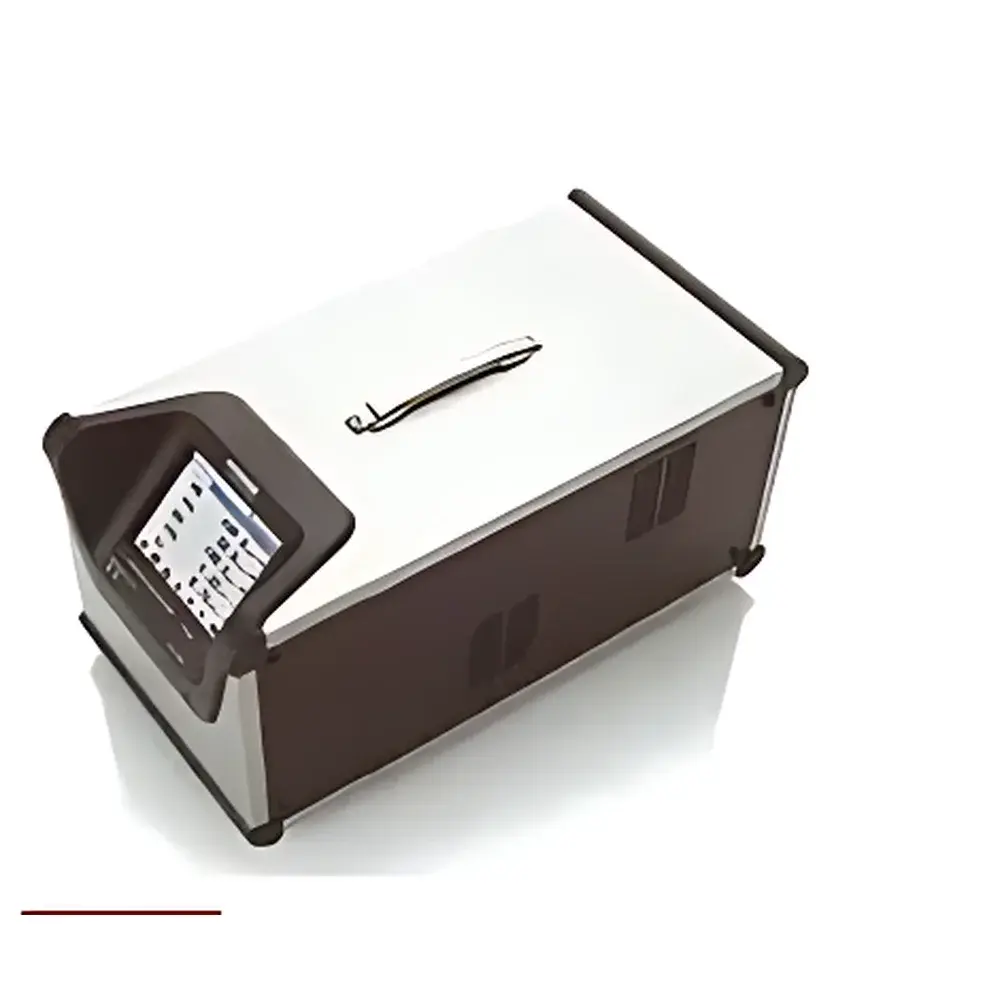
HORIBA PG-350 Portable Multi-Gas Analyzer
| Brand | HORIBA |
|---|---|
| Origin | Japan |
| Model | PG-350 |
| Instrument Type | Portable |
| Detection Targets | NOₓ, SO₂, CO, CO₂, O₂ (optional CH₄) |
| Range Options | 0–5 / 10 / 25 vol% (CO₂, O₂) |
| Repeatability | ±1.0% FS |
| Drift | ±1.0% FS/day (±2.0% FS/day for SO₂) |
| Linearity | ±2.0% FS |
| Response Time (T90) | ≤45 s (≤180 s for SO₂) |
| Sample Flow Rate | ~0.5 L/min |
| Warm-up Time | 30 min |
| Operating Temperature | 5–40 °C |
| Relative Humidity | ≤85% RH |
| Weight | ~14 kg |
| Dimensions | 226 × 265 × 510 mm (W × H × D) |
Overview
The HORIBA PG-350 is a field-deployable, multi-component gas analyzer engineered for high-fidelity in-situ measurement of combustion and ambient process gases. It integrates multiple detection principles within a single compact platform: alternating-flow modulated chemiluminescence (AFCM) for NOx, alternating-flow modulated non-dispersive infrared (AF-NDIR) for SO2, CO, and CH4, broadband NDIR for CO2, and electrochemical (galvanic cell) sensing for O2. This hybrid optical–electrochemical architecture enables simultaneous, independent quantification of up to five gas species—NOx, SO2, CO, CO2, and O2—with laboratory-grade accuracy under variable environmental conditions. Designed for regulatory-compliant monitoring, the PG-350 delivers trace-level sensitivity, low drift stability, and rapid T90 response—critical for dynamic stack testing, catalyst evaluation, and mobile emission audits.
Key Features
- Modular detection system combining AFCM, AF-NDIR, broadband NDIR, and galvanic O2 sensing for orthogonal cross-validation and reduced interferences
- Touch-enabled color LCD with real-time trend visualization, on-screen operational guidance, and intuitive menu navigation
- Integrated electronic condensate management with auto/manual drainage and programmable purge cycles to maintain sample integrity in high-humidity environments
- Full-system calibration capability—including pre-conditioning hardware (e.g., particulate filter, heated sample line, condensate trap)—traceable to NIST-certified standards
- Onboard SD card logging with user-defined sampling intervals; supports time-stamped event tagging (e.g., zero/span, alarm triggers, maintenance)
- Robust mechanical design compliant with IEC 60068-2 shock and vibration specifications; IP54-rated enclosure for field durability
- Dual communication interfaces: isolated 4–20 mA analog outputs and Ethernet (TCP/IP) for SCADA integration and remote diagnostics
Sample Compatibility & Compliance
The PG-350 accepts hot, humid, and particulate-laden sample streams typical of flue gas, engine exhaust, and biogas applications. Its integrated heated sampling line (up to 180 °C) and thermoelectric cooler prevent condensation-induced bias and ensure representative gas-phase analysis. The analyzer meets international performance validation protocols including MCERTS (UK), TÜV Rheinland (EU), GOST R (Russia), KOLAS (Korea), JIS Z 8808 (Japan), and China’s JJG 968–2019 verification standard for portable gas analyzers. It supports GLP/GMP-aligned data integrity through audit-trail-enabled firmware, secure SD card encryption (AES-256), and configurable user access levels—fully compatible with FDA 21 CFR Part 11 requirements when deployed with validated software configurations.
Software & Data Management
Data acquisition and instrument control are managed via embedded firmware with dual-mode operation: standalone field mode and networked supervisory mode. All measurements are timestamped with microsecond resolution and stored locally on removable SD cards (formatted FAT32, up to 32 GB). Export formats include CSV and XML, with metadata headers containing calibration history, sensor diagnostics, flow rate logs, and environmental parameters (ambient T/RH). Remote firmware updates and configuration backup/restore are supported over Ethernet using HTTPS-secured connections. Optional PC-based Horizon™ Software provides advanced post-processing: spectral deconvolution for overlapping NDIR bands, drift compensation algorithms, and automated compliance reporting aligned with ISO 14064, EN 15267, and US EPA Method 7E/10.
Applications
- Continuous Emission Monitoring System (CEMS) backup and verification in power plants, cement kilns, and waste incinerators
- In-field combustion optimization and stoichiometric tuning for industrial boilers and gas turbines
- Catalyst aging studies and light-off temperature profiling in automotive and stationary emission control research
- Mobile source testing—including heavy-duty engines, marine propulsion units, and fuel cell stacks—under transient operating conditions
- Academic and contract laboratory work requiring traceable, portable reference-grade measurements for method validation and inter-laboratory comparison
- Biogas quality assessment (CH4/CO2/H2S screening) and landfill gas monitoring per ISO 16000-32
FAQ
What gas species does the PG-350 measure by default?
The standard PG-350 configuration measures NOx, SO2, CO, CO2, and O2 simultaneously. CH4 detection is available as an optional channel upgrade.
Is the PG-350 suitable for hot, wet stack gas sampling?
Yes—the analyzer includes a heated sample probe (180 °C max), Peltier-cooled condensate separator, and corrosion-resistant internal path materials (316L SS, fluoropolymer-lined components) to handle temperatures up to 200 °C and dew points up to 90 °C.
How is calibration traceability maintained across field deployments?
Each unit ships with a Certificate of Conformance referencing NIST-traceable calibration gases. Onboard zero/span functions support daily verification using certified span gases; full multi-point calibration is performed using external gas standards per ISO 6145-7.
Can the PG-350 meet regulatory reporting requirements for CEMS redundancy?
Yes—it satisfies MCERTS Performance Standard 14 (PS14) and EN 14181 QAL2/QAL3 criteria when operated with documented calibration schedules, preventive maintenance logs, and data integrity controls per ISO/IEC 17025.
What is the minimum warm-up time before achieving specified accuracy?
30 minutes at ambient temperature (23 °C); accuracy specification (±2.0% FS) is guaranteed after stabilization and initial zero/span confirmation.
Related Products







