
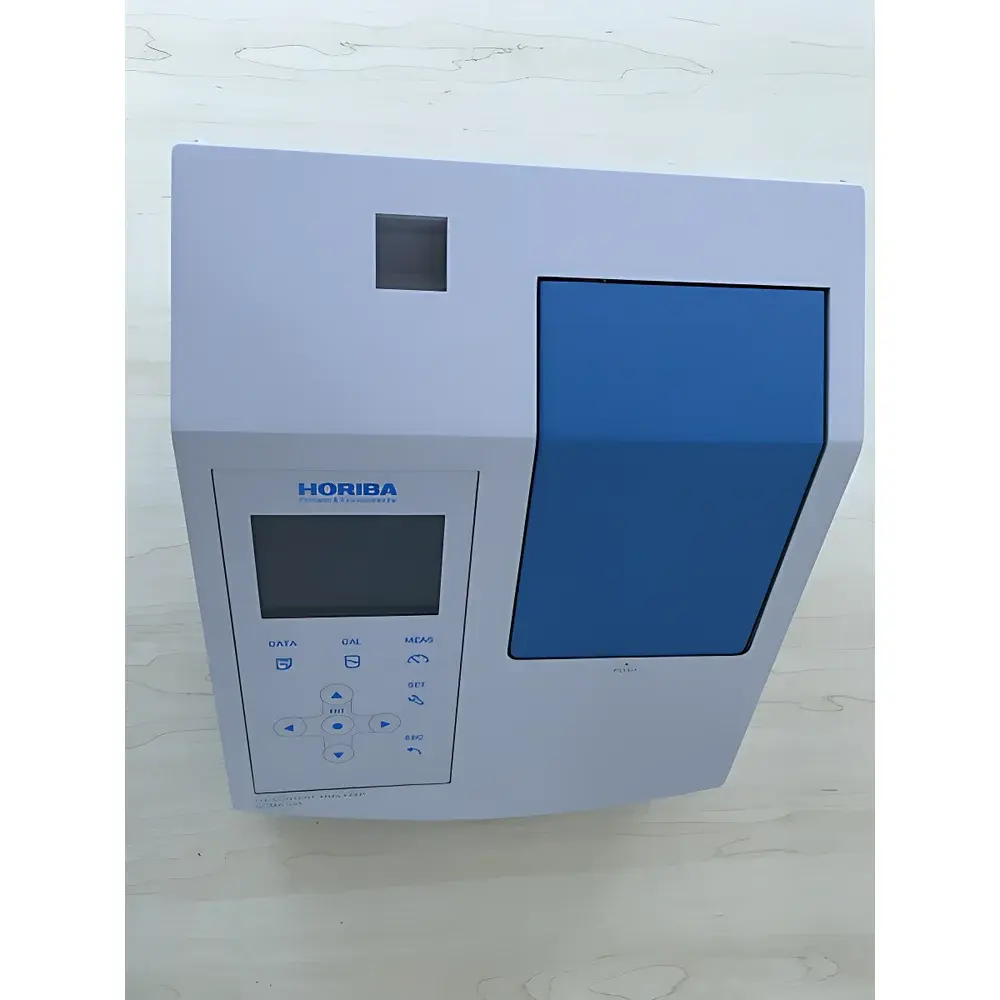
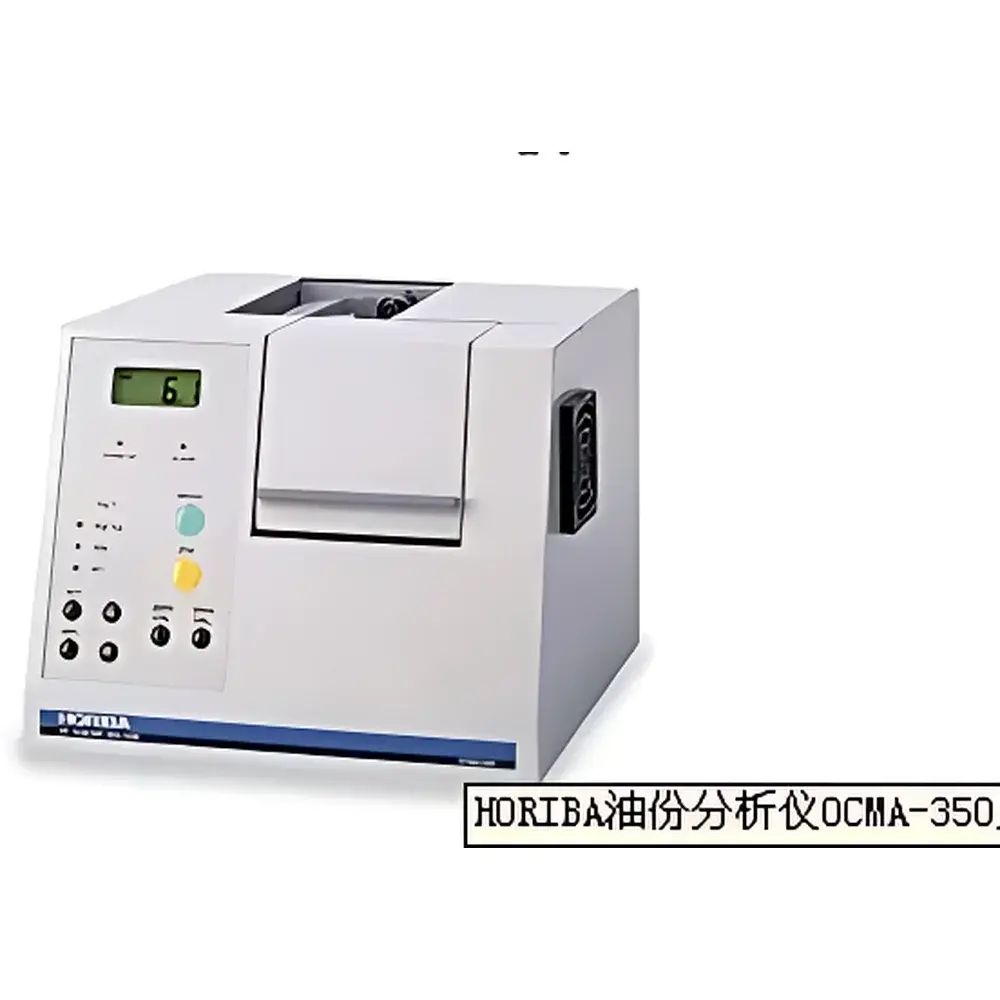
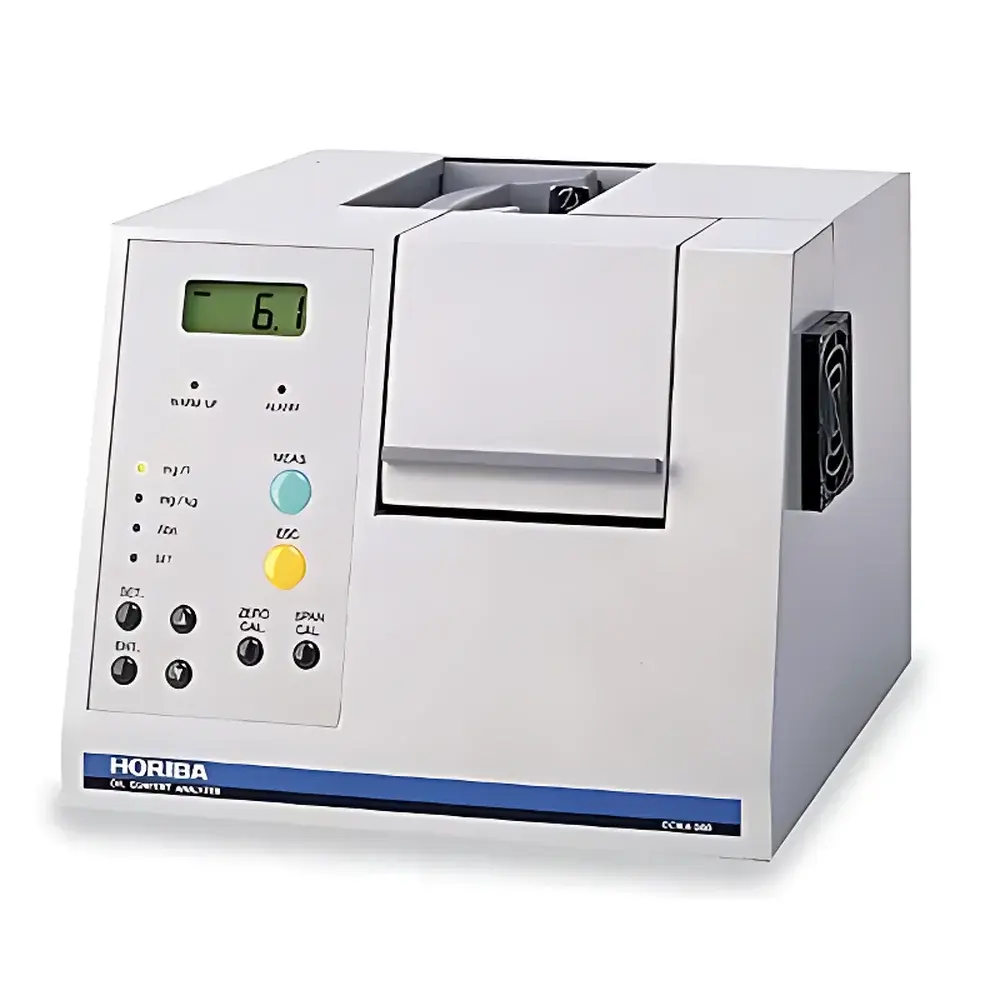
HORIBA OCMA-550/555 Oil Content Analyzer
| Brand | HORIBA |
|---|---|
| Origin | Japan |
| Model | OCMA-550/555 |
| Measurement Principle | Non-Dispersive Infrared (NDIR) Absorption Spectrophotometry |
| Measurement Range | 0–200 mg/L (water), 0–1000 mg/kg (soil), 0–1 Abs |
| Accuracy | ±0.4 mg/L (0–9.9 mg/L), ±2.0 mg/L (10.0–99.9 mg/L), ±4 mg/L (100–200 mg/L), ±1% F.S. (0–1 Abs) |
| Resolution | 0.2 mg/L (or equivalent in selected units) |
| Detector Type | Thermoelectric Sensor |
| Light Source | IR Emitter at ~3.4 µm |
| Solvent Compatibility | S-316 (OCMA-550), H-997 (OCMA-555) |
| Dimensions | 250 × 200 × 285 mm (W × H × D) |
| Power Supply | 230 V AC, 50 Hz |
| Display | Backlit LCD with timestamping |
| Interface | RS-232C serial port, parallel printer port |
Overview
The HORIBA OCMA-550 and OCMA-555 Oil Content Analyzers are laboratory-grade instruments engineered for precise quantification of hydrocarbon-based oil residues in aqueous, solid, and semi-solid matrices using non-dispersive infrared (NDIR) absorption spectrophotometry. Operating at a characteristic absorption band near 3.4 µm—where aliphatic C–H stretching vibrations exhibit strong, selective absorbance—the analyzers distinguish oil components from interfering substances by leveraging solvent-specific extraction and spectral isolation. Unlike broad-spectrum UV-Vis methods, NDIR eliminates cross-sensitivity to humic acids, chlorophyll, or suspended solids when paired with appropriate extraction solvents (S-316 for OCMA-550; H-997 for OCMA-555). The system is calibrated to measure extractable petroleum hydrocarbons (EPH) and total hydrocarbon content (THC) in compliance with widely adopted environmental testing frameworks, including EPA Method 1664A (for wastewater), ISO 9377-2 (petroleum hydrocarbons in water), and JIS K 0102 (Japanese Industrial Standard for oil in industrial effluents). Designed for reproducible, operator-independent analysis, the OCMA platform supports trace-level detection down to 0.1 ppm in extracted solutions, with full traceability via embedded time-stamped data logging.
Key Features
- Triple-unit measurement capability: switch seamlessly between concentration units—mg/L (for water samples), mg/kg (for soil/sediment extracts), and absorbance (Abs)—without recalibration.
- Thermoelectric IR detector with stable thermal baseline compensation, minimizing drift during extended operation or ambient temperature fluctuations.
- Integrated backlit LCD display with real-time result visualization, automatic zero calibration upon startup, and on-screen timestamping aligned to internal clock (RTC).
- Dual communication interfaces: RS-232C serial port for direct connection to LIMS or PC-based data acquisition software, plus parallel printer port for hard-copy reporting.
- Optimized optical path using high-transmittance quartz cuvettes (10 mm path length, supplied with lid), ensuring minimal scattering and consistent photometric performance across the IR band.
- Modular solvent handling compatibility: supports optional SR-300/SR-305 solvent regeneration systems for S-316 or H-997, reducing consumable costs and hazardous waste generation per ASTM D7066-18 guidelines.
Sample Compatibility & Compliance
The OCMA-550/555 accommodates a wide range of sample types following standardized liquid–liquid extraction protocols. Aqueous samples—including industrial wastewater, cooling tower blowdown, and post-treatment effluent—are extracted using S-316 (perchlorotrifluoroethane substitute) or H-997 (non-halogenated alternative), both exhibiting negligible IR absorbance at 3.4 µm. Solid-phase matrices such as soils, sludges, and metal parts are homogenized and subjected to Soxhlet or ultrasonic-assisted extraction prior to analysis. The instrument meets functional requirements for GLP-compliant laboratories: audit-trail-capable data storage (via external PC), user-accessible calibration logs, and adherence to ISO/IEC 17025 documentation standards for measurement uncertainty estimation. While not FDA 21 CFR Part 11–certified out-of-the-box, the system supports electronic record integrity when integrated with validated third-party data management software.
Software & Data Management
Data output is structured in ASCII format via RS-232C, enabling seamless ingestion into spreadsheet applications or laboratory information management systems (LIMS). Each measurement record includes sample ID (user-defined), date/time stamp, selected unit, raw absorbance value, calculated concentration, and instrument status flags (e.g., “CAL OK”, “LOW SIGNAL”). No proprietary software is bundled; however, HORIBA provides protocol documentation for interfacing with common serial terminal emulators (e.g., Tera Term, PuTTY) and scripting environments (Python pySerial, MATLAB Serial). Optional firmware upgrades may introduce CSV export formatting or enhanced metadata tagging—available through authorized service centers under documented change control procedures.
Applications
- Regulatory compliance testing of industrial discharge streams per local environmental codes (e.g., China’s GB 8978-1996, EU WFD Annex V).
- Residual oil verification on machined components in precision manufacturing, semiconductor wafer cleaning validation, and metalworking fluid carryover assessment.
- Soil contamination screening at brownfield sites, landfill leachate monitoring, and remediation endpoint verification.
- Quality control of detergent efficacy in parts washers and ultrasonic cleaning systems used in aerospace and medical device manufacturing.
- Research applications involving hydrophobic contaminant partitioning studies, sorption isotherm modeling, and solvent recovery efficiency evaluation.
FAQ
What extraction solvents are compatible with the OCMA-550 and OCMA-555?
The OCMA-550 requires S-316 (1,1,2-trichloro-1,2,2-trifluoroethane replacement), while the OCMA-555 uses H-997—a non-halogenated, low-toxicity alternative meeting REACH and RoHS criteria.
Can the instrument measure polycyclic aromatic hydrocarbons (PAHs) selectively?
No. The NDIR method measures total aliphatic and aromatic hydrocarbon mass based on C–H bond density; it does not resolve individual compounds. For PAH speciation, GC-MS or HPLC-UV is required.
Is calibration verification traceable to NIST standards?
Yes. Certified reference materials (CRMs) such as NIST SRM 2781 (diesel in water) or Horiba B-grade heavy oil standard enable traceable calibration verification when used according to SOP-OCMA-01.
Does the analyzer require annual factory recalibration?
Not mandatory, but recommended every 12 months or after 500 measurements—whichever occurs first—to maintain stated accuracy specifications under ISO/IEC 17025 Clause 6.5.
How is solvent carryover minimized during sample introduction?
The quartz cuvette design incorporates tapered inlet geometry and surface tension–optimized inner walls, reducing residual film formation. Users are advised to perform three blank rinses with fresh solvent between samples.
Related Products







