
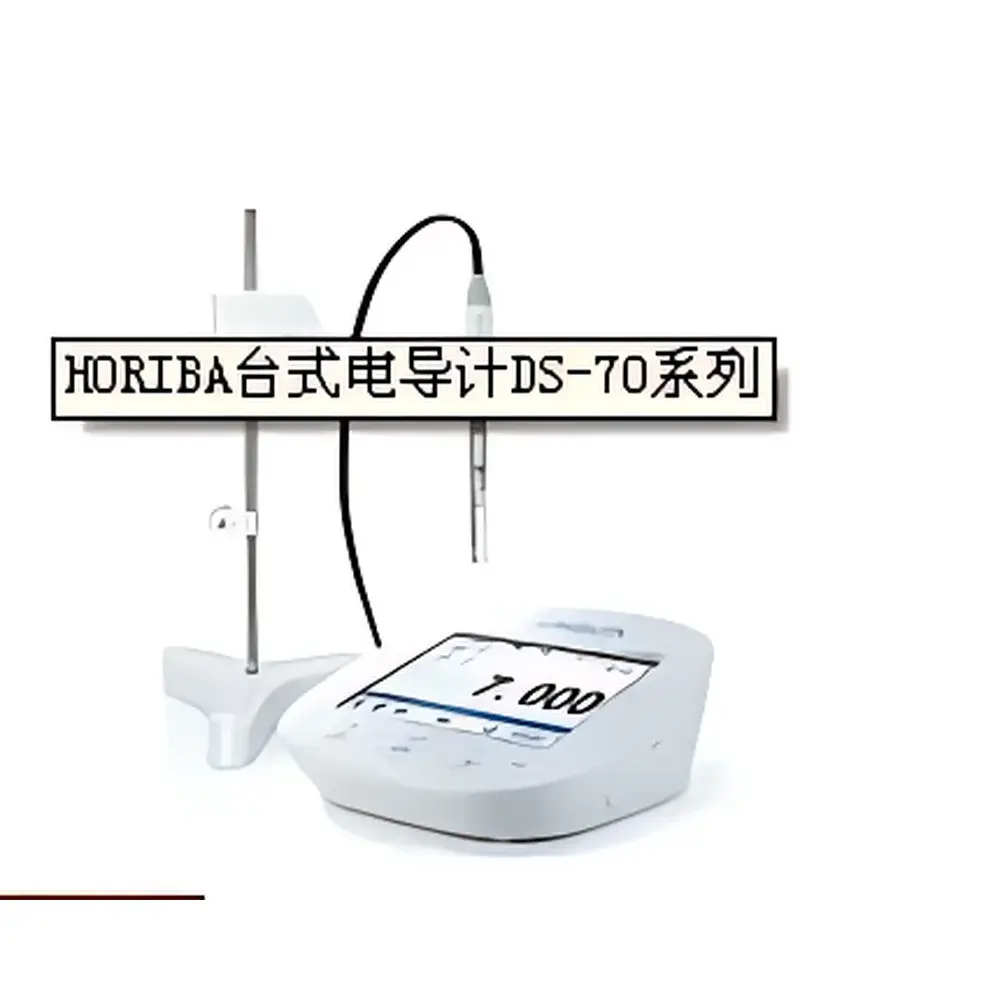
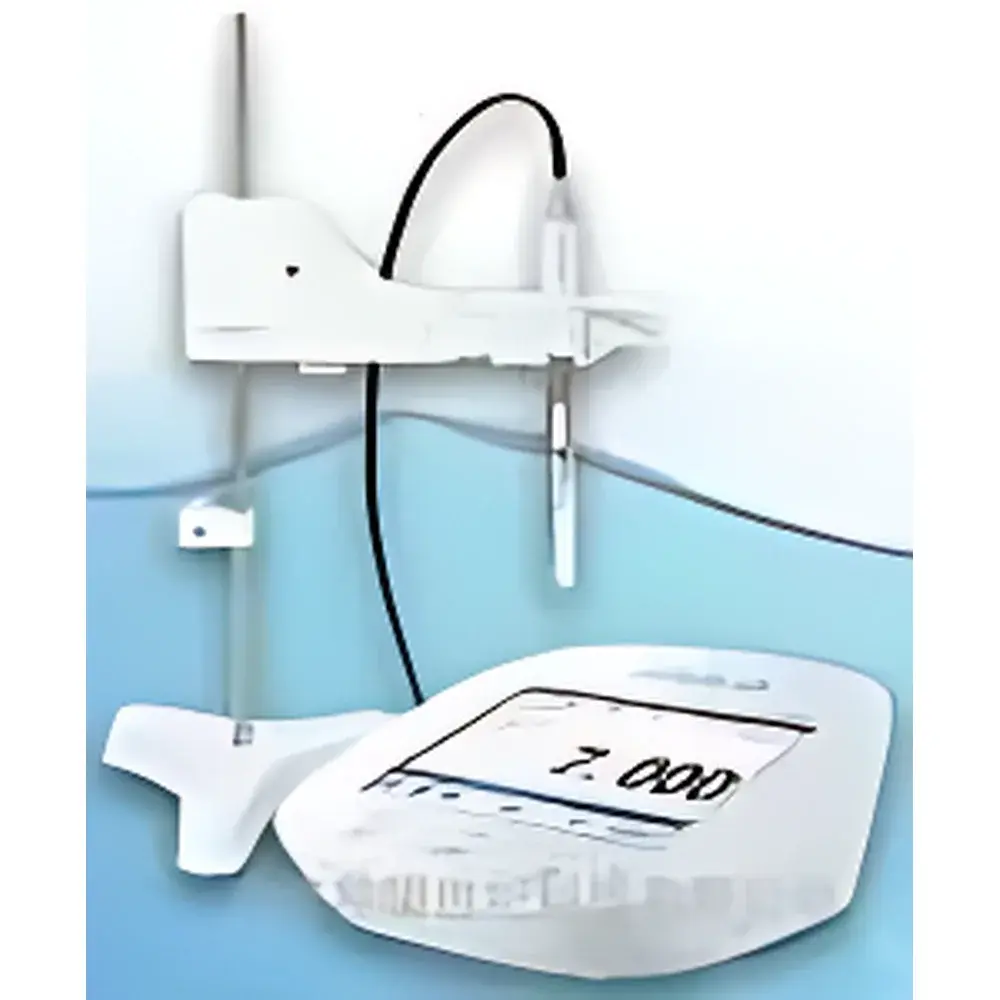
HORIBA DS-72 Benchtop Multi-Parameter Conductivity Analyzer
| Brand | HORIBA |
|---|---|
| Origin | Japan |
| Model | DS-72 |
| Form Factor | Benchtop |
| Conductivity Range | 0.0 µS/m – 1.999 S/m |
| TDS Range | 0.01 mg/L – 1000 g/L |
| Resistivity Range | 0.0 Ω·m – 1.999 MΩ·m |
| Salinity Range | 0.00 – 80.00 ppt |
| Temperature Range | 0.0 – 100.0 °C (extended to −30.0 – 130.0 °C) |
| Accuracy | ±0.5% F.S. ±1 digit (conductivity/resistivity/salinity/TDS), ±0.1 °C ±1 digit (temperature) |
| Resolution | 0.05% F.S. (conductivity/resistivity), 0.01 ppt (salinity), 0.01 mg/L (TDS), 0.1 °C (temperature) |
| Data Storage | 2000 measurements |
| Compliance | JIS Z 8806, USP <645>, EP 2.2.38, JP XVIII, ChP (Chinese Pharmacopoeia) General Chapter 0681 |
| Language Support | English, Japanese, Chinese, Korean |
| Power Supply | AC adapter 100–240 V, 50/60 Hz, ~9.8 VA |
| Weight | 700 g |
| Interfaces | USB port for PC communication and USB mass storage |
| GLP/GMP Features | Audit trail-capable data logging, user authentication support, calibration history with timestamped entries |
Overview
The HORIBA DS-72 is a benchtop multi-parameter conductivity analyzer engineered for high-precision electrochemical measurement in regulated laboratory environments. It employs a dual-electrode AC excitation method—compliant with ISO 8665 and ASTM D1125—to eliminate polarization errors and ensure stable, drift-free conductivity readings across a wide dynamic range. Unlike single-frequency or DC-based systems, the DS-72 applies controlled sinusoidal voltage at optimized frequencies to minimize electrode fouling and interfacial capacitance effects, enabling reliable quantification of low-conductivity ultrapure water (UPW) as well as high-salinity industrial process streams. Its core measurement architecture supports traceable conversion between conductivity, resistivity, total dissolved solids (TDS), and salinity using temperature-compensated algorithms aligned with IAPSO standard seawater equations and USP linear/nonlinear compensation models. Designed for pharmaceutical, biotechnology, and environmental quality control labs, the DS-72 delivers metrological integrity required for GxP-compliant water system validation and routine QC testing.
Key Features
- Electrode-agnostic measurement platform supporting interchangeable conductivity cells with cell constants of 0.01, 0.1, 1.0, and 10.0 cm⁻¹—enabling seamless transition from ultrapure water (0.055 µS/cm) to concentrated brines (up to 200 mS/cm).
- Capacitive touch interface with 7-inch full-color LCD display, offering intuitive navigation, real-time parameter overlay, and context-sensitive troubleshooting prompts.
- Integrated calibration guidance compliant with pharmacopeial standards: automated step-by-step workflows for USP Stage 1–3 verification, EP 2.2.38 system suitability checks, and JIS Z 8806 reference solution validation.
- GLP/GMP-ready data management: time-stamped measurements with operator ID tagging, editable comments, and encrypted USB export compatible with LIMS integration.
- Self-diagnostic firmware with continuous electrode health monitoring—including impedance spectroscopy diagnostics and open/short circuit detection—reducing downtime and ensuring measurement confidence.
- Multi-language UI (English, Japanese, Korean, Simplified Chinese) and configurable report templates aligned with 21 CFR Part 11 requirements for electronic records and signatures.
Sample Compatibility & Compliance
The DS-72 accommodates aqueous samples across diverse matrices: deionized water, purified water (PW), water for injection (WFI), wastewater effluents, cooling tower fluids, and seawater analogs. Its temperature-controlled measurement path (PT1000 sensor embedded in flow cell option) ensures ±0.1 °C thermal stability during kinetic studies or thermal coefficient evaluation. Regulatory alignment includes full support for USP conductivity acceptance criteria (e.g., Stage 1 limits at 25 °C, Stage 2 temperature correction protocols), EP 2.2.38 resistivity thresholds for PW/WFI, and JP XVIII conductivity specifications for sterile preparations. The instrument’s firmware implements automatic temperature compensation using both linear (0.02%/°C) and nonlinear (Curie-type) models per sample type selection, and all calibrations are traceable to NIST-certified KCl standards (e.g., 84 µS/cm, 1413 µS/cm, 12.88 mS/cm). Validation documentation packages—including IQ/OQ templates and uncertainty budgets—are available upon request.
Software & Data Management
Data acquisition and reporting are managed through HORIBA’s proprietary PC software suite, compatible with Windows 10/11 and supporting TLS 1.2 secure connections. Raw datasets include conductivity, temperature, cell constant, compensation mode, operator ID, and timestamp—all stored in CSV and XML formats with SHA-256 hash verification. The system enforces role-based access control (RBAC) with three-tier user permissions (Operator, Supervisor, Administrator), and maintains an immutable audit trail recording all configuration changes, calibration events, and data exports. USB mass storage mode allows direct saving of measurement logs, calibration certificates, and system diagnostic reports onto FAT32-formatted drives. For enterprise deployment, the DS-72 supports HL7 and ASTM E1384 message formatting for bidirectional interfacing with laboratory information management systems (LIMS) and electronic lab notebooks (ELN).
Applications
- Pharmaceutical water system qualification: continuous monitoring of PW/WFI loop conductivity per FDA guidance and EU Annex 1 requirements.
- Bioprocess buffer preparation: real-time verification of salt concentration and ionic strength prior to chromatography or ultrafiltration steps.
- Environmental compliance testing: EPA Method 120.1–compliant TDS and salinity profiling in surface water and groundwater sampling.
- Academic research: temperature-dependent conductivity mapping of electrolyte solutions for Arrhenius analysis and transport property modeling.
- Industrial cooling water management: rapid assessment of cycle concentration ratios and corrosion inhibitor efficacy via resistivity trend analysis.
- Calibration laboratory services: primary standard verification against certified reference materials (CRMs) with documented measurement uncertainty budgets.
FAQ
Does the DS-72 meet 21 CFR Part 11 requirements for electronic records?
Yes—the instrument supports user authentication, electronic signatures, and audit-trail-enabled data logging when used with validated software and appropriate administrative controls.
Can the DS-72 be used for USP Stage 3 testing?
Yes—it provides automated temperature correction, non-linear compensation, and pass/fail flagging per USP Table 1 and Table 2 criteria.
What cell constants are supported, and how is cell constant verification performed?
The DS-72 accepts cells with constants of 0.01, 0.1, 1.0, and 10.0 cm⁻¹; cell constant verification is conducted using NIST-traceable KCl standards and stored in the calibration history with uncertainty propagation.
Is external temperature compensation possible if using a separate probe?
No—the DS-72 uses only its integrated PT1000 sensor for temperature input; external RTD or thermistor inputs are not supported.
How is data security ensured during USB export?
All exported files include digital signatures and checksums; optional password protection and AES-256 encryption are available via enterprise software licensing.






