
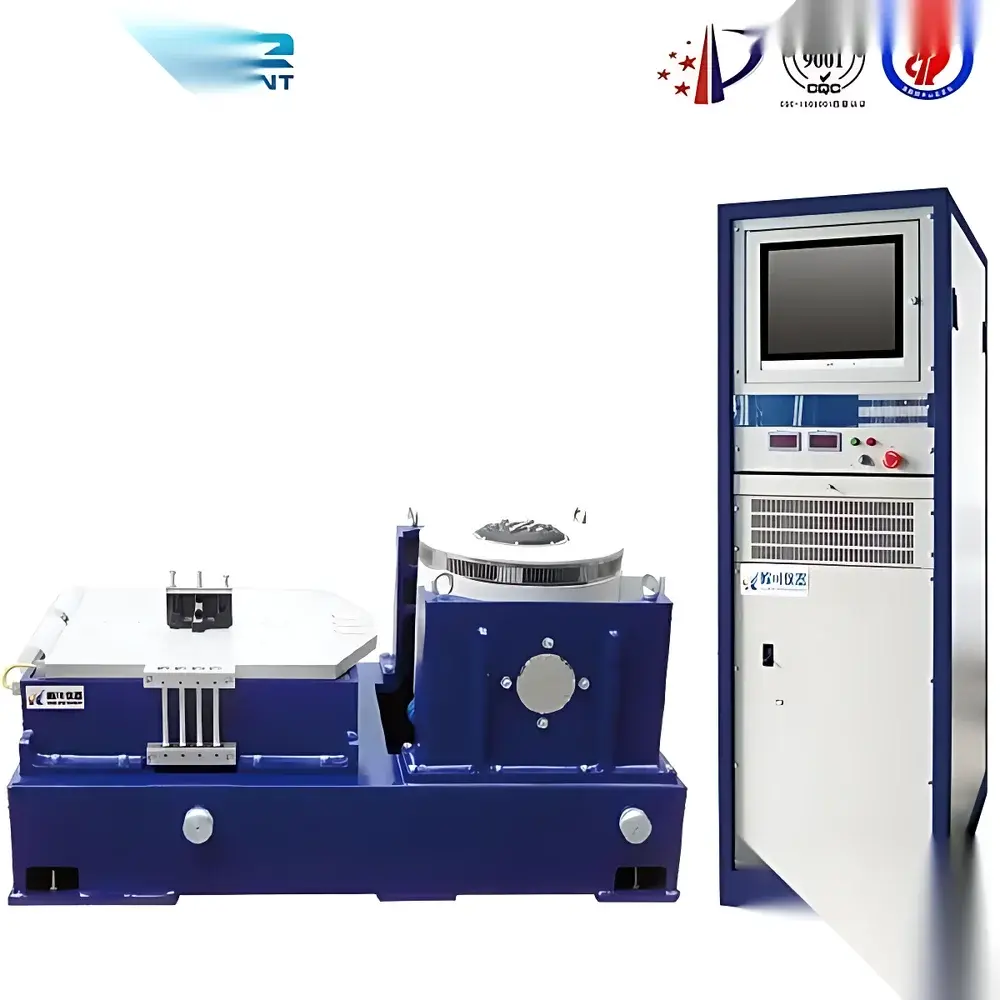
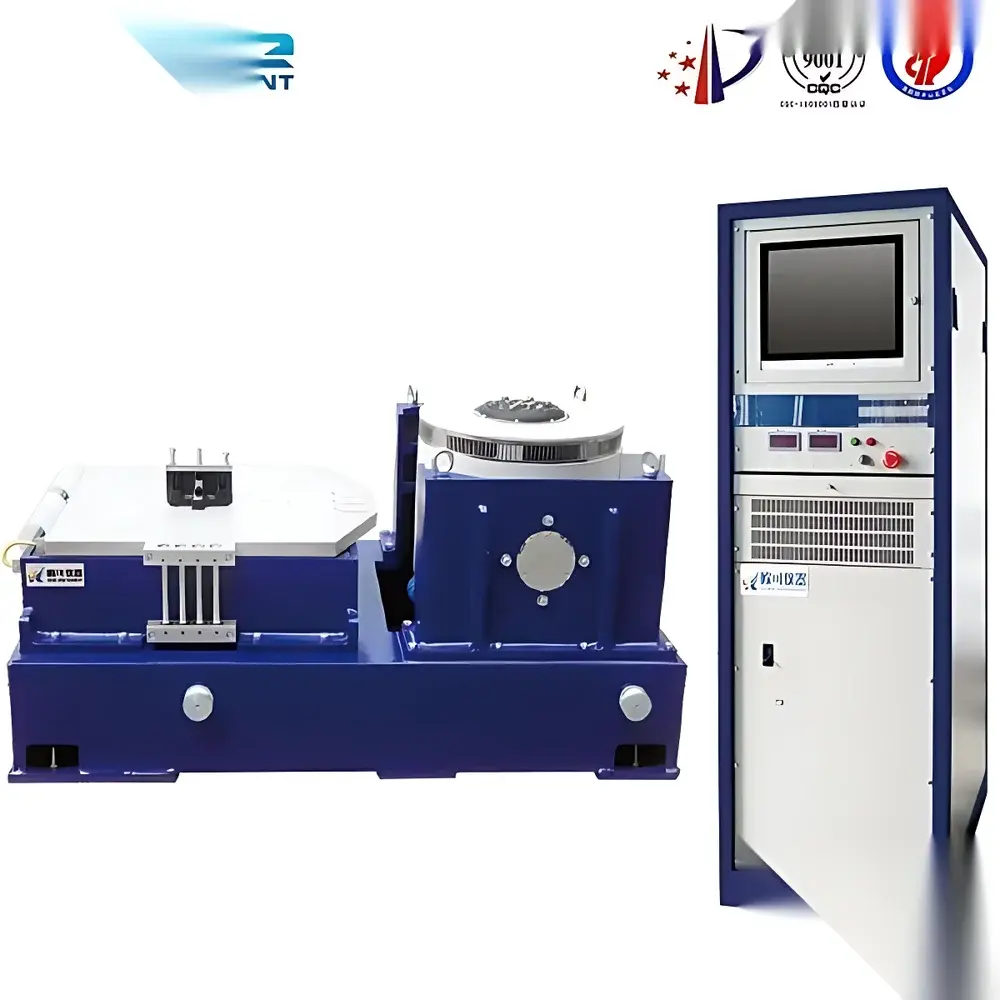
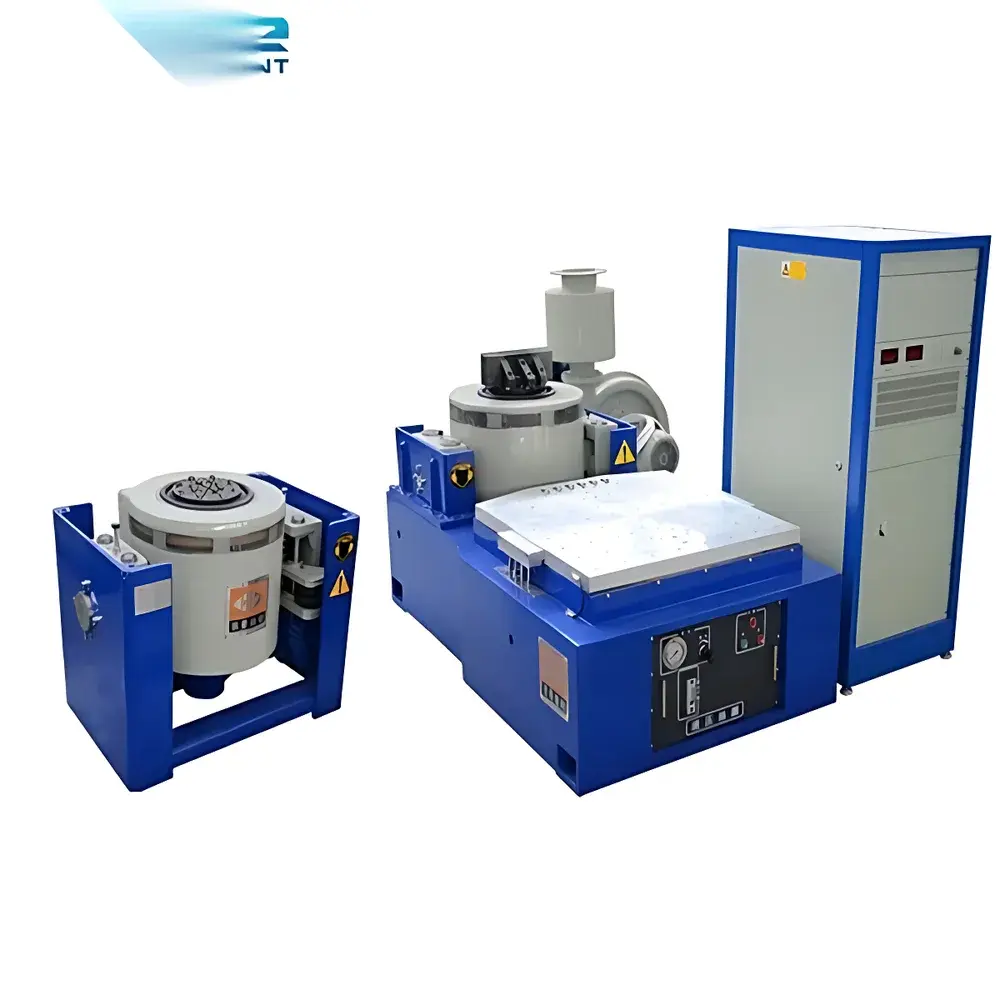
OK-ES-50 Electromagnetic 500 kg Multi-Axis Vibration Shaker System
| Brand | OEM / Custom-Built |
|---|---|
| Origin | Imported |
| Manufacturer Type | Authorized Distributor |
| Max Payload Capacity | 500 kg |
| Max Sinusoidal Force | 2000 kgf |
| Frequency Range | 1–5000 Hz (±0.1%) |
| Peak Acceleration | 0–20 g (0–196.13 m/s²) |
| Displacement (p-p) | 0–5 mm |
| Ambient Operating Range | −10°C to +60°C, 10–95% RH |
| Noise Level | ≤60 dB(A) |
| Magnetic Field Emission | ≤110 mG at 1 m |
| Power Supply | 220 V ±20%, 50/60 Hz, 10 A, 2.2 kW |
| Cooling | Natural Air-Cooled |
| Table Dimensions | 500 × 500 × 6 mm (L×W×H) with 25 × M10 threaded mounting holes |
| Base Dimensions | 50 × 50 × 45 cm (L×W×H) |
| Compliance | Designed for ASTM D999, ISO 13373-1, IEC 60068-2-6, MIL-STD-810H Method 514.8, and GB/T 2423.10 |
Overview
The OK-ES-50 is a high-capacity electromagnetic vibration shaker system engineered for rigorous mechanical stress screening of industrial components across aerospace, automotive, electronics, and transportation sectors. Unlike single-axis exciters, this system implements dual orthogonal electromagnetic actuators—integrated into a single rigid platform—to generate synchronized vertical (Z-axis) and horizontal (X- or Y-axis) motion, enabling true 4-degree-of-freedom (4-DOF) vibration profiles. Its core architecture leverages Lorentz-force-driven coil-magnet dynamics, delivering high-fidelity sinusoidal, swept-sine, random, and road-simulation waveforms with traceable linearity across its full operational bandwidth (1–5000 Hz). The system is calibrated to maintain frequency accuracy within ±0.01 Hz resolution and supports real-time amplitude and acceleration control under closed-loop feedback—critical for replicating transport-induced fatigue, resonance amplification, and structural boundary-condition testing per international environmental simulation standards.
Key Features
- Dual-axis electromagnetic excitation: Independent yet synchronized Z + X (or Z + Y) motion on a unified test table—no mechanical coupling or phase delay between axes
- Full-spectrum waveform generation: Standard-compliant sine, swept-sine (linear/logarithmic), programmable multi-segment profiles (up to 15 segments), octave-based frequency doubling, and pseudo-random vibration with user-defined PSD profiles
- High-force capability: 2000 kgf peak sinusoidal thrust enables testing of large assemblies—including EV battery modules, engine control units, and avionics enclosures—up to 500 kg mass load
- Precision actuation control: Adjustable displacement (0–5 mm p-p), acceleration (0–20 g), and frequency (1–5000 Hz) with ±0.1% frequency stability and 0.01 Hz digital resolution
- Robust mechanical design: Reinforced base structure (50 × 50 × 45 cm) with doubled rigidity versus legacy models; 500 × 500 mm aluminum test table featuring 25 × M10 threaded mounting points and four peripheral hook-mounting slots (70 mm length)
- Industrial-grade interface: RS-485 serial port for integration with external controllers, SCADA systems, or custom LabVIEW/Python automation frameworks
- Thermal and EMI management: Natural convection cooling ensures continuous operation; magnetic field emission ≤110 mG at 1 m distance—compliant with laboratory safety guidelines for adjacent instrumentation
Sample Compatibility & Compliance
The OK-ES-50 accommodates test specimens ranging from small PCBs to full-scale automotive subassemblies, provided center-of-gravity alignment remains within the table’s moment capacity and payload distribution avoids asymmetric overhang (>15% beyond table edge discouraged). Mounting fixtures must be dynamically balanced and secured using grade 8.8 or higher fasteners. The system meets mechanical and electrical requirements outlined in ASTM D999 (shipping vibration simulation), ISO 13373-1 (vibration condition monitoring), IEC 60068-2-6 (sinusoidal vibration testing), and MIL-STD-810H Method 514.8 (vibration exposure for military equipment). While not certified to GLP or FDA 21 CFR Part 11 out-of-the-box, its RS-485 interface and deterministic real-time control architecture support integration into validated computerized systems when paired with compliant data acquisition hardware and audit-trail-enabled software.
Software & Data Management
The OK-ES-50 operates in standalone mode via front-panel keypad and LCD interface, supporting manual setup of sweep rates, dwell times, amplitude ramps, and segment-based test sequences. For advanced analysis, optional PC-based control software (sold separately) provides full remote operation, real-time waveform visualization, automated test logging (CSV/TXT), and post-test FFT spectral analysis. All test parameters—including time-history acceleration, velocity, and displacement—are timestamped and exportable without interpolation. When deployed in regulated environments, the software package may be configured to meet ALCOA+ data integrity principles: attributable, legible, contemporaneous, original, accurate, complete, consistent, enduring, and available—with optional electronic signatures and change-control logs.
Applications
- Transportation durability validation: Simulating truck, rail, and air cargo vibration spectra per ISTA 3A/3E and ASTM D4169
- Automotive component qualification: Engine control modules, ADAS sensors, infotainment housings, and battery pack mounts subjected to road-profile emulation (e.g., Belgian block, cobblestone, washboard)
- Electronics reliability testing: SMT solder joint fatigue assessment, connector retention force evaluation, and MEMS device resonance mapping
- Aerospace ground vibration testing (GVT): Modal survey support for small UAV airframes and avionics racks
- Research-grade dynamic characterization: Material damping coefficient extraction, structural modal parameter identification (natural frequencies, damping ratios), and nonlinear response analysis under combined axial-lateral loading
FAQ
Does the OK-ES-50 support simultaneous vertical and horizontal vibration at independent frequencies?
No. The dual-axis architecture maintains strict phase synchronization; both axes operate at the same commanded frequency but may differ in amplitude and waveform type (e.g., vertical sine + horizontal random). Independent frequency control requires two separate shaker systems.
Is the 500 kg payload rating applicable for all vibration modes?
Yes, but maximum usable payload depends on center-of-gravity height and moment arm. For random or multi-axial tests above 200 Hz, derating to 300 kg is recommended to preserve mechanical fidelity and actuator longevity.
Can the system perform classical shock testing (e.g., half-sine, trapezoidal)?
Not natively. Shock simulation requires additional power amplifier configuration and transient waveform synthesis capabilities not included in standard firmware. Custom firmware development is available upon request.
What calibration documentation is supplied?
Each unit ships with a factory-as-built performance report including frequency response curves (acceleration vs. frequency), thrust linearity verification, and displacement repeatability data measured per ISO 16063-21. NIST-traceable third-party calibration is optional.
Is remote diagnostics supported?
Basic status telemetry (temperature, current draw, fault codes) is accessible via RS-485. Full remote diagnostic access requires integration with an external industrial gateway and secure VPN tunneling—configuration assistance is provided by technical support.



