
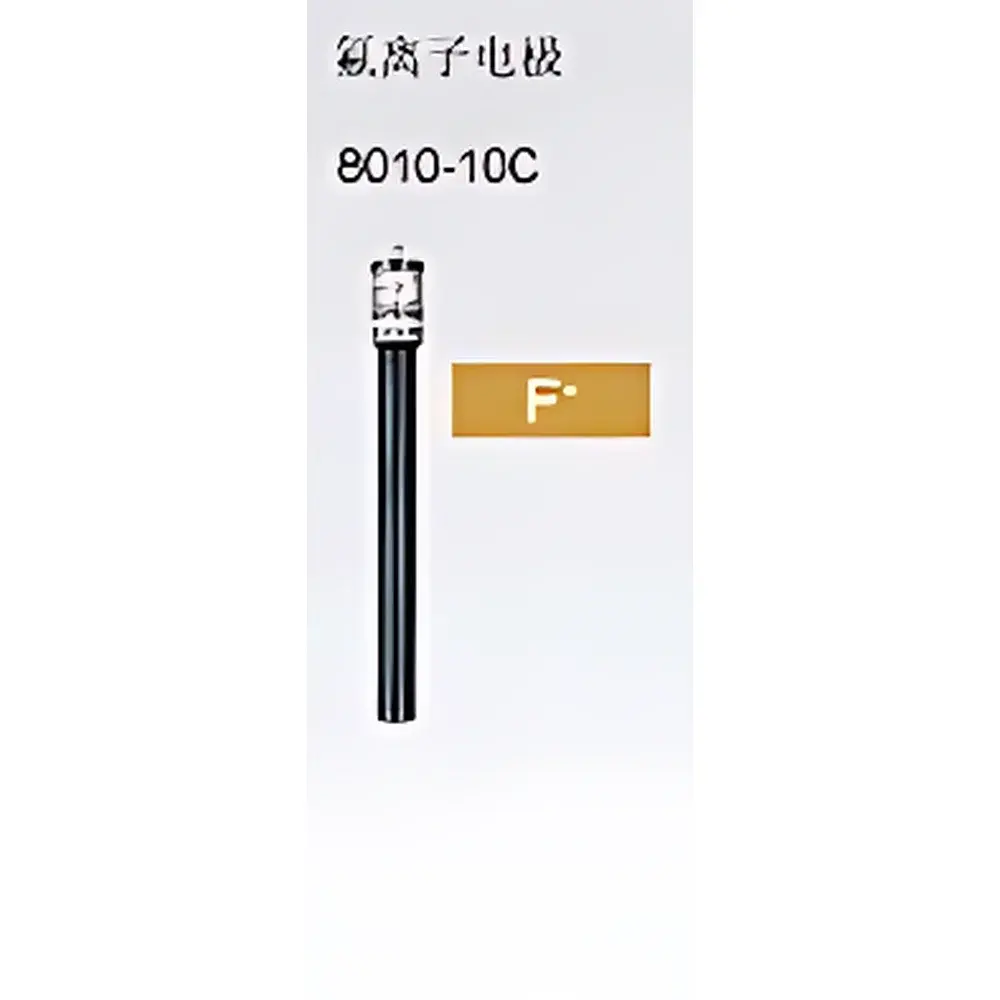
HORIBA 8010-10C Fluoride Ion-Selective Electrode
| Brand | HORIBA |
|---|---|
| Origin | Japan |
| Model | 8010-10C |
| Measuring Range | 0.02–19,000 ppm F⁻ |
| Compatible Reference Electrodes | 2060A & 2565A |
| Part Number | 3014093439 (9003016400) |
| Compliance | Designed for ASTM D1179, ISO 10304-1, and EPA Method 300.0 applications |
Overview
The HORIBA 8010-10C Fluoride Ion-Selective Electrode is a potentiometric sensor engineered for accurate, reproducible quantification of free fluoride ions (F⁻) in aqueous environmental and industrial samples. Based on a lanthanum fluoride (LaF₃) single-crystal membrane, the electrode operates via the Nernstian principle—generating a stable, logarithmic voltage response proportional to the activity of fluoride ions across six orders of magnitude (0.02–19,000 ppm F⁻). Its solid-state crystalline sensing element ensures minimal interference from hydroxide (OH⁻) at pH ≥ 5.0 and exhibits negligible response to common anions including chloride, nitrate, and sulfate—critical for reliable measurements in complex matrices such as drinking water, wastewater effluents, groundwater, and industrial process streams. The electrode is designed for direct integration with HORIBA’s benchtop (F-72/F-73/F-74/F-74BW) and portable (D-53) water quality analyzers, supporting both field-deployable and laboratory-grade compliance testing.
Key Features
- Lanthanum fluoride (LaF₃) single-crystal membrane offering high selectivity for F⁻ over competing anions (log KF⁻,OH⁻ = −4.8 at pH 5–8)
- Wide dynamic range: 0.02–19,000 ppm F⁻ (1.05 × 10⁻⁶ – 1.0 M), enabling trace-level detection and high-concentration monitoring without dilution
- Compatible with dual-reference electrode configurations: HORIBA 2060A (Ag/AgCl double-junction) and 2565A (Ag/AgCl gel-filled), minimizing liquid junction potential drift in variable ionic strength samples
- Robust PTFE-bodied construction with integrated temperature sensor (NTC 10 kΩ) for automatic temperature compensation (ATC) in accordance with NIST-traceable calibration protocols
- Optimized for use with standardized calibration buffers (e.g., 1.0 ppm and 100 ppm F⁻ in TISAB II matrix) and validated per ISO/IEC 17025 calibration requirements
- No internal filling solution required—maintenance-free operation with extended shelf life (>2 years when stored dry at 4–30°C)
Sample Compatibility & Compliance
The 8010-10C is validated for use in natural waters, treated drinking water, wastewater, leachates, and industrial discharges. To ensure measurement integrity, samples must be buffered with Total Ionic Strength Adjustment Buffer (TISAB II) to control pH (5.0–8.0), mask interfering metal ions (e.g., Al³⁺, Fe³⁺), and maintain constant ionic strength. The electrode meets performance criteria specified in ASTM D1179 (Standard Test Method for Fluoride in Water), ISO 10304-1 (Determination of dissolved anions by ion chromatography — Part 1: Determination of fluoride, chloride, nitrite, bromide, nitrate and sulfate), and U.S. EPA Method 300.0 (Determination of Inorganic Anions by Ion Chromatography). It supports GLP/GMP data integrity workflows when paired with HORIBA analyzers featuring audit-trail-enabled firmware compliant with FDA 21 CFR Part 11.
Software & Data Management
When connected to HORIBA F-series benchtop analyzers or the D-53 portable platform, the 8010-10C leverages embedded firmware supporting multi-point calibration (2–5 points), slope validation (−56.0 to −60.0 mV/decade at 25°C), and real-time drift monitoring. Data export is available in CSV format via USB or Bluetooth, preserving metadata including date/time stamp, operator ID, calibration history, temperature, and electrode impedance. All measurement records are time-stamped and cryptographically signed to satisfy regulatory audit requirements under ISO 17025 and EU Annex 11.
Applications
- Regulatory compliance monitoring for fluoride in public drinking water systems (WHO guideline: ≤1.5 mg/L; U.S. EPA MCL: 4.0 mg/L)
- Effluent characterization in aluminum smelting, phosphate fertilizer production, and semiconductor etching facilities
- Groundwater assessment in fluorosis-endemic regions (e.g., parts of India, China, East Africa)
- Quality control of fluoride-containing dental products and pharmaceutical excipients
- Research applications in geochemical speciation modeling and adsorption kinetics studies using activated alumina or bone char media
FAQ
What reference electrodes are mandatory for the 8010-10C?
The 8010-10C requires either the HORIBA 2060A (double-junction Ag/AgCl) or 2565A (single-junction Ag/AgCl gel) reference electrode to maintain stable liquid junction potential and minimize contamination in low-ionic-strength samples.
Can the 8010-10C be used with the D-53 portable analyzer?
No—the D-53 accepts only composite ion-selective electrodes (e.g., 6561-10C); the 8010-10C is a non-composite, separate-body electrode intended for use with F-72/F-73/F-74/F-74BW benchtop instruments.
How often should calibration be performed?
Calibration is required before each analytical session and after every 2 hours of continuous use; verification with a mid-range standard (e.g., 10 ppm F⁻) is recommended between samples.
Does the electrode require conditioning before first use?
Yes—immerse the sensing tip in 100 ppm F⁻ standard for 30 minutes prior to initial calibration to stabilize membrane potential and reduce response time.
What is the typical service life under routine use?
With proper storage (dry, at room temperature) and avoidance of prolonged exposure to HF, strong oxidizers, or pH < 4.5, the LaF₃ membrane maintains Nernstian response for ≥18 months of active deployment.
Related Products







