
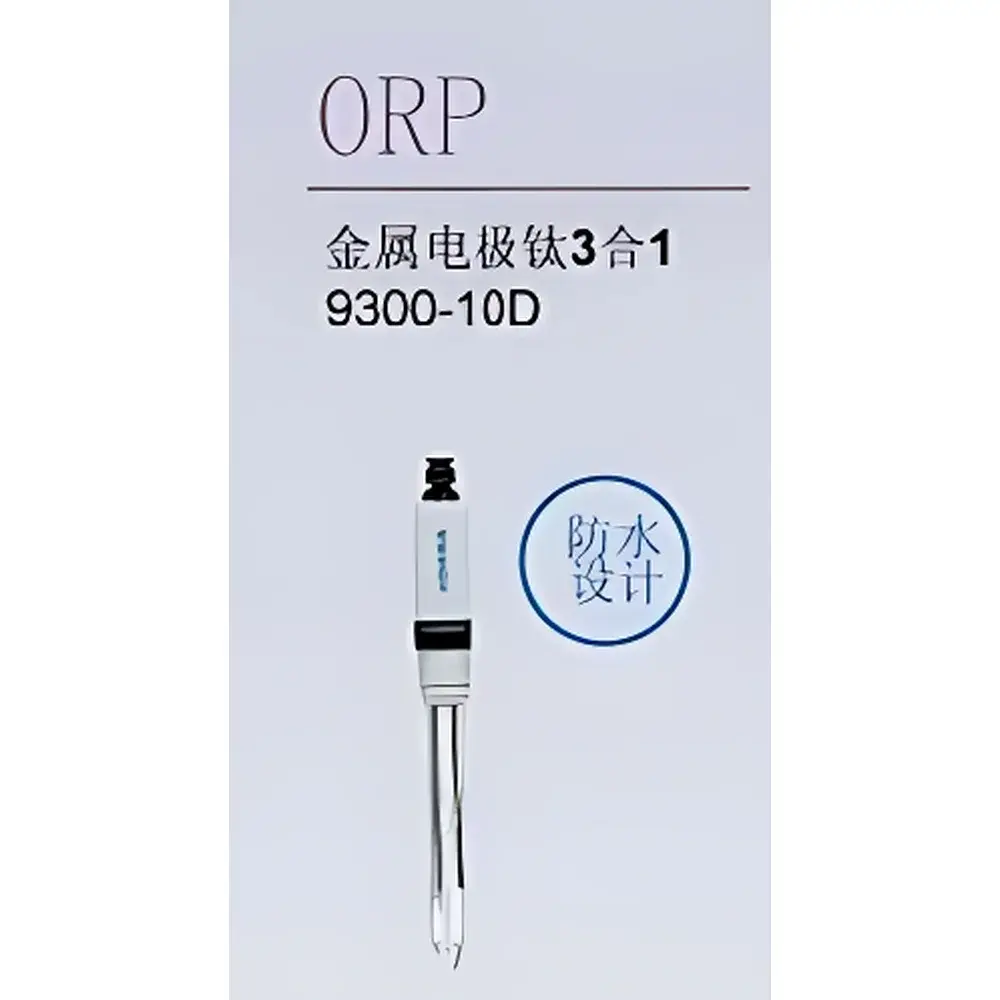
HORIBA 9300-10D Waterproof Platinum Composite ORP Electrode
| Brand | HORIBA |
|---|---|
| Origin | Japan |
| Type | Composite Redox Electrode (Pt/Ag-AgCl Reference) |
| Model | 9300-10D |
| Temperature Range | 0–60 °C |
| Body Material | Waterproof Glass |
| Electrode Configuration | Integrated Pt Sensing Element + Double-Junction Ag/AgCl Reference |
| Compatibility | Aqueous Solutions, Wastewater, Industrial Process Streams |
| Electrical Connection | BNC |
| IP Rating | IP67 (when capped) |
| Calibration Support | Single-point or multi-point ORP standard verification (e.g., ±200 mV, +450 mV Zobell’s solution, +220 mV saturated quinhydrone) |
Overview
The HORIBA 9300-10D is a robust, waterproof composite redox (oxidation-reduction potential) electrode engineered for reliable, long-term ORP measurement in demanding laboratory, environmental monitoring, and industrial process control applications. Based on the fundamental Nernstian principle—where the measured potential (mV) reflects the thermodynamic tendency of a solution to gain or lose electrons—the 9300-10D employs a high-purity platinum sensing element coupled with a stable, double-junction Ag/AgCl reference system. This architecture minimizes liquid junction potential drift and contamination from sample matrices, ensuring consistent baseline stability and high reproducibility across repeated measurements. Unlike conventional single-junction electrodes, the double-junction design isolates the internal reference electrolyte (3 mol/L KCl) from aggressive or low-conductivity samples—critical for wastewater effluent, chlorinated disinfection systems, electroplating baths, and bioreactor redox profiling. The electrode’s hermetically sealed glass body conforms to IP67 specifications when the protective cap is engaged, enabling safe use in humid enclosures, outdoor sampling stations, and splash-prone production environments.
Key Features
- Integrated platinum sensing surface with optimized surface area and catalytic activity for rapid electron transfer kinetics
- Double-junction reference system with outer sleeve filled with KNO₃ or KCl-free electrolyte—reducing clogging risk in sulfide-, protein-, or heavy-metal-rich media
- Waterproof glass housing rated to IP67 (dust-tight and immersion-resistant up to 1 m for 30 min), eliminating seal degradation under thermal cycling
- Fixed 1 m coaxial cable with molded BNC connector, shielded against electromagnetic interference (EMI) in plant-floor settings
- Optimized tip geometry for minimal polarization error during static or low-flow measurements
- Compatible with HORIBA’s LAQUA series meters (e.g., LAQUA twin, LAQUA pH/ORP/Temp handhelds) as well as third-party analyzers supporting standard mV input and manual temperature compensation
Sample Compatibility & Compliance
The 9300-10D is validated for use in aqueous solutions with conductivity ≥50 µS/cm. It demonstrates stable response in municipal wastewater, cooling tower water, swimming pool chlorine systems, fermentation broths, and electrochemical synthesis reactors. For low-conductivity samples (<50 µS/cm), optional use of a separate temperature-compensated conductivity probe is recommended to assess ionic strength influence on ORP interpretation. The electrode complies with ISO 11283:2015 (water quality — determination of oxidation-reduction potential), ASTM D1293-22 (standard test method for pH of water), and supports GLP/GMP data integrity requirements when paired with compliant data loggers featuring audit-trail functionality. Its construction excludes PVC and phthalates per RoHS Directive 2011/65/EU and REACH Annex XVII restrictions.
Software & Data Management
While the 9300-10D operates as an analog mV transducer without embedded digital logic, it integrates seamlessly into HORIBA’s LAQUA Connect software ecosystem via compatible meters (e.g., LAQUAtwin pH/ORP models). Raw mV outputs are timestamped, temperature-corrected using integrated Pt1000 sensor inputs (when used with dual-probe holders), and exported in CSV format for traceable post-processing. When deployed with HORIBA’s AD-2000 series benchtop analyzers, the electrode supports automated calibration logging, user-defined pass/fail thresholds, and 21 CFR Part 11-compliant electronic signatures through optional validation packages.
Applications
- Real-time redox monitoring in activated sludge and anaerobic digesters to optimize denitrification and sulfate reduction
- Chlorine residual control in potable water distribution networks and recreational facilities
- Quality assurance of electroplating bath redox state (e.g., Cr⁶⁺/Cr³⁺ ratio in chromic acid baths)
- In-process verification of chemical oxidation (e.g., Fenton, ozone, permanganate) treatment efficiency
- Redox profiling in soil leachate studies and sediment pore-water analysis
- Validation of sterilization cycles involving hydrogen peroxide vapor or peracetic acid
FAQ
Can the 9300-10D be used for pH measurement?
No. It is a dedicated ORP electrode without pH-sensitive glass membrane; simultaneous pH/ORP requires a separate combination electrode or dual-probe setup.
Is temperature compensation automatic?
The electrode itself does not include a built-in temperature sensor; external temperature input (e.g., via meter-integrated Pt1000 probe) is required for accurate Nernst correction.
What cleaning protocol is recommended after exposure to sulfide-rich samples?
Soak the sensing tip in 0.1 mol/L HNO₃ for 5 minutes, rinse thoroughly with deionized water, then recondition in pH 4 buffer for 15 minutes prior to recalibration.
Why must this electrode not be used simultaneously with other reference electrodes?
Parallel connection creates galvanic coupling between dissimilar reference systems, inducing offset potentials and irreversible drift in measured mV values.
Does the 9300-10D support autoclaving?
No. Exposure to steam sterilization (>100 °C) will compromise the glass-to-metal seal and reference junction integrity; chemical disinfection (e.g., 70% ethanol wipe) is permitted.





