
HORIBA LAQUAtwin B-711/B-712 Pocket-Sized pH Meters
| Brand | HORIBA |
|---|---|
| Origin | Japan |
| Model | B-711 / B-712 |
| Instrument Type | Pen-style |
| Parameter Types | Multi-parameter |
| Measurement Accuracy | ±0.1 pH |
| Measurement Range | 2–12 pH |
| Calibration | B-711 — Single-point |
| Sample Volume | ≥0.05 mL (with sampling film B) or ≥0.1 mL |
| Temperature Compensation | Yes |
| Auto-Hold | Yes |
| IP Rating | IP67 |
| Operating Environment | 5–40 °C, <85% RH (non-condensing) |
| Power | Two CR2032 batteries |
| Dimensions | 164 × 29 × 20 mm (excl. protrusions) |
| Weight | ~50 g (instrument only, excl. batteries) |
Overview
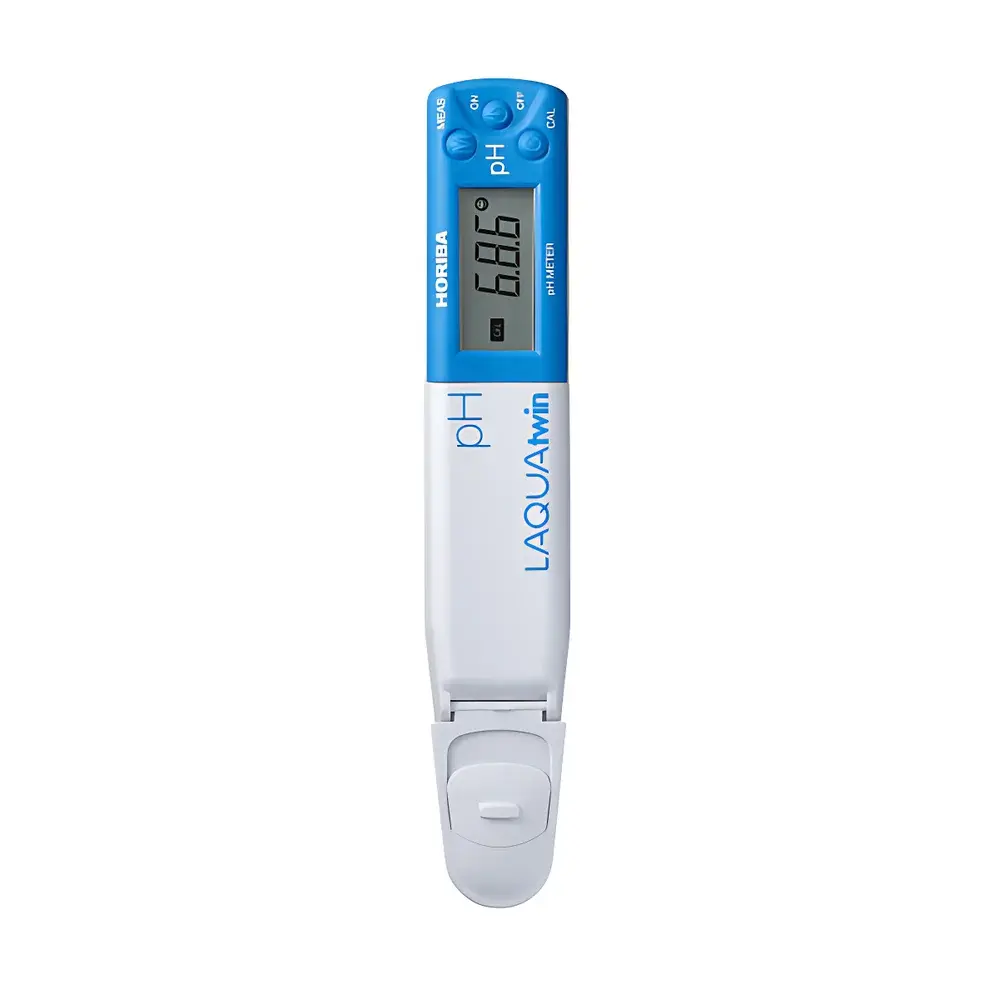
The HORIBA LAQUAtwin B-711 and B-712 are compact, pen-style pH meters engineered for rapid, reliable field and point-of-use measurements in environmental monitoring, aquaculture, hydroponics, food safety verification, and educational laboratories. Based on proven glass electrode potentiometry, these instruments deliver high reproducibility and stability across diverse aqueous matrices. Unlike conventional benchtop or handheld pH meters requiring bulk sample volumes and complex setup, the B-711/B-712 utilize a proprietary flat-surface pH electrode architecture developed from HORIBA’s decades of electrochemical sensor expertise. This design enables accurate measurement with as little as 0.05 mL of sample—ideal for micro-volume applications such as leaf sap analysis, droplet testing, or limited-access industrial process streams. The devices feature automatic temperature compensation (ATC) referenced to built-in thermistors, ensuring pH readings remain traceable to NIST-traceable standards across the operational range of 5–40 °C.
Key Features
- Ultra-low sample requirement: Measures accurately with ≥0.05 mL (when used with optional sampling film B) or ≥0.1 mL standard volume—minimizing waste and enabling analysis where sample is scarce.
- Intuitive single-button operation: One press initiates calibration or measurement; visual feedback (smiley-face icon) confirms readiness and stable reading acquisition.
- Rugged IP67-rated enclosure: Fully dust-tight and submersible up to 1 m for 30 minutes—validated per IEC 60529—making it suitable for outdoor, wet-lab, and industrial environments where incidental exposure to moisture or particulates occurs.
- Dual calibration flexibility: B-711 supports single-point calibration at pH 7.00; B-712 supports both single- and dual-point calibration (e.g., pH 4.01/7.00 or 7.00/10.01), enhancing accuracy across wide pH ranges and improving linearity verification.
- Integrated auto-hold function: Locks the stabilized reading automatically upon signal convergence, eliminating subjective judgment of endpoint stability.
- Compact ergonomics: 164 mm × 29 mm × 20 mm form factor and ~50 g mass enable one-handed use and easy portability in lab coats, tool belts, or field kits.
Sample Compatibility & Compliance
The B-711/B-712 are optimized for clear, low-turbidity aqueous solutions. For samples containing suspended solids or particulates, HORIBA recommends filtration using the optional “separation membrane” prior to measurement to prevent electrode fouling and ensure consistent junction potential. The flat electrode surface resists clogging better than traditional bulb-type electrodes, extending service intervals between cleanings. These instruments comply with general requirements for portable electrochemical analyzers under ISO 15195:2018 (reference measurement systems for enzymes and metabolites) and support GLP-aligned workflows through documented calibration events and stable repeatability (±0.1 pH per IUPAC-recommended validation protocols). While not FDA 21 CFR Part 11–certified out-of-the-box, audit trails can be maintained manually via logbooks referencing calibration dates, buffers used, and operator IDs—consistent with ISO/IEC 17025:2017 documentation expectations for testing laboratories.
Software & Data Management
The B-711 and B-712 operate as standalone instruments without Bluetooth or USB connectivity; data recording is manual. However, their design facilitates integration into structured quality systems: each unit displays real-time pH, temperature, and status icons, allowing operators to transcribe values directly into electronic lab notebooks (ELNs) or LIMS-compatible spreadsheets. Calibration records—including date, buffer pH values, and measured offsets—can be archived alongside environmental conditions (temperature/humidity) to satisfy internal QA audits. The fixed 2% per °C temperature coefficient aligns with common industry practice for non-ATC-compensated systems and is programmatically embedded—no user adjustment required. Battery life exceeds 1,000 measurements per set of CR2032 cells under typical usage, minimizing downtime during extended field campaigns.
Applications
- Aquaculture & hydroponics: Routine pH screening of recirculating water, nutrient solutions, and root-zone media.
- Food & beverage QC: Spot-checking rinse water, brine solutions, fermentation broths, and surface swab eluents.
- Environmental fieldwork: Rapid assessment of stream, pond, or runoff pH during site surveys or regulatory compliance checks.
- Education & training: Demonstrating fundamental electrochemical principles, calibration methodology, and measurement uncertainty concepts in undergraduate chemistry and environmental science labs.
- Pharmaceutical excipient testing: Preliminary pH evaluation of purified water batches or buffer stock solutions prior to formal pharmacopeial testing (e.g., USP ).
FAQ
What is the minimum sample volume required for accurate measurement?
With the optional sampling film B accessory, the B-711/B-712 can measure reliably using as little as 0.05 mL. Without the film, ≥0.1 mL is recommended.
Can the instrument measure samples with suspended solids?
Yes—provided the sample is pre-filtered using the HORIBA separation membrane to avoid clogging the flat electrode surface and reference junction.
Is temperature compensation automatic?
Yes. An integrated thermistor provides real-time ATC, and the device applies the standard 2 °C⁻¹ coefficient per IUPAC guidelines.
How often should calibration be performed?
Daily calibration is recommended for routine QC use; before each measurement session in critical applications; and immediately after electrode cleaning or prolonged storage.
Does the IP67 rating permit underwater operation?
No. IP67 certifies resistance to temporary immersion (1 m depth for ≤30 min), but the instrument must not be operated while submerged.




