
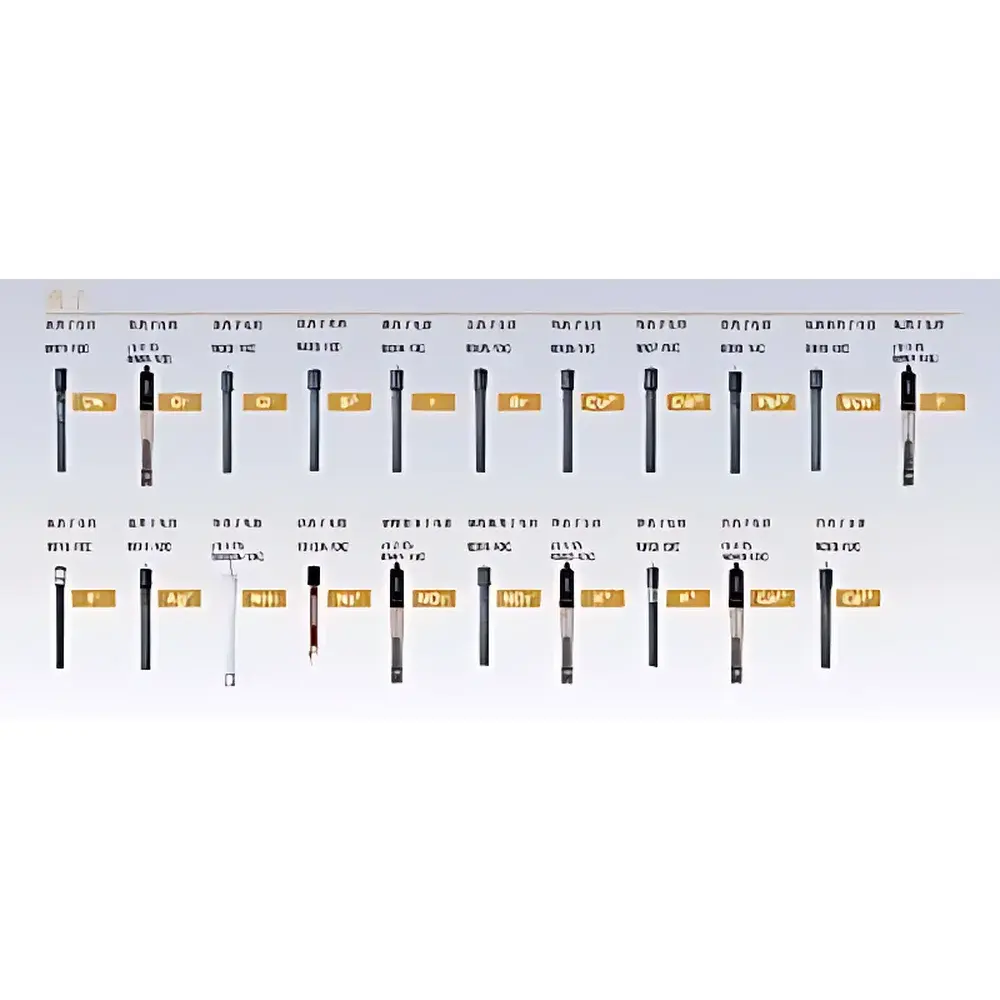
HORIBA Ion-Selective Electrodes (ISEs)
| Brand | HORIBA |
|---|---|
| Origin | Japan |
| Type | Import |
| Model Range | 8001-10C, 6560-10C, 8002-10C, 8003-10C, 8004-10C, 8005-10C, 8006-10C, 8007-10C, 8008-10C, 8009-10C, 6561-10C, 8010-10C, 8011-10C, 5002A-10C, 1512A-10C, 6581-10C, 8201-10C, 6582-10C, 8202-10C, 6583-10C, 8203-10C, and corresponding electrode cartridges (e.g., 7660, 7661, 7681–7683) |
| Compatible Instruments | HORIBA F-72 / F-73 / F-74 / F-74BW benchtop analyzers |
| Reference Electrodes Required | 2060A and/or 2565A (except for composite electrodes) |
| Measurement Principle | Potentiometric ion-selective membrane sensing per IUPAC guidelines |
| Compliance | Designed for ASTM D1129, ISO 10523, USP <791>, and EPA Method 300.0 applications |
Overview
HORIBA Ion-Selective Electrodes (ISEs) are precision potentiometric sensors engineered for direct, real-time measurement of specific ionic species in aqueous environmental and industrial water samples. Based on the Nernst equation, each electrode incorporates a chemically selective membrane—typically polymeric or crystalline—that generates a stable, reproducible potential difference proportional to the logarithm of the target ion’s activity. This thermodynamically grounded principle ensures trace-level detection without sample derivatization or complex pretreatment. The electrode series is designed for integration with HORIBA’s F-series benchtop analyzers (F-72, F-73, F-74, F-74BW) and the D-53 portable platform, supporting regulatory-compliant water quality monitoring across municipal, wastewater, industrial effluent, and natural surface water applications.
Key Features
- Multi-ion capability: Certified electrodes for CN⁻, Cl⁻, S²⁻, I⁻, Br⁻, Cu²⁺, Cd²⁺, Pb²⁺, SCN⁻, F⁻, Ag⁺, NH₃(aq), Na⁺, NO₃⁻, K⁺, and Ca²⁺ — each validated against reference standards per ISO/IEC 17025-accredited protocols.
- Composite and conventional configurations: Composite electrodes (e.g., 6560-10C Cl⁻, 6561-10C F⁻, 5002A-10C NH₃) integrate internal reference elements and liquid junctions into a single body, eliminating external reference electrode dependency—ideal for field use on the D-53 analyzer.
- Robust membrane architecture: Solid-state and PVC-based membranes exhibit low drift (<0.5 mV/h), high selectivity coefficients (log Kpotij ≤ –3 to –5 for major interferents), and resistance to fouling in turbid or organic-rich matrices.
- Trace-level sensitivity: Detection limits range from 0.01 ppm (I⁻, Ag⁺) to 0.1 ppm (NH₃, Cd²⁺), enabling compliance verification against WHO drinking water guidelines and EU Directive 2020/2184 thresholds.
- Standardized calibration: Supports two-point (10⁻⁴ M and 10⁻¹ M) or multi-point calibration routines with automatic slope calculation and offset validation per ASTM D1129 Annex A3.
Sample Compatibility & Compliance
HORIBA ISEs operate within pH ranges specified per electrode type (e.g., F⁻: pH 5–8; NH₃: pH >11; S²⁻: pH 12–13), requiring appropriate buffer or pH adjustment prior to analysis. Sample temperature must be maintained between 5–40 °C, with built-in temperature compensation (±0.003 mV/°C) integrated into compatible analyzers. All electrodes meet ISO 10523 (water quality — determination of pH) and EPA Method 300.0 (determination of anions by ion chromatography and ISE) structural and performance criteria. For GLP/GMP environments, the F-74BW and F-74 systems support 21 CFR Part 11-compliant audit trails when paired with HORIBA LabSolutions software, including user authentication, electronic signatures, and immutable calibration logs.
Software & Data Management
When used with HORIBA’s F-series benchtop analyzers, ISE measurements are managed via LabSolutions QA/QC software (v3.5+), which provides automated calibration curve generation, interference correction tables (based on Nikolsky-Eisenman equation inputs), and export to CSV, PDF, or LIMS-compatible XML formats. The D-53 portable analyzer features embedded firmware with on-device calibration storage, real-time slope monitoring, and Bluetooth 5.0 data transfer to HORIBA’s FieldLink mobile application for geotagged reporting. All raw potential (mV) and concentration (ppm or mol/L) outputs include metadata: timestamp, operator ID, electrode serial number, temperature, and calibration history—enabling full traceability under ISO/IEC 17025 Clause 7.7.
Applications
- Drinking water compliance: Quantification of F⁻ (0.02–19,000 ppm), NO₃⁻ (0.62–62,000 ppm), and Pb²⁺ (2–20,000 ppm) against WHO and national regulatory limits.
- Wastewater discharge monitoring: Simultaneous tracking of Cl⁻, NH₃, and SCN⁻ in industrial effluents subject to ISO 14001 environmental management systems.
- Surface and groundwater assessment: Field-deployable detection of Cd²⁺ and Cu²⁺ at sub-ppb levels using pre-concentration protocols validated per EPA Method 1640.
- Laboratory QC/QA: Routine verification of ion chromatography system performance using ISE as orthogonal reference method per USP .
- Aquaculture and hydroponics: Real-time Na⁺, K⁺, and Ca²⁺ profiling to maintain optimal electrolyte balance in recirculating systems.
FAQ
Which electrodes are compatible with the D-53 portable analyzer?
Only composite-type electrodes (e.g., 6560-10C Cl⁻, 6561-10C F⁻, 5002A-10C NH₃, 6581-10C NO₃⁻, 6582-10C K⁺, 6583-10C Ca²⁺) are supported due to their integrated reference architecture. Conventional electrodes requiring external reference cells (e.g., 8002-10C Cl⁻ + 2565A) are incompatible.
How often should I calibrate an ISE?
Calibration frequency depends on usage intensity and matrix complexity. For routine compliance testing, daily two-point calibration is recommended. In high-precision labs, calibration before each analytical batch—with verification standards—meets ISO/IEC 17025 requirements.
Can I use the same electrode for multiple ions?
No. Each electrode is chemically tuned for a single ionic species. Cross-sensitivity is minimized by membrane formulation, but simultaneous multi-ion measurement requires separate, dedicated electrodes.
What maintenance extends electrode service life?
Store hydrated in manufacturer-recommended storage solution (e.g., 1 mM KCl for Cl⁻ electrodes); avoid drying or immersion in deionized water. Clean membranes weekly with mild detergent and soft brush; regenerate F⁻ electrodes with 0.001 M NaF if response slows. Typical lifespan exceeds 12 months with proper handling.
Are replacement cartridges available for composite electrodes?
Yes. Cartridge-only replacements (e.g., 7660 for Cl⁻, 7661 for F⁻, 7681–7683 for NO₃⁻/K⁺/Ca²⁺) allow cost-effective refurbishment without replacing the entire sensor body—reducing long-term operational expenditure.
Related Products







