
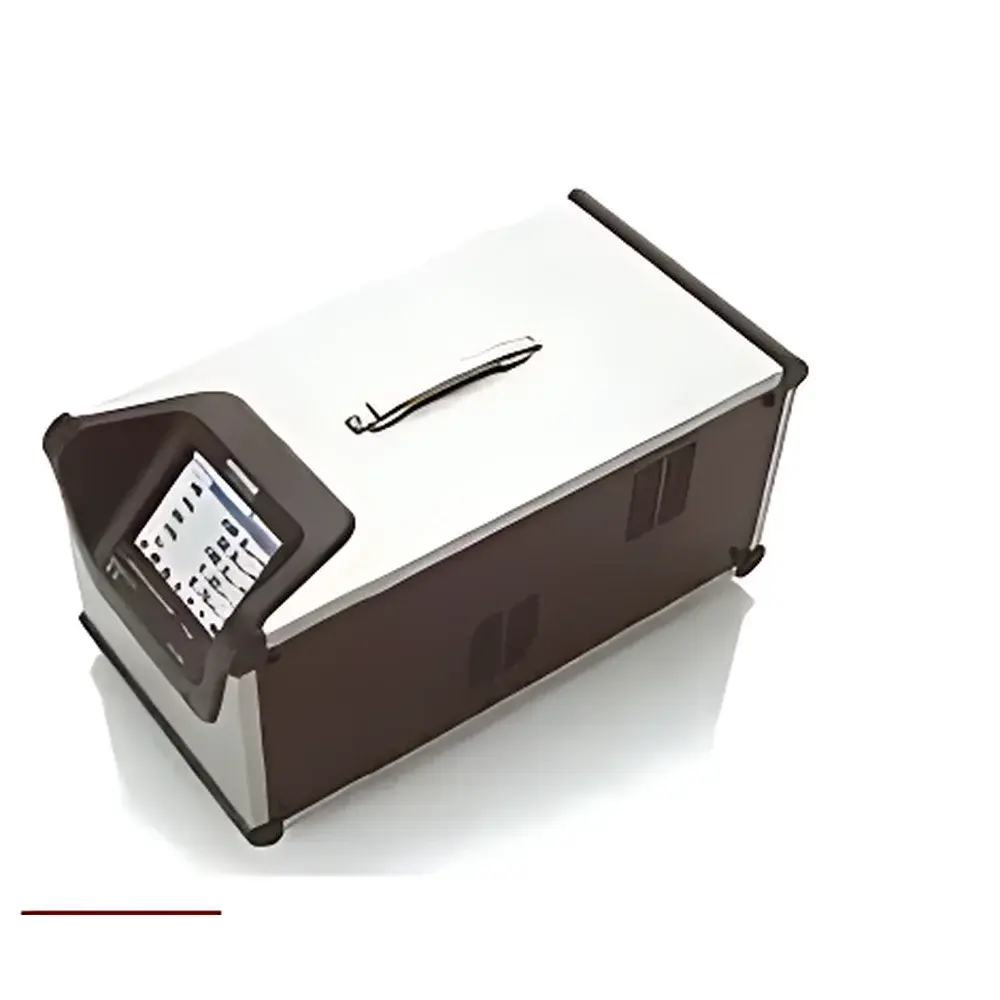
HORIBA PG-300 Portable Multi-Gas Emission Analyzer
| Brand | HORIBA |
|---|---|
| Origin | Japan |
| Model | PG-300 |
| Detection Principles | Pulsed Flow Modulation Chemiluminescence (NOₓ), Pulsed Flow Modulation NDIR (SO₂, CO, CH₄), Broadband NDIR (CO₂), Galvanic Cell (O₂) |
| Measured Gases | SO₂, NOₓ, CO, CO₂, O₂, CH₄ (optional) |
| Range Options | NOₓ: 0–25 to 0–2500 ppm (7 ranges) |
| SO₂ | 0–200 to 0–3000 ppm (4 ranges) |
| CO | 0–200 to 0–5000 ppm (5 ranges) |
| CO₂ | 0–10 to 0–30 vol% |
| O₂ | 0–5 to 0–25 vol% |
| CH₄ | 0–2000/5000 ppm |
| Accuracy | ±1.0% F.S. (SO₂: ±2.0% F.S./day) |
| Repeatability | ±1.0% F.S. |
| Linearity | ±2.0% F.S. |
| T₉₀ Response Time | ≤45 s (SO₂: ≤180 s) |
| Sample Flow Rate | ~0.5 L/min |
| Warm-up Time | 30 min (±2.0% F.S. stabilized within 2 h) |
| Display | Color TFT LCD touchscreen with real-time trend plotting |
| Data Storage | SD card (user-configurable interval) |
| Outputs | 4–20 mA analog, Ethernet |
| Power Supply | 100–120 VAC / 200–240 VAC, 50/60 Hz |
| Dimensions | 226 × 265 × 510 mm (W×H×D) |
| Weight | ~14 kg |
| Operating Environment | 5–40 °C, ≤85% RH |
| Certifications | TÜV (EU), MCERTS (UK), GOST-R (Russia), ETV (US), CNAS/CMA (China), KOLAS (Korea), JIS/MLIT (Japan) |
| Compliance | Designed for EN 15267, EN 14181, ISO 12039, ISO 10849, US EPA Methods 6C, 7E, 10, and applicable CEMS QA/QC protocols |
Overview
The HORIBA PG-300 Portable Multi-Gas Emission Analyzer is an engineered field-deployable instrument designed for high-fidelity, real-time quantification of regulated combustion exhaust gases under demanding environmental and industrial conditions. It employs a hybrid optical and electrochemical detection architecture: pulsed flow modulation chemiluminescence (PFM-CLD) for nitrogen oxides (NOₓ), pulsed flow modulation non-dispersive infrared (PFM-NDIR) for sulfur dioxide (SO₂), carbon monoxide (CO), and methane (CH₄), broadband non-dispersive infrared (NDIR) for carbon dioxide (CO₂), and a temperature-compensated galvanic cell sensor for oxygen (O₂). This multi-principle approach ensures selectivity, minimizes cross-sensitivity, and maintains metrological traceability across dynamic gas matrices—particularly critical in flue gas, engine exhaust, catalyst evaluation, and fuel cell testing. Unlike benchtop analyzers constrained by fixed installation, the PG-300 delivers laboratory-grade accuracy (±1.0% F.S. repeatability, ±2.0% F.S. linearity) in a ruggedized portable platform certified to international performance standards including EN 15267-3 (QAL1), EN 14181 (ASTM D6522 equivalent), and US EPA Performance Specifications 2, 3, and 6C.
Key Features
- Compact modular design weighing only ~14 kg—20% lighter than prior-generation portable emission analyzers—enabling single-operator transport and rapid deployment at stack access points, mobile test cells, or remote field sites.
- Integrated sample conditioning system featuring electronic condensate management with auto/manual drainage, programmable purge cycles, and heated sampling line interface (optional) to maintain representative gas integrity during high-moisture or particulate-laden measurements.
- High-resolution 7-inch color TFT touchscreen with intuitive icon-driven navigation, on-screen step-by-step operation guides, and real-time dual-axis trend plots for up to six simultaneous gas channels—including configurable alarm thresholds and deviation flags.
- Full-system calibration capability covering analyzer electronics, optical paths, electrochemical cells, and pre-conditioning components—validated per ISO 12039 Annex B and supporting compliance with EN 14181 Level 2/3 QA procedures.
- Dual data acquisition architecture: internal SD card logging (time-stamped, user-defined intervals from 1 s to 1 h) plus IEEE 802.3-compliant Ethernet interface for integration into centralized SCADA, LIMS, or cloud-based emissions reporting platforms.
- Robust mechanical housing rated to IP54, incorporating shock-absorbing elastomeric mounts and reinforced chassis geometry to withstand vibration, thermal cycling, and incidental impact encountered during transit and field operation.
Sample Compatibility & Compliance
The PG-300 is validated for continuous or intermittent analysis of hot, humid, and particulate-containing flue gases across diverse source categories—including coal- and biomass-fired boilers, gas turbines, internal combustion engines, catalytic converters, and stationary fuel cells. Its PFM-NDIR and PFM-CLD methodologies inherently suppress water vapor interference and hydrocarbon cross-talk, enabling stable measurement in SO₂ concentrations as low as 200 ppm and NOₓ down to 25 ppm without dilution. Regulatory alignment includes full conformance with EU MCERTS requirements for portable reference analyzers, UK EA QAL3 validation protocols, US EPA ETV verification criteria for portable CEMS, and national type-approval mandates in China (CMA certification), Korea (KOLAS), and Japan (JIS Z 8000 series). All firmware and calibration records support audit-ready GLP/GMP documentation workflows, including electronic signature capture and 21 CFR Part 11–compliant data integrity controls when connected to validated network environments.
Software & Data Management
Instrument control, data visualization, and report generation are managed via HORIBA’s proprietary PG-Manager software suite—compatible with Windows 10/11 and deployable on external laptops or embedded industrial PCs. The software provides synchronized waveform viewing of raw detector signals, automated zero/span validation logs with timestamped operator ID, and export functions compliant with ASTM D7467 and ISO 14064-3 data formatting conventions. Raw SD card archives follow FAT32-compliant CSV structure with header metadata (gas species, range, units, UTC timestamp, calibration status), facilitating third-party ingestion into MATLAB, Python pandas, or commercial analytics tools. Remote diagnostics are supported through secure SSH tunneling; firmware updates preserve all user-configured parameters and historical calibration coefficients without reset.
Applications
- CEMS backup verification and periodic QA/QC audits per EN 14181 S1/S2 protocols
- In-stack compliance monitoring of SO₂, NOₓ, CO, CO₂, and O₂ during boiler tuning, SCR/SNCR commissioning, or desulfurization system troubleshooting
- Transient emission profiling of reciprocating engines and microturbines under ISO 8178 or UN ECE R49 duty cycles
- Catalyst aging studies requiring precise stoichiometric O₂ tracking alongside reductant slip (CO, CH₄) and oxidation products (CO₂, NOₓ)
- Academic research in low-carbon energy systems—including PEM and SOFC stack effluent characterization under variable load and fuel composition
- Third-party verification services for environmental consultancies and accredited testing laboratories requiring ISO/IEC 17025 traceable field measurements
FAQ
What gas species can the PG-300 measure simultaneously?
The standard configuration measures SO₂, NOₓ, CO, CO₂, and O₂ concurrently. Methane (CH₄) is available as an optional sixth channel via hardware-enabled PFM-NDIR extension.
Does the PG-300 meet US EPA requirements for portable reference analyzers?
Yes—it has undergone independent Environmental Technology Verification (ETV) testing per EPA/ERTL protocols and satisfies PS-2 (SO₂), PS-3 (NOₓ), and PS-6C (CO) performance criteria for field use in compliance verification.
How is calibration traceability maintained across operating conditions?
Each unit ships with NIST-traceable span gas certificates; onboard zero air generation and dual-point automated calibration routines ensure drift correction per EN 14181 requirements, with full audit trails stored on SD card and exportable via Ethernet.
Can the PG-300 operate unattended for extended periods?
Yes—programmable sleep/wake scheduling, automatic condensate purging, and battery-backed real-time clock enable autonomous 72-hour deployments when paired with external uninterruptible power supplies.
Is the touchscreen interface compatible with gloved operation in industrial settings?
The projected capacitive display supports stylus and gloved-finger input; UI contrast and icon sizing are optimized for visibility under direct sunlight and ambient stack lighting conditions.
Related Products







