
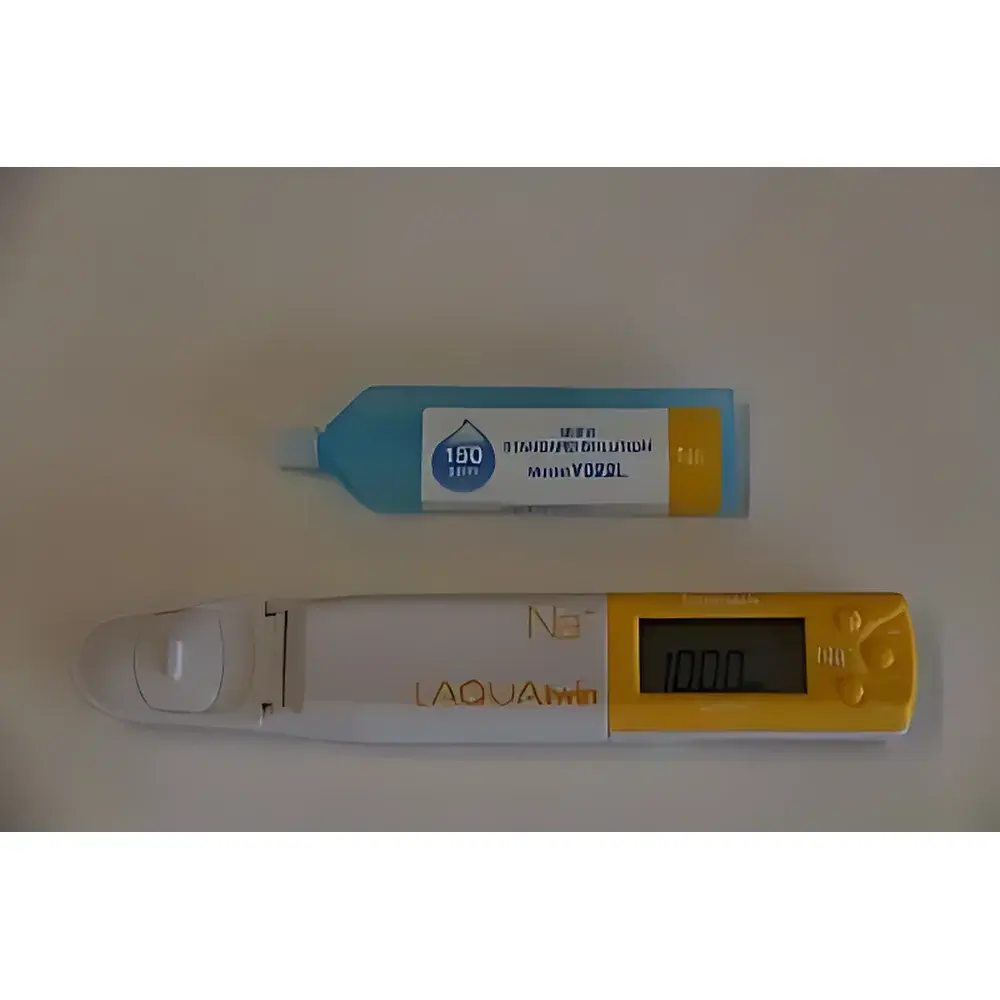
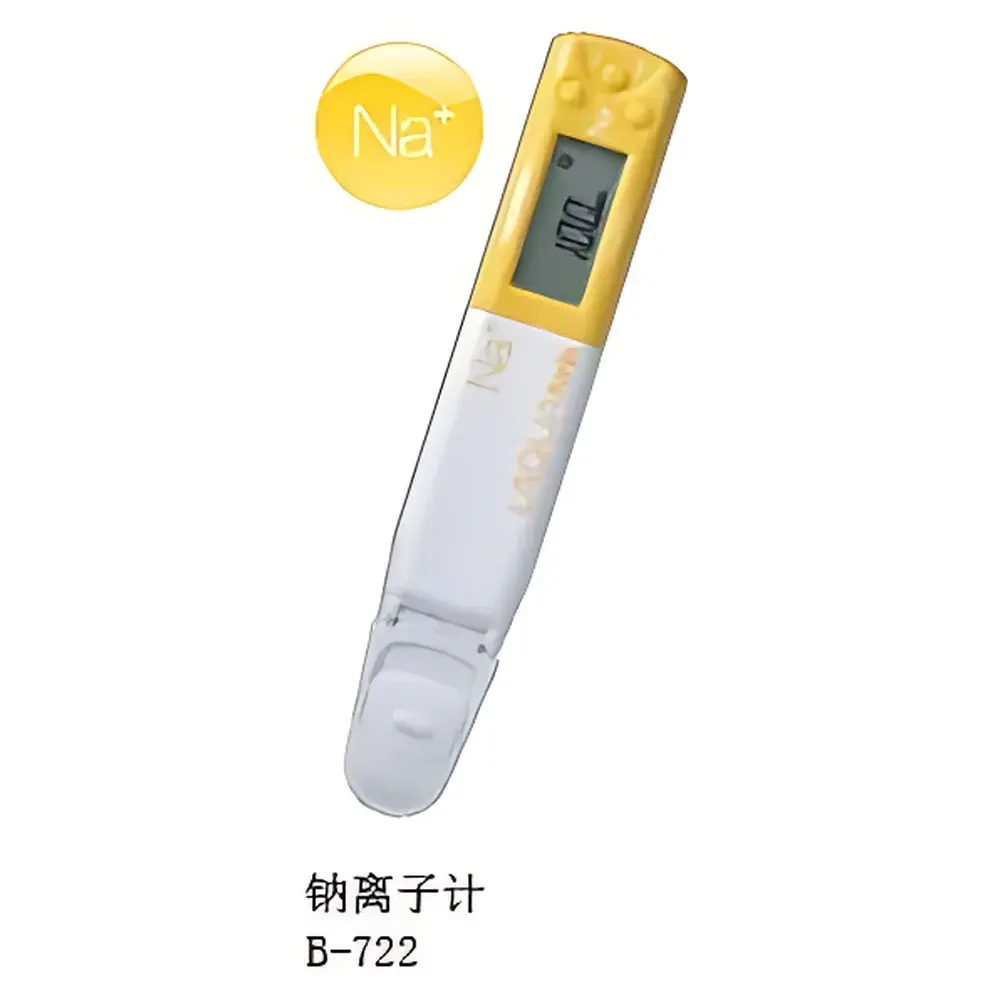
HORIBA B-722 Portable Pen-Type Sodium Ion Analyzer
| Brand | HORIBA |
|---|---|
| Origin | Japan |
| Model | B-722 |
| Measurement Principle | Ion-Selective Electrode (ISE) Method |
| Measurement Range | 23–2300 ppm (mg/L) [1.0 × 10⁻³ – 1.0 × 10⁻¹ mol/L] |
| Minimum Sample Volume | 0.05 mL × 2 or ≥0.3 mL |
| Calibration | Two-Point Calibration |
| Accuracy | ±10% of reading |
| Temperature Compensation | Automatic (fixed coefficient: 2%/°C) |
| Auto-Hold Function | Yes |
| Ingress Protection Rating | IP67 |
| Operating Environment | 5–40 °C, <85% RH (non-condensing) |
| Power Supply | Two CR2032 batteries |
| Dimensions (L×W×H) | 164 × 29 × 20 mm (excl. protrusions) |
| Weight | Approx. 50 g (instrument only, batteries excluded) |
Overview
The HORIBA B-722 is a compact, handheld sodium ion analyzer engineered for rapid, on-site quantification of Na⁺ concentration in aqueous solutions using the potentiometric ion-selective electrode (ISE) principle. Designed around a solid-state sodium-selective membrane electrode, the instrument measures the potential difference between the sensing electrode and an integrated reference electrode, converting it into a stable, temperature-compensated concentration value in ppm (mg/L) or mol/L. Its pen-style form factor—measuring just 164 mm in length and weighing approximately 50 g—enables single-handed operation in field environments, process streams, wastewater treatment plants, boiler feedwater monitoring, and laboratory benchtop screening. Unlike lab-based benchtop ISE meters requiring bulky modules and external calibration stations, the B-722 integrates all critical electronics, power management, and signal conditioning into a sealed, ergonomic housing. The device complies with fundamental electrochemical measurement standards for portable ion analyzers, including ISO 10523 (water quality — determination of pH) and ASTM D1293 (standard test method for pH of water), while its operational methodology aligns with the principles outlined in ISO 17294-2 for ion chromatography validation frameworks.
Key Features
- True pen-type design optimized for portability and one-handed use in confined or remote sampling locations
- Integrated sodium-selective ISE sensor with stable response time (<60 seconds to 95% stability under standard conditions)
- Automatic temperature compensation using a built-in NTC thermistor (fixed 2%/°C coefficient per ISE Nernstian behavior)
- Auto-hold function freezes the stabilized reading upon signal convergence—critical for low-flow or static sampling points
- IP67-rated enclosure ensures full protection against dust ingress and immersion in up to 1 m of water for 30 minutes, enabling use in humid industrial zones or outdoor rain-exposed sites
- Two-point calibration protocol supports traceable adjustment using certified Na⁺ standard solutions (e.g., 100 ppm and 1000 ppm NaCl)
- Low-power architecture powered by two replaceable CR2032 coin cells, delivering >2000 measurements per battery set under typical usage
Sample Compatibility & Compliance
The B-722 is validated for direct measurement in clear, low-turbidity aqueous samples with total dissolved solids (TDS) < 5000 ppm and conductivity < 20 mS/cm. It is not intended for use in viscous, highly colored, or suspended-solid-laden matrices without prior filtration (e.g., 0.45 µm membrane). Interference from high concentrations of potassium (K⁺), lithium (Li⁺), or ammonium (NH₄⁺) ions may occur above 100-fold molar excess relative to Na⁺; users are advised to assess matrix effects per ISO/IEC 17025:2017 Clause 7.2.2. The instrument meets CE marking requirements for electromagnetic compatibility (EN 61326-1) and safety (EN 61010-1). While not FDA 21 CFR Part 11 compliant as a standalone device (lacking audit trail or electronic signature capability), it supports GLP-compliant workflows when paired with documented manual recording procedures and calibrated reference standards traceable to NIST SRM 3192a (Sodium Chloride Solution).
Software & Data Management
The B-722 operates as a stand-alone measurement tool with no onboard data logging or Bluetooth/Wi-Fi connectivity. All readings are displayed on a high-contrast LCD screen and must be manually recorded. For regulated environments requiring data integrity, users integrate the instrument into existing LIMS or ELN systems via standardized observation templates. Calibration records—including date, operator ID, standard lot numbers, and measured mV offsets—must be maintained externally per ISO/IEC 17025 Clause 7.7. Firmware is non-upgradable; performance verification is conducted annually using control samples within the 100–1000 ppm Na⁺ range per internal SOP-QC-08.
Applications
- Boiler water and steam condensate monitoring for sodium breakthrough detection in power generation facilities
- Drinking water distribution system surveillance, especially post-desalination or ion exchange unit outlets
- Environmental field testing of surface water, groundwater, and estuarine samples for salinity-related Na⁺ loading
- Pharmaceutical water system qualification (Purified Water, Water for Injection) per USP guidance
- Educational laboratories demonstrating selective ion detection principles and Nernst equation applications
- Food & beverage process water checks where sodium carryover affects product formulation consistency
FAQ
What sample volume is required for a valid measurement?
A minimum of 0.05 mL applied twice (i.e., two sequential 50 µL aliquots) or a single volume ≥0.3 mL is required to ensure full electrode immersion and stable potential development.
Can the B-722 measure sodium in seawater?
No. Seawater (≈10,500 ppm Na⁺) exceeds the upper measurement limit of 2300 ppm. Dilution is not recommended due to increased uncertainty from dilution error and altered ionic strength effects on ISE response.
Is electrode replacement possible by the user?
Yes—the sodium ISE sensor is a field-replaceable module (HORIBA Part No. 9301-01B). Replacement requires recalibration and verification per manufacturer’s instructions.
Does the device comply with ISO 5667-3 for water sampling?
The B-722 itself does not perform sampling but supports compliance when used with ISO 5667-3–approved containers and handling protocols for Na⁺-specific analysis.
How often should calibration be performed?
Calibrate before each measurement session, after electrode cleaning, or when ambient temperature changes exceed ±5 °C—whichever occurs first.







