
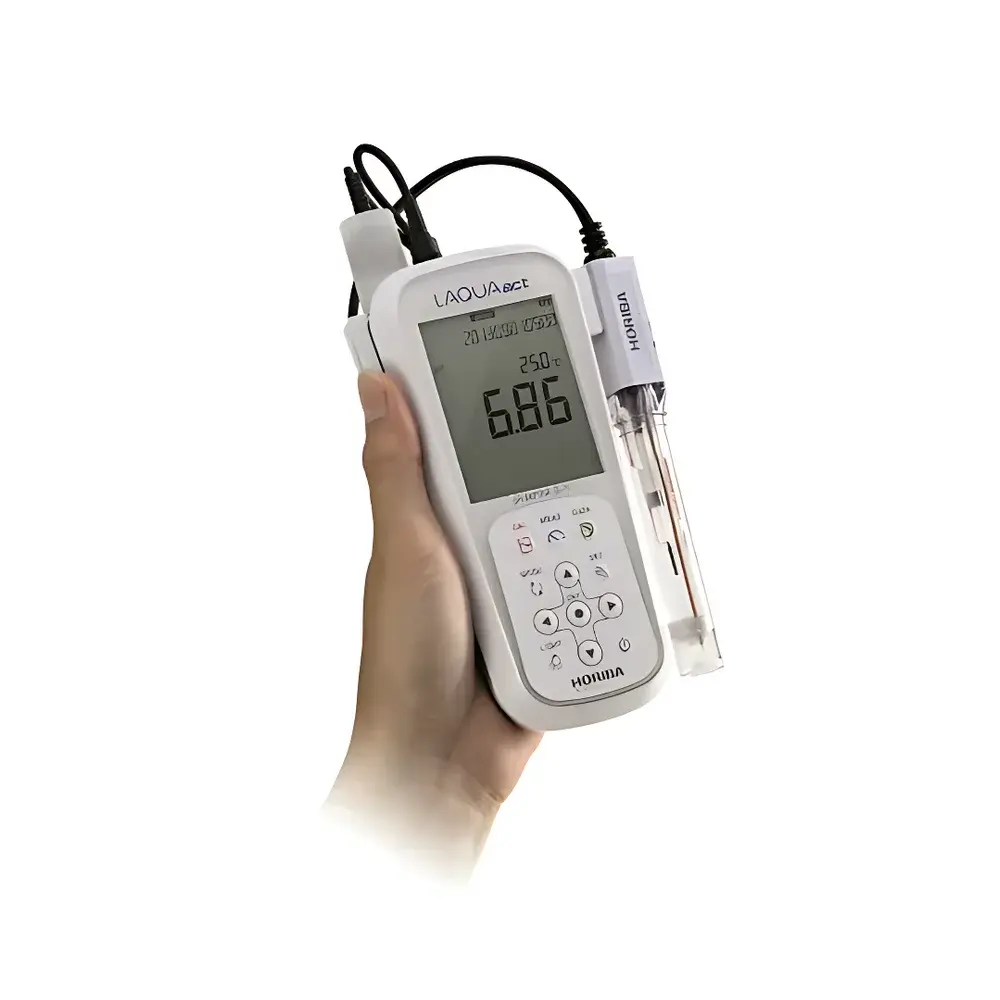
HORIBA LAQUAact D-71 Portable Multiparameter Water Quality Analyzer
| Brand | HORIBA |
|---|---|
| Origin | Japan |
| Model | D-71 |
| Instrument Type | Portable/Handheld Water Quality Analyzer |
| Measured Parameters | pH, mV (ORP), Ion Concentration, Conductivity, Resistivity, Salinity, Total Dissolved Solids (TDS) |
| IP Rating | IP67 |
| Display | Backlit LCD with Capacitive Touchscreen |
| Data Storage | 1,000 measurement records |
| Power Supply | AAA alkaline batteries, Ni-MH rechargeable batteries, or AC adapter |
| Compliance | JIS Z 8401 (pH), JIS K 0101 (conductivity), NIST-traceable calibration support |
| Calibration | Auto-calibration assist, 5-point pH calibration, automatic range switching & temperature compensation for conductivity, salinity/TDS/resistivity auto-conversion |
Overview
The HORIBA LAQUAact D-71 is a rugged, field-deployable multiparameter water quality analyzer engineered for high-reliability measurements across diverse environmental, municipal, and industrial monitoring applications. Based on electrochemical sensing principles—including glass electrode potentiometry for pH/ORP, ion-selective electrode (ISE) methodology for specific ion quantification, and four-electrode conductivity cell technology for precise conductance measurement—the D-71 delivers traceable, reproducible data under variable ambient conditions. Its compact, IP67-rated enclosure ensures operational integrity during immersion, rain exposure, or dust-laden deployments—making it suitable for wastewater outfalls, surface water surveys, aquaculture management, and drinking water distribution system verification. The instrument complies with Japanese Industrial Standards (JIS Z 8401 for pH and JIS K 0101 for conductivity) and supports NIST-traceable calibration protocols required for regulatory reporting and QA/QC documentation.
Key Features
- Capacitive touchscreen interface with chemically resistant tempered glass display—enables intuitive operation while wearing gloves and resists corrosion from reagents or field contaminants
- Dual-channel simultaneous measurement and real-time display of two independent parameters (e.g., pH + conductivity or ORP + TDS)
- Integrated self-diagnostic system that evaluates electrode health post-calibration and provides visual status indicators for sensor readiness
- Automated calibration assistance including step-by-step on-screen guidance, slope/mV offset validation, and 5-point pH calibration capability aligned with both USA and NIST standard buffer sets
- Intelligent conductivity module with automatic range switching, built-in temperature compensation (ATC), pressure- and salinity-corrected dissolved oxygen calculation (when paired with optional OM-71 probe), and real-time conversion between conductivity, resistivity, salinity, and TDS using configurable conversion factors
- Extended data logging capacity—stores up to 1,000 timestamped records with sample ID tagging, date/time stamping, and user-defined annotation fields
Sample Compatibility & Compliance
The D-71 is validated for aqueous matrices ranging from ultrapure water (resistivity >18.2 MΩ·cm) to high-salinity seawater (up to 45 ppt). It accommodates standard 12-mm diameter combination pH electrodes, interchangeable ISEs (e.g., Na⁺, K⁺, NH₄⁺, NO₃⁻), and toroidal or graphite conductivity cells optimized for fouling-prone environments. All measurement algorithms adhere to internationally recognized methodologies: pH per ISO 3696 and ASTM D1293; conductivity per ISO 7888 and ASTM D1125; and dissolved oxygen (with OM-71 accessory) per ISO 5814 and APHA Standard Methods 4500-O. The device supports GLP-compliant workflows through audit-trail-capable data export (via USB or optional Bluetooth module) and meets requirements for field instrumentation under EPA Method 150.1 (conductivity), 150.2 (pH), and 150.3 (dissolved oxygen).
Software & Data Management
Data retrieval and configuration are managed via HORIBA’s LAQUA Connect PC software (Windows-compatible), which enables secure export in CSV, Excel, or PDF formats with embedded metadata (operator ID, location tag, calibration history). The software enforces structured data governance: all calibration events are time-stamped and logged with reference values, slopes, and offsets; measurement records include GPS coordinates when synchronized with compatible external modules. Exported files retain digital signatures and are compliant with FDA 21 CFR Part 11 requirements when used with appropriate system validation packages and user access controls. Firmware updates are delivered via signed binary packages to ensure integrity and version traceability.
Applications
- Regulatory compliance monitoring at wastewater treatment plant effluent discharge points (NPDES permit tracking)
- In-field assessment of source water quality prior to treatment—especially for pH stability, ionic load, and conductivity-driven scaling potential
- Aquaculture pond management—real-time tracking of pH diurnal shifts, ammonia-N via ISE, and salinity fluctuations affecting osmoregulation
- Environmental impact assessments (EIA) requiring rapid, multi-parameter profiling across transects or depth profiles
- Drinking water distribution network surveillance—detecting corrosion-induced pH anomalies or conductivity spikes indicating pipe leaching
- Educational laboratory use where portability, ease of calibration, and pedagogical interface design support undergraduate analytical chemistry curricula
FAQ
Does the D-71 support GLP-compliant data handling?
Yes—when used with LAQUA Connect software and configured with user authentication, electronic signatures, and audit-trail logging, the system meets core GLP data integrity requirements.
Can the D-71 perform automatic temperature compensation for all parameters?
It applies automatic temperature compensation (ATC) to pH, conductivity, resistivity, salinity, and TDS measurements using an integrated Pt1000 thermistor; dissolved oxygen compensation requires optional OM-71 probe with barometric and salinity inputs.
Is the instrument certified for use in hazardous locations?
No—the D-71 is not intrinsically safe or ATEX-certified; it is rated for general-purpose environmental use per IP67 but not for explosive atmospheres.
What battery life can be expected during continuous field operation?
With AAA alkaline batteries, typical runtime exceeds 200 hours in standby mode and 10–15 hours under active measurement cycling (including backlight and data logging).
Are calibration standards included with the instrument?
No—calibration buffers and standard solutions must be procured separately; HORIBA recommends certified NIST-traceable standards (e.g., pH 4.01/7.00/10.01, 1413 µS/cm KCl) for metrological continuity.







