
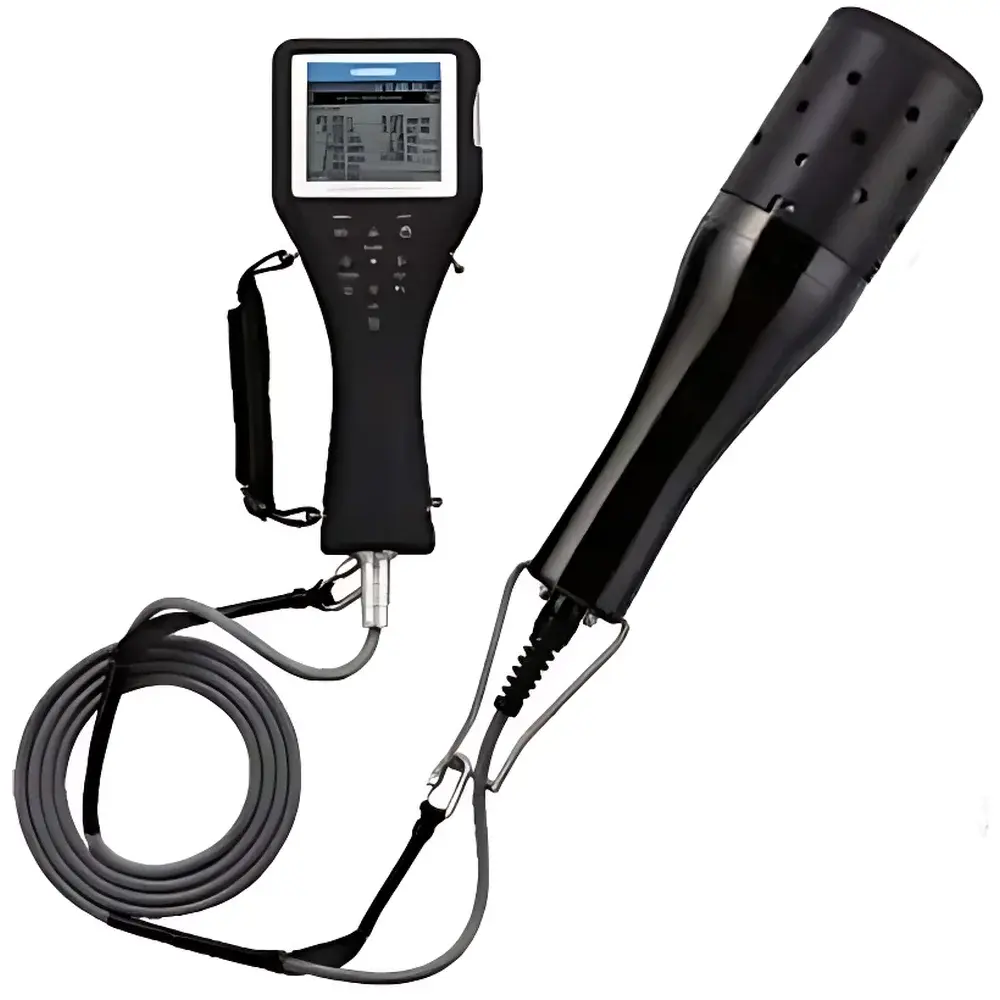
HORIBA U-50 Series Portable Multi-Parameter Water Quality Analyzer
| Brand | HORIBA |
|---|---|
| Origin | Japan |
| Model | U-50 Series (U-51/U-52/U-52G/U-53/U-53G/U-54/U-54G) |
| Instrument Type | Handheld Portable Water Quality Analyzer |
| Measurable Parameters | pH, ORP, Dissolved Oxygen (DO), Conductivity, Salinity, TDS, Specific Gravity (Seawater), Temperature, Turbidity (LED or Tungsten Lamp), Depth (pressure-based, up to 30 m), GPS (U-52G/U-53G/U-54G models) |
| Turbidity Standards | US EPA Method (U-53/U-53G), EN ISO 7027 (U-54/U-54G) |
| Turbidity Resolution | 0.01 NTU |
| IP Rating | IP67 (instrument), IP68 (probe) |
| Operating Temperature | –5 °C to +45 °C |
| Storage Temperature | –10 °C to +60 °C |
| Battery Life | Up to 70 hours (alkaline AA ×4, backlight off) |
| Data Storage | 10,000 measurement sets |
| Communication | USB |
| Display | 320 × 240 monochrome LCD with backlight |
Overview
The HORIBA U-50 Series is a rugged, field-deployable multi-parameter water quality analyzer engineered for high-reliability environmental monitoring in diverse aquatic environments—including rivers, lakes, groundwater wells, wastewater treatment plants, and coastal zones. Built on HORIBA’s legacy of electrochemical and optical sensor engineering, the U-50 platform integrates seven core sensor modalities—glass electrode (pH), platinum redox electrode (ORP), Clark-type polarographic DO sensor, four-electrode AC conductivity cell, NIST-traceable temperature sensor (Pt1000, JIS Class B), dual-wavelength turbidity optics (LED or tungsten lamp), and piezoresistive pressure transducer (depth)—into a single handheld architecture. Each sensor operates with factory-calibrated analog signal conditioning and digital compensation algorithms, ensuring consistent accuracy across variable thermal and ionic conditions. The system supports automatic temperature compensation (ATC) for all parameters and employs dual-point calibration protocols compliant with ASTM D1293 (pH), ASTM D3693 (ORP), ASTM D888 (DO), and ISO 7888 (conductivity). Its modular probe design allows configuration-specific deployment—enabling users to select optimal turbidity detection geometry (90° forward-scatter LED for freshwater, 90° side-scatter tungsten for turbid estuarine or wastewater matrices) and depth-rated pressure sensing (up to 30 m) without sacrificing portability or operational continuity.
Key Features
- Ruggedized industrial design: Probe housing constructed from PPS, PEEK, SUS316L stainless steel, titanium, and FEP membrane; rated IP68 submersion (30 m, 24 h); instrument body rated IP67.
- Multi-language interface: On-device display supports English, Japanese, Russian, Spanish, and Portuguese—optimized for international field teams and regulatory reporting consistency.
- Simultaneous real-time display of up to 11 parameters: pH, pH(mV), ORP, dissolved oxygen (mg/L & % saturation), conductivity (S/m or mS/cm), salinity (ppt), TDS (g/L), seawater specific gravity (δt), temperature (°C), turbidity (NTU), and depth (m).
- Turbidity compliance flexibility: U-53/U-53G probes conform to US EPA Method 180.1 (LED 30° forward scatter); U-54/U-54G probes comply with EN ISO 7027 (90° nephelometric detection using tungsten lamp)—ensuring data acceptability under regional regulatory frameworks.
- Integrated mechanical cleaning brush (U-53G/U-54G): Reduces biofouling-induced drift during extended immersion or high-sediment deployments.
- GPS geotagging (U-52G/U-53G/U-54G models): 12-channel receiver enables precise spatial referencing of measurements for GIS integration and longitudinal site tracking per ISO 14001 or EPA WQX requirements.
- Long-duration field operation: Powered by four standard AA alkaline batteries (no proprietary packs); 70-hour runtime at 20 °C with backlight disabled; data retention preserved during battery replacement.
Sample Compatibility & Compliance
The U-50 Series is validated for use across natural and anthropogenic water matrices—including low-ionic freshwater (pH 4–10, conductivity < 1 mS/cm), brackish estuaries (salinity up to 70 ppt), municipal wastewater effluents (turbidity ≤1000 NTU), and seawater (specific gravity δ15 up to 50 δt). Sensor materials resist corrosion from chloride, sulfide, and organic solvents commonly encountered in industrial discharge monitoring. All measurement protocols align with internationally recognized standards: pH and ORP per ASTM D1293 and D3693; dissolved oxygen per ASTM D888-22 (membrane-covered polarographic method); conductivity and salinity per ISO 7888 and ASTM D1125; turbidity per US EPA 180.1 (U-53 series) or EN ISO 7027:2016 (U-54 series). The system supports GLP-compliant audit trails when paired with HORIBA’s optional LabSTATION software, including electronic signature capability and 21 CFR Part 11–ready data export formats (CSV, XML).
Software & Data Management
Measurements are stored onboard in non-volatile memory (10,000 datasets) with timestamp, GPS coordinates (where equipped), operator ID, and sensor status flags (e.g., “calibration due”, “probe fouled”). Data transfer occurs via USB 2.0 to Windows-compatible PCs running HORIBA’s free LabSTATION software—supporting automated report generation (PDF/Excel), statistical analysis (mean, SD, min/max per parameter), trend visualization, and batch calibration management. LabSTATION enforces secure user authentication, change logging, and version-controlled method templates aligned with ISO/IEC 17025 documentation requirements. Raw sensor voltage outputs and compensated values are retained separately, enabling retrospective reprocessing using updated calibration coefficients or temperature algorithms without re-measurement.
Applications
- Regulatory compliance monitoring: EPA NPDES permit verification, EU Water Framework Directive (WFD) status assessment, and China’s GB 3838–2002 surface water classification.
- Drinking water source protection: Real-time detection of pH anomalies, ORP shifts indicating microbial activity, and turbidity spikes signaling watershed disturbance.
- Wastewater process control: Aeration basin DO profiling, influent/effluent conductivity tracking for load estimation, and clarifier effluent turbidity validation against discharge limits.
- Ecological field studies: Longitudinal river transects with GPS-synchronized profiles; groundwater–surface water interaction mapping via salinity and temperature gradients.
- Emergency response: Rapid deployment for post-spill assessment (e.g., acid mine drainage pH/ORP screening, hydrocarbon-induced DO suppression).
FAQ
What turbidity standards does the U-50 support, and how do I select the appropriate probe?
The U-53 and U-53G probes implement US EPA Method 180.1 (LED-based 30° forward scatter) and are recommended for clean to moderately turbid freshwater. The U-54 and U-54G probes comply with EN ISO 7027 (tungsten lamp, 90° nephelometry) and are optimized for high-turbidity matrices such as wastewater, estuaries, and sediment-laden rivers.
Does the U-50 require routine maintenance beyond calibration?
Yes. The polarographic DO membrane requires periodic replacement (typically every 6–12 months depending on usage), and the turbidity window should be cleaned before each deployment. Models with the integrated cleaning brush (U-53G/U-54G) reduce manual intervention frequency but do not eliminate it.
Can the U-50 meet GLP or 21 CFR Part 11 requirements?
While the instrument itself is not individually certified, its data integrity architecture—combined with LabSTATION software—supports implementation of ALCOA+ principles (Attributable, Legible, Contemporaneous, Original, Accurate). Full 21 CFR Part 11 compliance requires site-specific validation of the complete workflow, including user access controls, electronic signatures, and audit trail review procedures.
How is temperature compensation handled across parameters?
Each sensor includes a Pt1000 temperature element co-located within the probe. Compensation algorithms apply NIST-traceable polynomial functions per parameter: DIN EN 60751 for conductivity, ASTM D888 Annex A3 for DO, and ISO 7888 Annex B for salinity—ensuring accuracy across –10 °C to +55 °C operating range.
Is depth measurement available on all U-50 models?
No. Depth functionality is exclusive to U-52G, U-53G, and U-54G variants, utilizing a calibrated piezoresistive pressure sensor with ±0.3 m absolute accuracy and 0.05 m resolution up to 30 m. U-51 and U-52 lack this module.







