
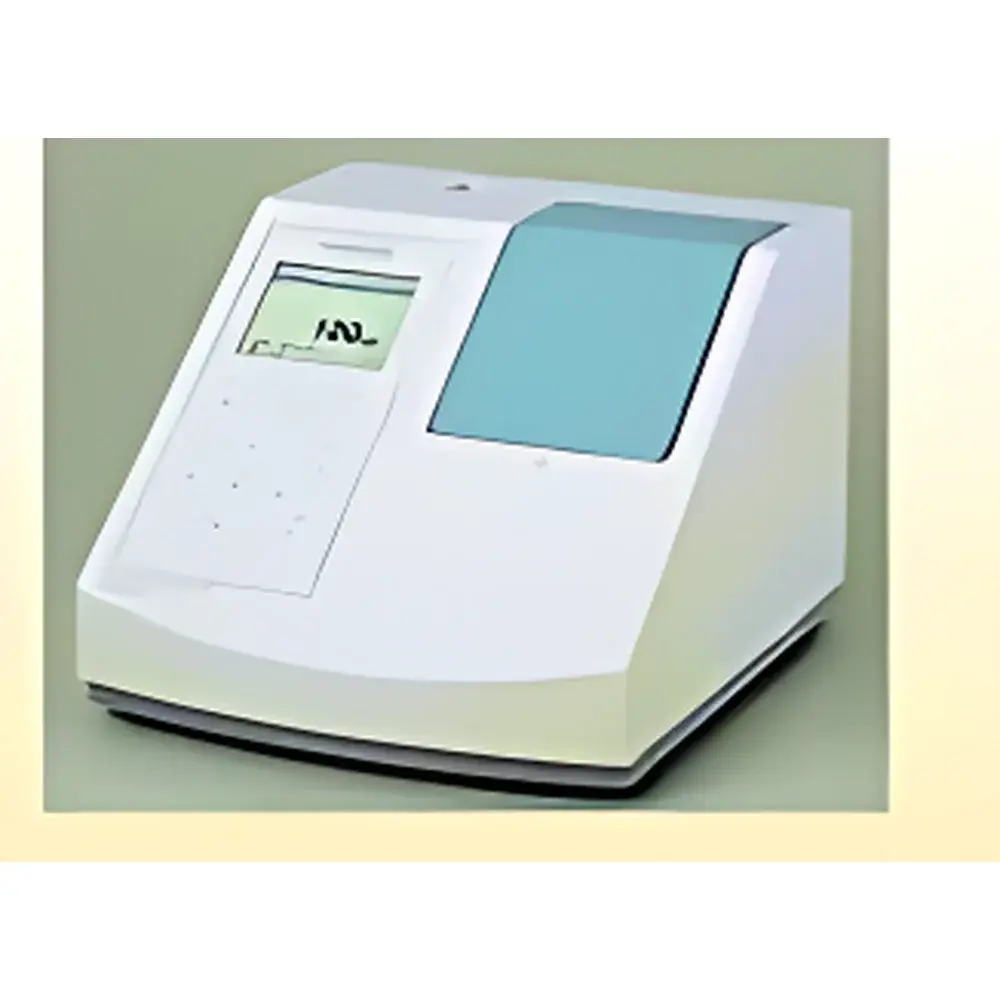
HORIBA OCMA-555 Portable Oil Content Analyzer
| Brand | HORIBA |
|---|---|
| Origin | Japan |
| Model | OCMA-555 |
| Instrument Type | Portable |
| Measurement Principle | Non-Dispersive Infrared (NDIR) Absorption at ~3.4 µm |
| Measurement Ranges | 0–200 mg/L, 0–1000 mg/kg, 0–1 Abs |
| Detection Limit | 0.1 mg/L |
| Accuracy | ±1% of reading (for aqueous phase) |
| Resolution | 0.1 mg/L (0–99.9 mg/L range) |
| Repeatability | ±0.4 mg/L ±1 digit (0–9.9 mg/L), ±2.0 mg/L ±1 digit (10.0–99.9 mg/L), ±4 mg/L ±1 digit (100–200 mg/L), ±1% F.S. (0–1 Abs) |
| Detector | Thermoelectric (Thermopile) Sensor |
| Display | Backlit LCD with timestamping |
| Data Interface | RS-232C port and parallel printer port |
| Power Supply | 230 V AC, 50 Hz |
| Dimensions | 250 × 200 × 285 mm (W × H × D) |
| Standard Accessories | Quartz cuvette with lid, power cord, heavy oil standard (B-grade), 2 A fuse, 10 mL syringe, 25 µL syringe |
| Optional Accessory | Solvent Regenerator SR-305 |
Overview
The HORIBA OCMA-555 is a portable, field-deployable oil content analyzer engineered for rapid, quantitative determination of hydrocarbon contamination in water, soil extracts, and surface residues. It employs non-dispersive infrared (NDIR) absorption spectroscopy centered at the characteristic C–H stretching vibration band near 3.4 µm — a spectral region where hydrocarbons exhibit strong, selective absorbance while common extraction solvents such as HORIBA’s proprietary H-997 remain optically transparent. This spectral specificity eliminates interference from solvent matrix effects and enables direct quantification without spectral deconvolution or multivariate calibration. The instrument is designed for compliance with standard environmental testing protocols requiring trace-level hydrocarbon detection, including EPA Method 1664 (revision B) and ISO 9377-2 (petroleum hydrocarbons in water), and supports GLP-aligned data integrity through built-in timestamping and digital output logging.
Key Features
- Triple-unit measurement capability: seamlessly switch between concentration units — mg/L (aqueous phase), mg/kg (soil extract), or absorbance (Abs) — via front-panel selection, eliminating manual unit conversion errors.
- Integrated thermoelectric (thermopile) detector ensures stable, drift-free signal acquisition across ambient temperature fluctuations typical in field environments (10–40 °C operating range).
- Backlit monochrome LCD display with real-time timestamping supports on-site documentation without external devices; all measurements are tagged with date and time automatically.
- Single-button operation after sample introduction: once the H-997-extracted oil/solvent solution is loaded into the quartz cuvette, analysis initiates with one press — no software setup or wavelength alignment required.
- Compact footprint (250 × 200 × 285 mm) and 230 V AC operation enable deployment in mobile labs, wastewater treatment control rooms, and remote remediation sites without auxiliary power conditioning.
- RS-232C serial interface allows bidirectional communication with laboratory information management systems (LIMS) or PCs for automated report generation and audit trail archiving.
Sample Compatibility & Compliance
The OCMA-555 is validated for use with liquid-phase samples prepared via solvent extraction using HORIBA H-997 — a non-polar, IR-transparent solvent optimized for aliphatic and aromatic hydrocarbon recovery. It accommodates both aqueous effluents (e.g., industrial discharge, leachate, cooling water) and solid-phase extractions (e.g., soil, sediment, swabbed metal surfaces) when processed per ASTM D7066 or ISO 11500 guidelines. The instrument meets functional requirements for routine monitoring under ISO/IEC 17025-accredited laboratories and supports 21 CFR Part 11 readiness when paired with compliant LIMS software (audit trail, electronic signature, and data immutability features implemented externally). Its ±1% accuracy specification aligns with USP performance expectations for hydrocarbon quantitation in pharmaceutical manufacturing utilities.
Software & Data Management
While the OCMA-555 operates as a standalone instrument with embedded firmware, its RS-232C interface enables integration into structured data workflows. Raw absorbance values and calculated concentrations are transmitted as ASCII strings with fixed-field formatting, facilitating parsing by third-party data acquisition tools. Timestamped records can be exported in CSV-compatible format for trend analysis, regulatory submission (e.g., NPDES reporting), or QC charting (X-bar/R charts). Optional solvent regeneration system SR-305 — featuring dual-stage activated carbon and activated alumina columns — extends H-997 usability over >200 extractions, reducing solvent consumption and waste disposal burden in high-throughput labs.
Applications
- Real-time monitoring of oily wastewater discharge compliance at industrial outfalls (e.g., automotive, metalworking, textile facilities).
- Field screening of contaminated soils during Phase II environmental site assessments (ESAs) and brownfield redevelopment projects.
- Validation of cleaning efficacy in precision engineering: quantifying residual cutting oils on semiconductor wafers, aerospace components, or medical device substrates.
- Quality assurance of recycled coolant and quenching oils in heat-treatment operations.
- Regulatory testing of produced water in upstream oil & gas operations per API RP 45 or OSPAR Commission standards.
FAQ
What extraction solvent is required for OCMA-555 operation?
HORIBA H-997 solvent is mandatory — it exhibits negligible IR absorption at 3.4 µm, ensuring selective detection of hydrocarbon analytes without baseline interference.
Can the OCMA-555 measure total petroleum hydrocarbons (TPH) directly?
Yes — when used with standardized extraction protocols (e.g., EPA 3550C + 3510C), it delivers TPH-equivalent results calibrated against reference heavy oil standards supplied with the instrument.
Is the quartz cuvette included with the system autoclavable?
No — the supplied fused-silica cuvette is chemically resistant but not rated for steam sterilization; cleaning is performed with H-997 rinse followed by nitrogen purge.
Does the instrument support multi-point calibration?
It performs automatic zero and span verification upon startup using internal optical references; full calibration requires only a single-point standard (B-grade heavy oil) per batch of samples.
How is measurement traceability maintained?
Each unit ships with NIST-traceable calibration documentation for the B-grade oil standard; users are responsible for maintaining in-house calibration logs per ISO/IEC 17025 clause 6.4.
Related Products







