
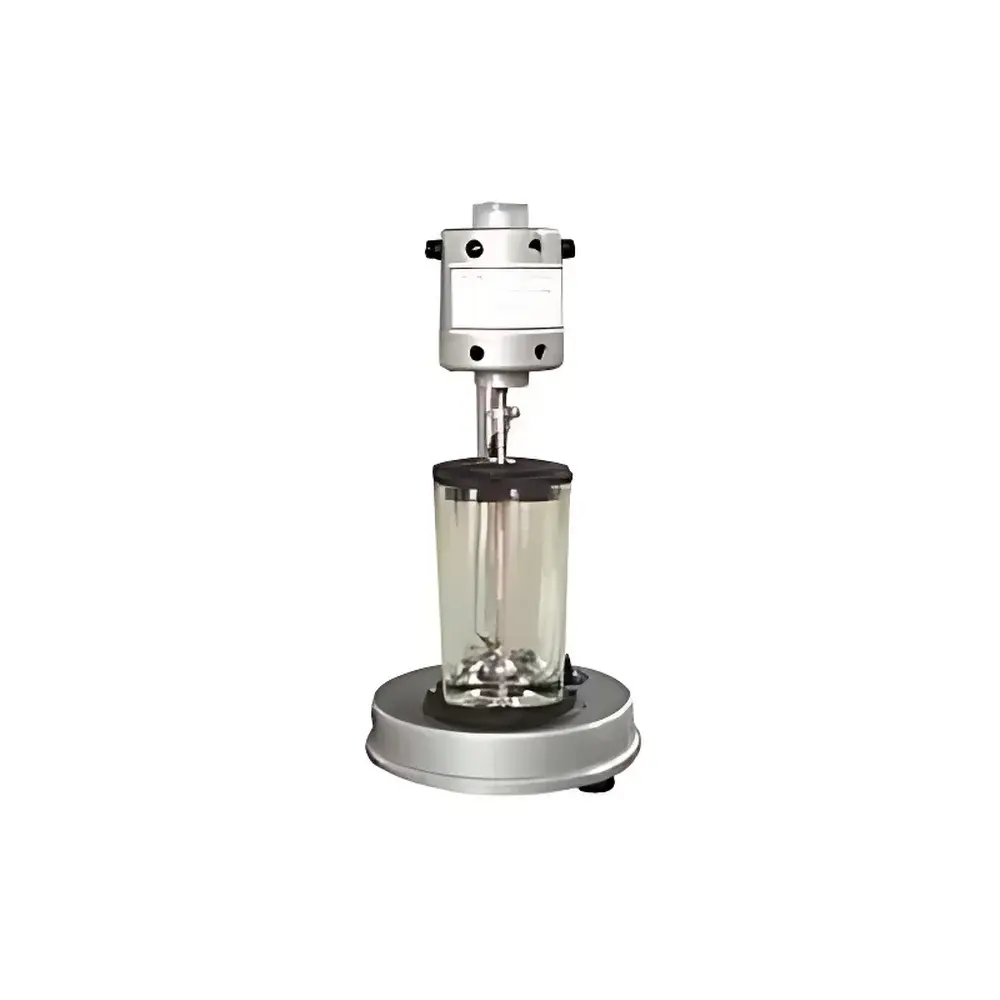
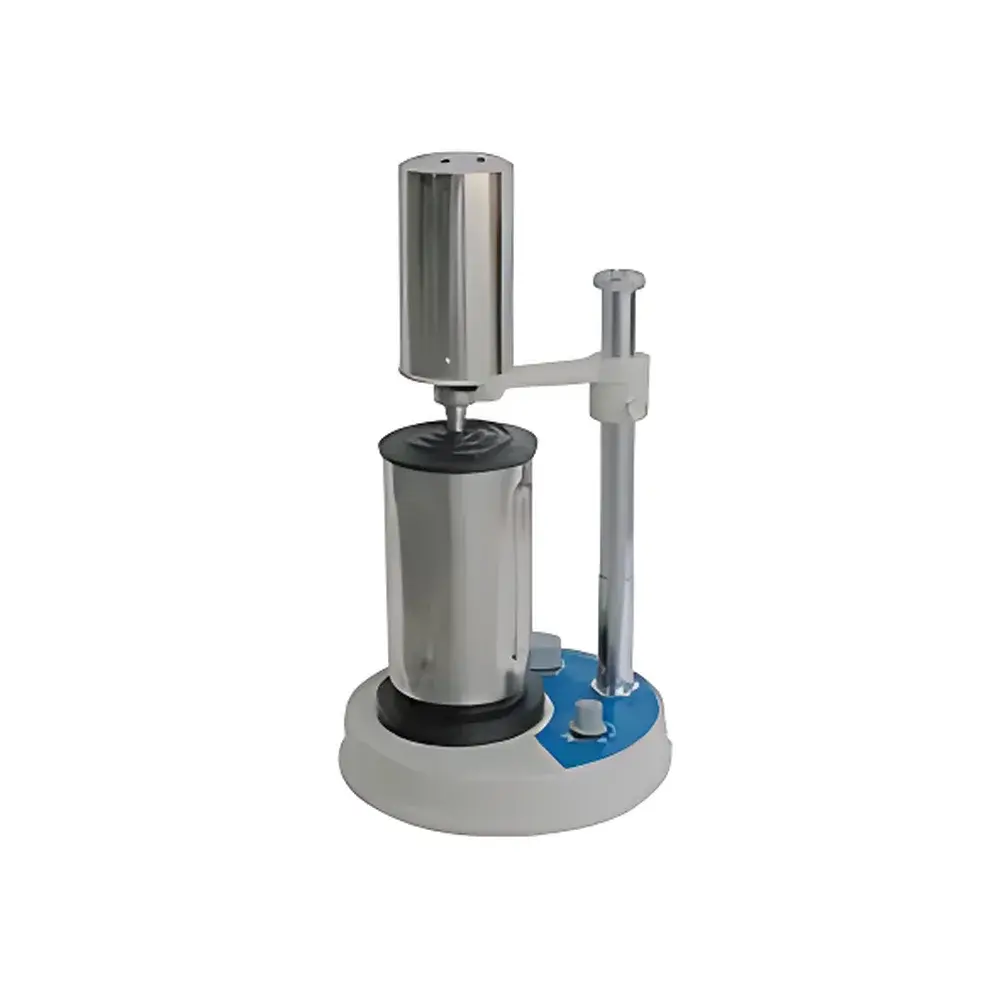
Hanuo JJ-2B High-Speed Tissue Homogenizer
| Brand | Hanuo |
|---|---|
| Origin | Shanghai, China |
| Model | JJ-2B |
| Instrument Type | Benchtop Homogenizer |
| Instrument Category | Tissue Disruption Homogenizer |
| Sample Processing Volume | 1000 mL |
| Output Power | 220 W |
| Speed Range | 0–12000 rpm (Continuously Variable) |
| Power Supply | 220 V, 50 Hz |
| Net Weight | 7.5 kg |
| Dimensions (L×W×H) | 48 × 24 × 24 cm |
| Construction | 304 Stainless Steel Body & Tempered Glass Homogenizing Cup |
| Speed Control | Dual-Range Electronic Regulator (High/Low) |
| Drive Coupling | Removable Shaft Coupler for Easy Blade Assembly/Disassembly |
Overview
The Hanuo JJ-2B High-Speed Tissue Homogenizer is a benchtop mechanical homogenization system engineered for rapid, reproducible disruption of soft to semi-fibrous biological tissues, cell suspensions, and emulsifiable matrices. It operates on the principle of high-shear rotor-stator homogenization: a precisely balanced stainless steel blade assembly rotates within a tempered glass chamber at speeds up to 12,000 rpm, generating intense hydrodynamic shear, cavitation, and impact forces that effectively lyse cells, homogenize viscous slurries, and reduce particle size distribution in heterogeneous samples. Designed for routine laboratory use rather than high-throughput or GMP-critical environments, the JJ-2B delivers consistent mechanical energy input across sample volumes up to 1000 mL—making it suitable for preparatory steps in nucleic acid extraction, protein solubilization, tissue digestion, and formulation development in academic, clinical, and industrial R&D settings.
Key Features
- Tempered glass homogenizing cup (1000 mL capacity) enables real-time visual monitoring of sample consistency, foam formation, and homogenization endpoint without interrupting operation.
- 304 stainless steel housing provides corrosion resistance, structural rigidity, and compatibility with common lab cleaning agents and alcohol-based disinfectants.
- Continuously variable electronic speed control (0–12000 rpm) allows precise adjustment to match sample viscosity, thermal sensitivity, and desired degree of cellular disruption—critical for preserving labile biomolecules such as enzymes or membrane receptors.
- Quick-release shaft coupling mechanism facilitates tool-free removal and reinstallation of the stainless steel blade assembly, minimizing cross-contamination risk between samples and enabling rapid sterilization via autoclaving or chemical immersion.
- Compact footprint (48 × 24 × 24 cm) and low power consumption (220 W) support integration into space-constrained fume hoods, biosafety cabinets, or shared instrumentation rooms without requiring dedicated electrical circuits.
Sample Compatibility & Compliance
The JJ-2B accommodates a broad range of soft-tissue specimens—including liver, spleen, brain, muscle, and cultured cell pellets—as well as non-biological materials such as food pastes, polymer dispersions, and pharmaceutical suspensions. It is not recommended for hard tissues (e.g., bone, cartilage), fibrous plant material, or highly abrasive particulates without pre-mechanical reduction. While not certified to ISO 13485 or FDA 21 CFR Part 11, its construction and operational repeatability align with general Good Laboratory Practice (GLP) expectations for exploratory research and method development. Users performing regulated work should validate homogenization efficiency per ASTM D4290 (Standard Practice for Evaluation of Homogenizers) or internal SOPs covering recovery yield, temperature rise (< 5 °C under standard 60-sec run), and inter-run coefficient of variation (CV < 8% for duplicate tissue lysates).
Software & Data Management
The JJ-2B operates as a standalone analog-controlled instrument with no embedded firmware, digital interface, or data logging capability. Speed setting is managed exclusively via front-panel potentiometer with dual-range selector (high/low), eliminating software dependencies and cybersecurity concerns. This architecture ensures long-term operational reliability, minimal maintenance, and full compatibility with Class II biosafety cabinets where electromagnetic interference or USB port restrictions apply. For traceable process documentation, users are advised to record speed, duration, and ambient temperature manually—or integrate external timers and thermal probes compliant with ISO/IEC 17025 calibration requirements.
Applications
- Pre-analytical sample preparation for downstream assays including qPCR, Western blotting, ELISA, and metabolomics profiling.
- Routine homogenization of rodent organ tissues in pharmacokinetic and toxicology studies.
- Dispersion of active pharmaceutical ingredients (APIs) in preformulation suspension studies.
- Cell lysis optimization trials for recombinant protein expression systems.
- Homogenization of food samples (e.g., dairy blends, fruit pulps) prior to rheological or microbiological testing.
FAQ
Is the JJ-2B suitable for sterile processing?
Yes—when equipped with autoclavable stainless steel blades and a borosilicate or tempered glass cup, the unit supports steam sterilization of wetted components at 121 °C for 20 minutes. The motor housing must remain unsterilized.
Can I use plastic homogenizing cups with this model?
No—the JJ-2B is calibrated and mechanically stabilized for use only with the supplied tempered glass cup. Substitution with polycarbonate or polypropylene vessels may cause imbalance, vibration-induced failure, or inconsistent shear delivery.
What maintenance is required for long-term performance?
Routine inspection of blade sharpness, coupling integrity, and bearing smoothness every 200 operating hours is recommended. Lubrication is not required; however, wiping the shaft seal area with isopropyl alcohol after each use prevents residue buildup.
Does the device comply with CE or UL safety standards?
The JJ-2B meets basic IEC 61010-1:2010 requirements for laboratory electrical equipment but does not carry CE marking or UL certification. It is intended for research-use-only (RUO) applications outside regulated manufacturing environments.
How is speed accuracy verified during qualification?
Speed calibration should be performed using a non-contact optical tachometer traceable to NIST standards. Deviation beyond ±3% of setpoint at any speed within the 3000–10,000 rpm range warrants recalibration of the internal potentiometer by authorized service personnel.



