
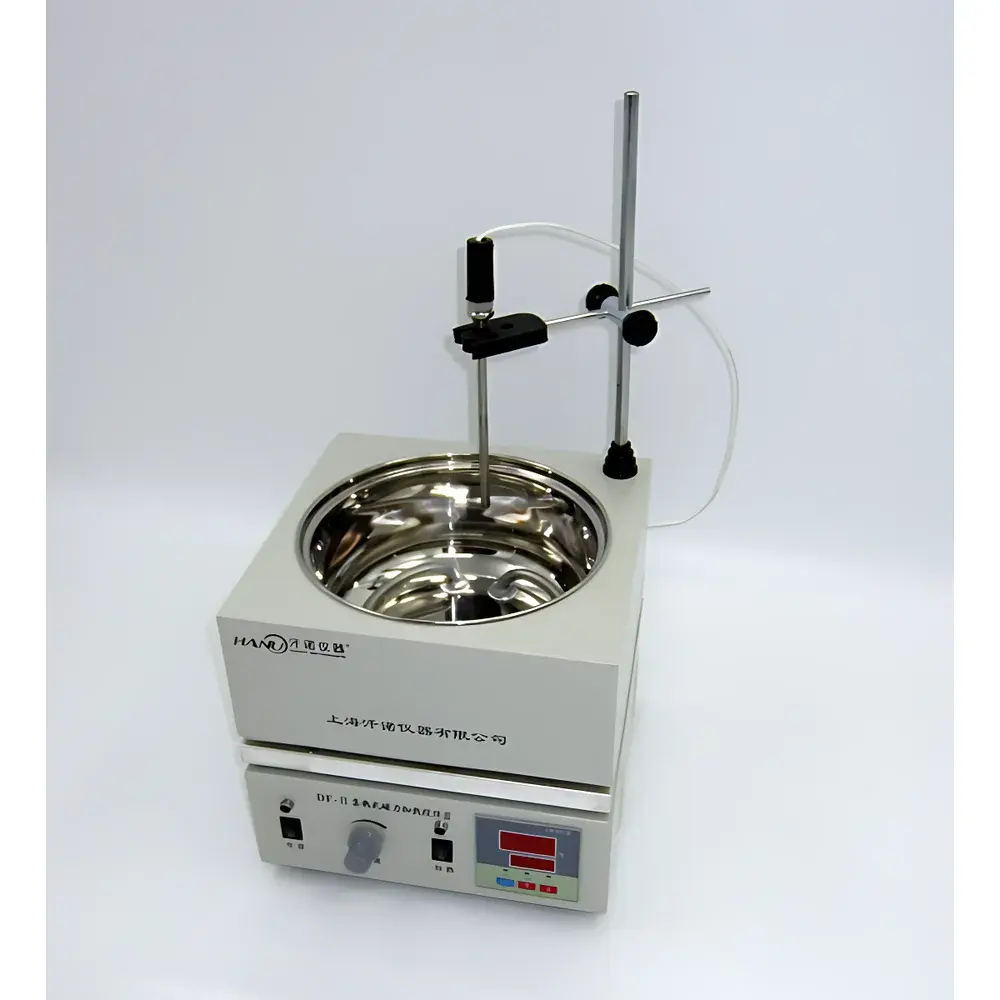
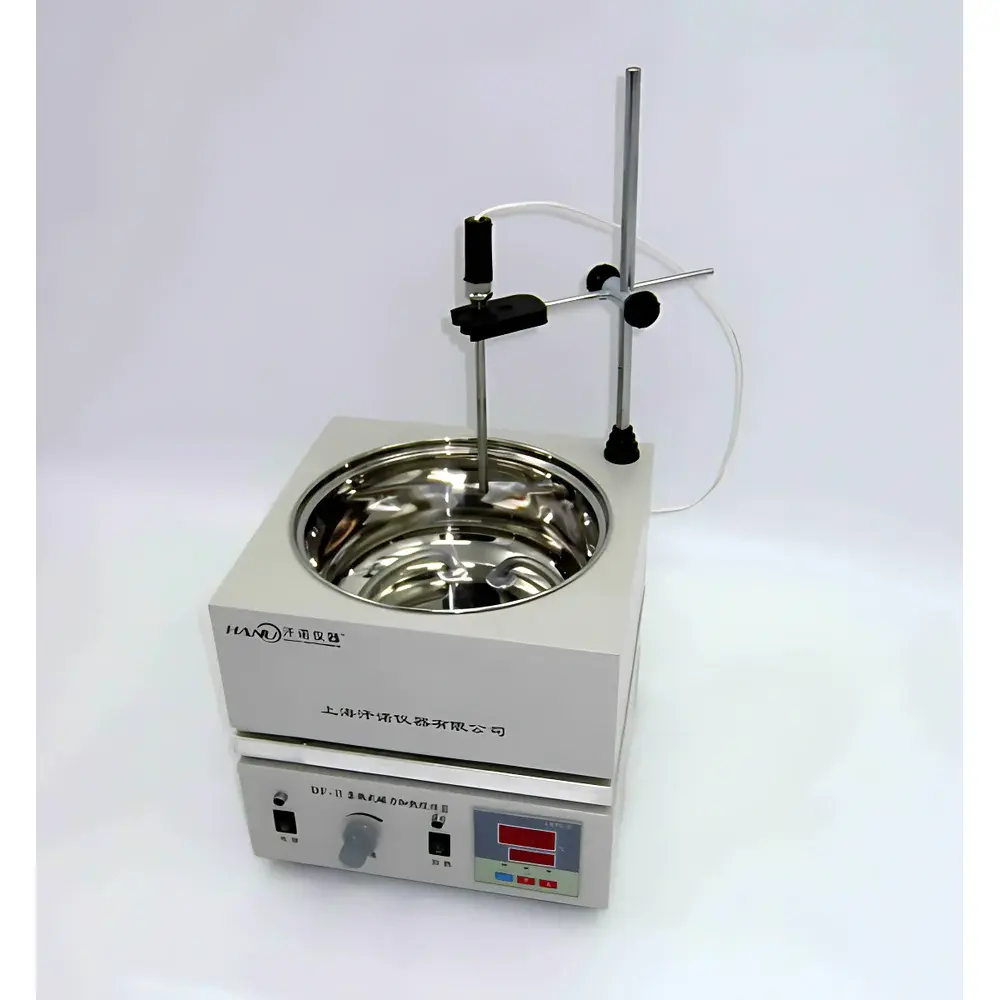
Hanuo DF-I Integrated Heating Magnetic Stirrer
| Brand | Hanuo |
|---|---|
| Origin | Shanghai, China |
| Model | DF-I |
| Stirrer Type | Magnetic Stirrer |
| Max. Stirring Volume | Not Specified |
| Speed Range | 0–2600 rpm |
| Temperature Control Range | Ambient to 300 °C |
| Heating Power | 600 W |
| Working Surface Dimensions | 18 × 18 × 13 cm (square) |
| Overall Dimensions | 25 × 30 × 28 cm |
| Display | Digital Temperature & Speed Control |
| Heating Modes | Water Bath, Oil Bath, Dry Heating |
| Material Compatibility | PTFE-coated stir bars, corrosion-resistant heating plate |
Overview
The Hanuo DF-I Integrated Heating Magnetic Stirrer is an engineered solution for laboratories requiring simultaneous precise temperature control and robust mechanical agitation under diverse thermal conditions. Unlike conventional hotplate stirrers with surface-conduction heating, the DF-I employs integrated radiant heating architecture—where the entire heating element is embedded beneath a ceramic-coated aluminum plate—to deliver uniform thermal distribution across the working surface. This design ensures rapid heat-up times, minimal thermal gradient across reaction vessels (including round-bottom flasks under vacuum or pressure), and stable setpoint maintenance within ±1.5 °C over extended operation. The device operates on the principle of magnetic coupling: a rotating permanent magnet array beneath the plate induces synchronous rotation in a PTFE-encapsulated stir bar immersed in the sample, enabling contactless mixing without shaft seals or mechanical drive penetration—critical for maintaining system integrity during inert-atmosphere, vacuum, or sealed-vessel reactions.
Key Features
- Integrated radiant heating system with 600 W power output, supporting ambient-to-300 °C operation with digital PID temperature regulation
- Digital dual-display interface showing real-time speed (rpm) and temperature (°C), with adjustable ramping and hold functions
- Uniform heating zone (18 × 18 cm square platform) optimized for standard round-bottom flasks (up to 2 L capacity), flat-bottom beakers, and jacketed reactors
- High-torque magnetic drive capable of sustaining stable rotation up to 2600 rpm—even with high-viscosity media (e.g., polymer solutions, molten salts, or viscous organic reaction mixtures)
- Ceramic-reinforced aluminum heating plate resistant to thermal shock, chemical splashes, and mechanical abrasion; compatible with water bath, silicone oil bath, and direct dry-heating protocols
- PTFE-coated stir bars included (standard sizes: 20 × 6 mm and 30 × 8 mm), rated for continuous use up to 300 °C and chemically inert toward acids, bases, and organic solvents
Sample Compatibility & Compliance
The DF-I accommodates a broad range of vessel geometries and materials—including borosilicate glass (e.g., Pyrex®, Duran®), stainless steel reactors, and quartz containers—without compromising thermal or rotational performance. Its open-platform configuration supports custom fixtures for reflux condensers, gas inlet/outlet adapters, or pressure-rated caps. While not certified to IEC 61010-1 as a standalone safety-certified instrument, the unit complies with general laboratory equipment requirements for electrical insulation, overtemperature cutoff (auto-shutdown at 320 °C), and electromagnetic compatibility (EMC Class B). It is routinely deployed in environments adhering to GLP documentation practices, where temperature and speed parameters are manually logged for audit trails; optional RS-232 output enables integration with LIMS for semi-automated data capture.
Software & Data Management
The DF-I operates as a stand-alone analog-digital hybrid controller with no embedded firmware or cloud connectivity. All operational parameters are set and monitored via front-panel push-button navigation and LED display. For laboratories requiring electronic recordkeeping, the device supports external data logging via its analog voltage output (0–5 V proportional to temperature) and TTL-compatible speed pulse signal—compatible with third-party DAQ systems (e.g., National Instruments USB-6009, LabVIEW-based acquisition) or programmable logic controllers. No proprietary software is required, eliminating vendor lock-in and ensuring long-term maintainability in regulated settings where software validation per FDA 21 CFR Part 11 is impractical for basic instrumentation.
Applications
- Synthesis and purification workflows involving temperature-sensitive organometallic or Grignard reactions requiring inert atmosphere and precise thermal ramping
- Preparation of nanoparticle dispersions, colloidal suspensions, and emulsions where shear history and thermal homogeneity directly impact particle size distribution
- Accelerated solvent extraction (ASE) and Soxhlet-type digestions using high-boiling-point solvents (e.g., ethylene glycol, diphenyl ether)
- Calibration of thermocouples and RTDs under controlled convective and conductive heating profiles
- Teaching laboratories conducting kinetics experiments (e.g., iodine clock, ester hydrolysis) where reproducible temperature–rate correlation is essential
- Materials science labs performing polymer melt blending, ceramic slurry deagglomeration, or phase-change material characterization
FAQ
Can the DF-I be used under vacuum or positive pressure?
Yes—the magnetic drive eliminates rotating shafts, making it suitable for sealed or evacuated glassware; ensure flask clamping and gasket integrity are verified prior to operation.
Is the heating plate compatible with corrosive reagents like concentrated HNO₃ or HF?
The ceramic-coated surface resists mild acid splashes but is not HF-resistant; always use secondary containment and avoid direct contact with hydrofluoric acid or molten alkalis.
What is the recommended maximum flask size for stable stirring at 2600 rpm?
For optimal vortex formation and thermal uniformity, use round-bottom flasks ≤2 L with appropriate stir bar length-to-diameter ratio (e.g., 30 mm bar for 1000 mL flask).
Does the unit support external temperature probe input for jacketed reactor control?
No—the built-in sensor measures plate surface temperature only; for internal solution monitoring, use a separate calibrated probe connected to an independent controller.
How often should the magnetic coupling strength be verified?
No routine verification is required; however, if slippage occurs above 1500 rpm with standard stir bars, inspect for magnet demagnetization or excessive plate scaling—clean with non-abrasive ceramic cleaner every 200 operating hours.



