
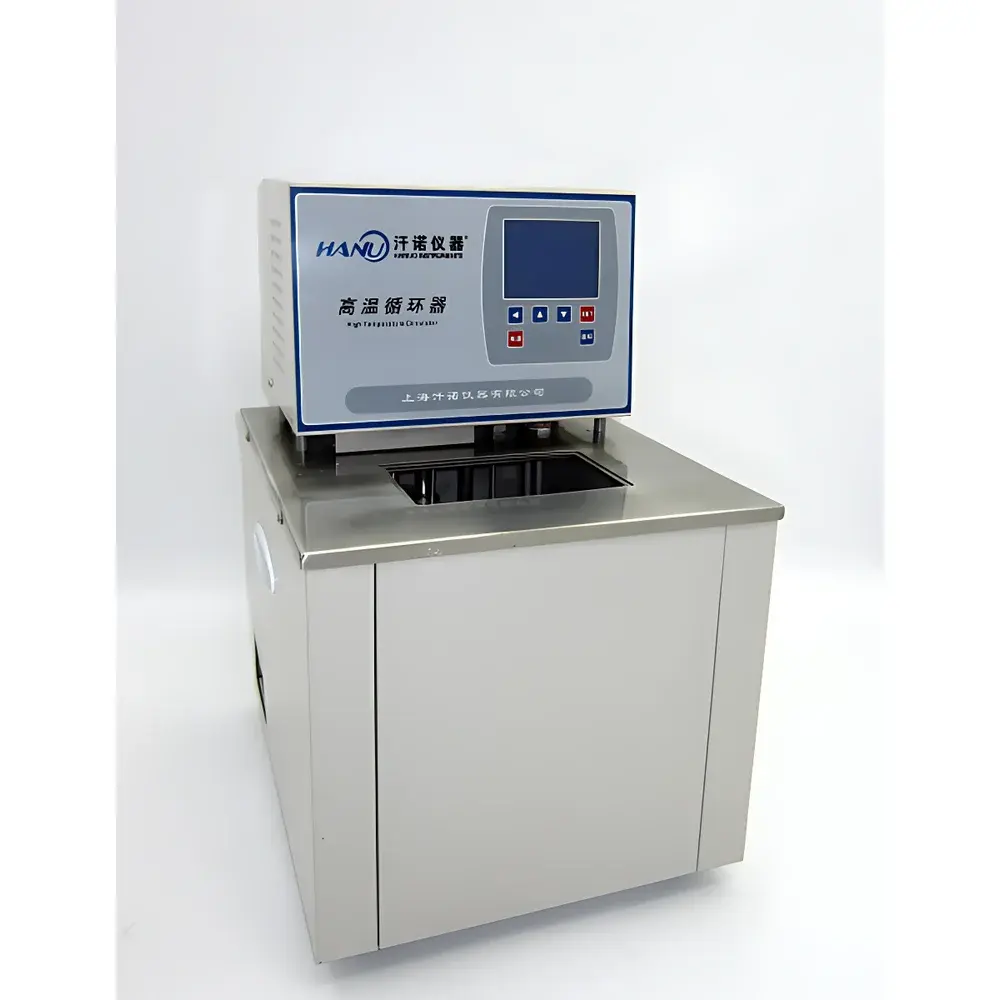
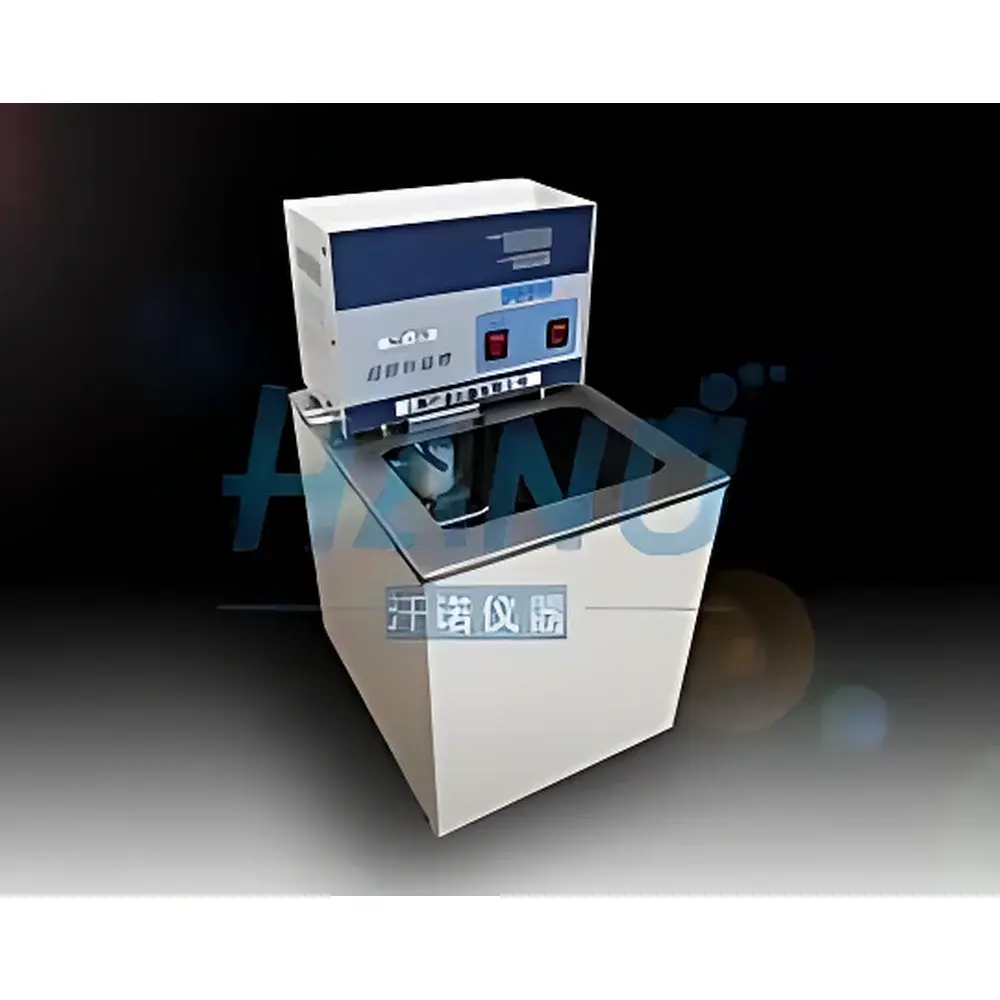
Hanuo GX-2010 High-Temperature Circulating Oil Bath
| Brand | Hanuo |
|---|---|
| Origin | Shanghai, China |
| Model | GX-2010 |
| Temperature Range | RT to 300 °C |
| Temperature Stability | ±0.2 °C |
| Bath Volume | 10 L |
| External Circulation Flow Rate | 15 L/min |
| Bath Dimensions (W×D×H) | 280×190×200 mm |
| Depth | 200 mm |
| Display | Dual LED (Setpoint & Actual Temperature) |
| Control System | Microprocessor-Based PID Controller |
| Compatibility | Water and Heat-Stable Thermal Oils (e.g., silicone, aromatic hydrocarbons) |
| Optional Integration | External Chiller for Rapid Cooling |
Overview
The Hanuo GX-2010 High-Temperature Circulating Oil Bath is a precision-engineered thermal management system designed for laboratory and pilot-scale applications requiring stable, controllable heating up to 300 °C. Unlike standard water baths, this unit operates with high-boiling-point heat transfer media—including silicone oils and synthetic aromatic fluids—enabling safe, uniform temperature delivery in closed-loop external circulation configurations. Its core function relies on forced convection via an integrated high-flow centrifugal pump, delivering consistent thermal energy to auxiliary equipment such as jacketed reactors, distillation columns, calorimeters, and semiconductor processing fixtures. The system employs a microprocessor-based PID temperature controller with real-time feedback from a calibrated Pt100 sensor immersed directly in the bath medium, ensuring minimal thermal lag and high reproducibility across extended operation cycles. Designed for continuous duty under industrial-grade conditions, the GX-2010 complies with IEC 61010-1 safety standards for laboratory electrical equipment and incorporates over-temperature cut-off, dry-run protection, and grounded chassis construction.
Key Features
- Wide operational range from ambient temperature to 300 °C, validated for long-term stability at maximum setpoints using certified thermal oils.
- Dual LED display showing both setpoint and real-time measured temperature, with intuitive touch-sensitive membrane keypad for parameter entry and mode selection.
- High-capacity external circulation pump rated at 15 L/min nominal flow, supporting pressure heads up to 0.3 bar—sufficient for feeding multi-jacket reactors or parallel thermal loops.
- Stainless steel 304 bath tank with reinforced insulation and vapor-tight lid, minimizing evaporation losses and thermal drift during prolonged high-temperature operation.
- Modular architecture allows seamless integration with optional external chillers (e.g., recirculating refrigerated units), enabling rapid cooldown profiles for exothermic reaction control per ASTM E178 guidelines.
- Front-panel accessible calibration offset adjustment and user-defined ramp/soak profiles for process-critical thermal protocols.
Sample Compatibility & Compliance
The GX-2010 is compatible with a broad spectrum of thermally stable heat transfer fluids, including polydimethylsiloxane (PDMS)-based silicone oils (flash point >300 °C), biphenyl-diphenyl ether blends, and high-aromatic mineral oils meeting ISO 6743-12 classification. It is not suitable for water above 100 °C or low-flash-point solvents. All wetted components conform to USP Class VI biocompatibility requirements for non-invasive contact surfaces. The device meets CE marking criteria under the Low Voltage Directive (2014/35/EU) and Electromagnetic Compatibility Directive (2014/30/EU). For regulated environments, audit trails and parameter lockout can be implemented via external SCADA systems compliant with FDA 21 CFR Part 11 when paired with validated data acquisition hardware.
Software & Data Management
While the GX-2010 operates as a standalone instrument with local PID control, its RS485 serial interface (Modbus RTU protocol) enables bidirectional communication with laboratory information management systems (LIMS) or programmable logic controllers (PLCs). Users may log temperature profiles, alarm events, and runtime statistics using third-party software such as LabVIEW, MATLAB Data Acquisition Toolbox, or custom Python scripts leveraging PySerial. Firmware supports configurable logging intervals (1–600 seconds), event-triggered alerts (e.g., deviation >0.5 °C), and password-protected configuration changes—facilitating GLP/GMP-aligned documentation practices.
Applications
- Temperature control of glass-lined or stainless-steel jacketed reactors during high-temperature catalytic hydrogenation, Friedel-Crafts acylation, or Grignard synthesis.
- Thermal conditioning of optical components and photolithography stages in semiconductor R&D facilities.
- Calibration of high-temperature reference sensors (e.g., Type K thermocouples, RTDs) per ISO/IEC 17025-accredited procedures.
- Accelerated aging studies of polymer composites and battery electrolytes under controlled thermal stress.
- Supporting vacuum distillation setups where precise boiling-point control is required across multiple fractions.
FAQ
What types of thermal fluids are recommended for use at 300 °C?
Silicone oils with flash points exceeding 320 °C (e.g., Dow Corning 200 Fluid Series, Wacker SE 1000) or eutectic biphenyl/diphenyl oxide blends (e.g., Dowtherm A) are validated for continuous operation at 300 °C. Always consult fluid manufacturer SDS for oxidation stability and maximum service life.
Can the GX-2010 be used with water below 100 °C?
Yes—though its design prioritizes oil compatibility, it functions reliably with deionized water for applications between ambient and 95 °C; however, corrosion-resistant additives or periodic descaling are advised to prevent mineral buildup.
Is remote monitoring supported out-of-the-box?
No native Ethernet or Wi-Fi interface is included; remote supervision requires connection via RS485-to-Ethernet gateway and compatible Modbus master software.
Does the unit include a drain valve for fluid replacement?
Yes—a front-mounted brass ball valve with PTFE seal facilitates safe, tool-free drainage without disassembling the bath assembly.
What maintenance intervals are recommended for sustained accuracy?
Biannual verification of Pt100 sensor calibration against NIST-traceable references and annual inspection of pump impeller wear and seal integrity are advised per ISO/IEC 17025 maintenance schedules.



