
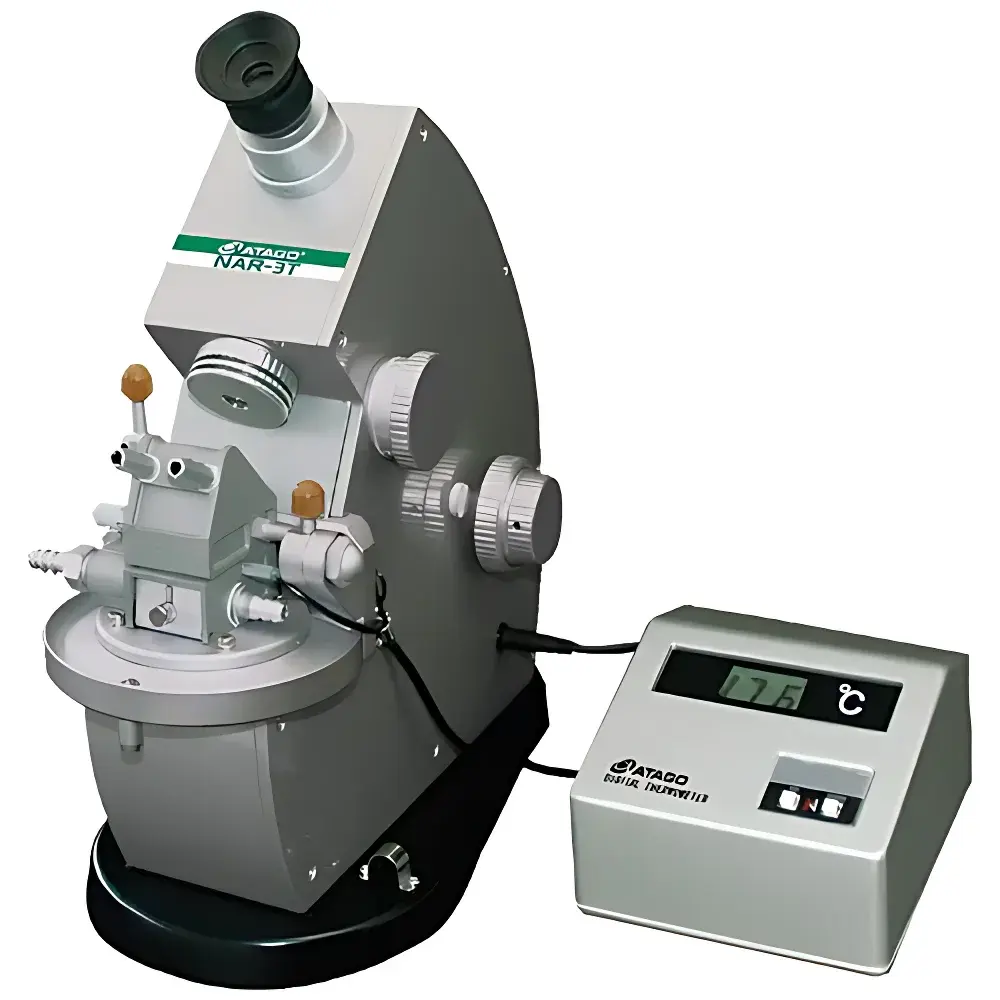
ATAGO NAR-3T High-Precision Abbe Refractometer
| Brand | ATAGO |
|---|---|
| Origin | Japan |
| Model | NAR-3T (High-Precision) |
| Product Type | Benchtop Abbe Refractometer |
| Temperature Control | Yes |
| Digital Display | No |
| Refractive Index Range | 1.30000–1.71000 |
| Brix Range | 0.00–95.00% |
| Refractive Index Accuracy | ±0.0001 |
| Brix Accuracy | ±0.05% |
| Refractive Index Resolution | 0.0002 |
| Brix Resolution | 0.1% |
| Temperature Measurement Range | 5–50°C |
| Temperature Accuracy | ±0.2°C (ambient, 5–40°C) |
| Power Supply | AC 100–240 V, 50/60 Hz |
| Power Consumption | 5 VA |
| Dimensions (Main Unit) | 12 × 31 × 34 cm |
| Weight (Main Unit) | 9.0 kg |
| Dimensions (Temperature Display Module) | 10 × 11 × 7 cm |
| Weight (Temperature Display Module) | 0.5 kg |
Overview
The ATAGO NAR-3T High-Precision Abbe Refractometer is a benchtop optical instrument engineered for accurate and repeatable measurement of refractive index (nD) and Brix values in transparent or translucent liquid samples. Based on the classical Abbe principle—utilizing total internal reflection at the prism-sample interface—the NAR-3T determines refractive index by precisely locating the critical angle of light transition between a high-refractive-index glass prism (typically flint glass) and the sample. This fundamental optical method enables direct correlation between refractive index and thermodynamic properties such as concentration, purity, and molecular composition. The instrument incorporates an enhanced optical system featuring a stabilized high-intensity tungsten-halogen light source and optimized collimation optics, delivering improved signal-to-noise ratio and sharper shadow-line definition—critical for achieving ±0.0001 refractive index accuracy. Designed for rigorous laboratory environments, the NAR-3T supports temperature-controlled measurements from 5 °C to 50 °C, with integrated temperature sensing and real-time ambient compensation (±0.2 °C), ensuring traceable results compliant with ISO 21748 and ASTM D1218 standards for refractometric analysis.
Key Features
- High-precision Abbe optical architecture with calibrated sapphire-contact prism surface for long-term stability and minimal hysteresis
- Integrated temperature monitoring module with independent display unit (0.5 kg, compact form factor) enabling simultaneous visual verification of sample temperature during measurement
- Extended refractive index range (1.30000–1.71000) suitable for low-index solvents (e.g., hydrocarbons, ethers) and high-index specialty fluids (e.g., glycerol/water mixtures, polymer solutions, essential oils)
- Direct Brix scale calibrated per ICUMSA Method GS2/3-15 and AOAC Official Method 932.12, supporting routine quality control in food, beverage, and pharmaceutical manufacturing
- Manual vernier scale readout with 0.0002 resolution for refractive index and 0.1% resolution for Brix—designed for operator-controlled calibration verification and GLP-compliant manual data recording
- Rugged cast-aluminum chassis and vibration-damped base structure minimizing mechanical drift during extended measurement sessions
Sample Compatibility & Compliance
The NAR-3T accommodates a broad spectrum of homogeneous liquid samples including aqueous solutions, organic solvents, edible oils, syrups, glycols, and low-viscosity resins. Sample volume requirement is ≤1.0 mL per measurement; compatibility extends to mildly corrosive media (e.g., diluted acids/bases) when used with optional quartz-prism accessories. The instrument conforms to key regulatory frameworks governing analytical instrumentation: its mechanical design and thermal management support adherence to Good Laboratory Practice (GLP) and current Good Manufacturing Practice (cGMP) requirements; temperature-controlled operation satisfies USP refractometry guidelines; and its traceable calibration methodology aligns with ISO/IEC 17025 clause 6.4.2 for measurement equipment verification. While not electronically networked, the NAR-3T’s analog readout and documented manual procedure enable full auditability in FDA 21 CFR Part 11–aligned workflows when paired with controlled lab notebooks and SOP-driven operation.
Software & Data Management
The NAR-3T operates as a standalone optical instrument without embedded microprocessor control or digital output interfaces. All measurements are recorded manually via the precision vernier scale, supporting paper-based or LIMS-integrated documentation protocols. For laboratories requiring digital traceability, ATAGO recommends pairing the NAR-3T with the optional NAR-Temp software suite (sold separately), which captures temperature readings from the auxiliary display module and generates time-stamped calibration logs compliant with ISO 17025 record retention requirements. Raw refractive index values may be converted to concentration using ATAGO’s certified Brix conversion tables (traceable to NIST SRM 84d sucrose reference solutions) or user-defined polynomial equations validated per ICH Q2(R2) guidelines.
Applications
- Concentration monitoring of sugar solutions in juice processing, confectionery, and dairy production
- Purity assessment of organic solvents (e.g., acetone, ethanol, toluene) in chemical synthesis and QC labs
- Quality screening of pharmaceutical excipients (e.g., propylene glycol, glycerin) per USP monographs
- Refractive index profiling of lubricating oils and transformer fluids for oxidation state evaluation
- Educational use in university physics and analytical chemistry curricula for teaching optical dispersion and Snell’s law principles
- Field-deployable verification of antifreeze concentration (ethylene/propylene glycol) in automotive and HVAC maintenance
FAQ
Does the NAR-3T support automatic temperature compensation (ATC)?
No—it features manual temperature measurement via a dedicated external sensor module, requiring operator input of observed temperature for correction using built-in conversion tables or external calculation tools.
Can the NAR-3T measure opaque or highly viscous samples?
It is restricted to optically clear, low-turbidity liquids; suspended particles or high viscosity (>500 mPa·s) will degrade shadow-line definition and compromise accuracy.
Is calibration verification possible without certified reference standards?
While distilled water (nD = 1.3330 at 20 °C) serves as a primary zero-point check, ATAGO recommends annual verification using NIST-traceable sucrose or bromonaphthalene standards per ISO 7027 Annex B.
What maintenance is required for long-term optical performance?
Prism cleaning with lens-grade tissue and anhydrous ethanol after each use; annual inspection of light source intensity and collimator alignment by authorized ATAGO service centers.
Is the NAR-3T suitable for ISO 17025-accredited testing?
Yes—when operated under documented SOPs, with verified temperature control, traceable calibration standards, and controlled environmental conditions (ISO 17025 clause 7.2.2), it meets technical validity requirements for refractometric testing.




