
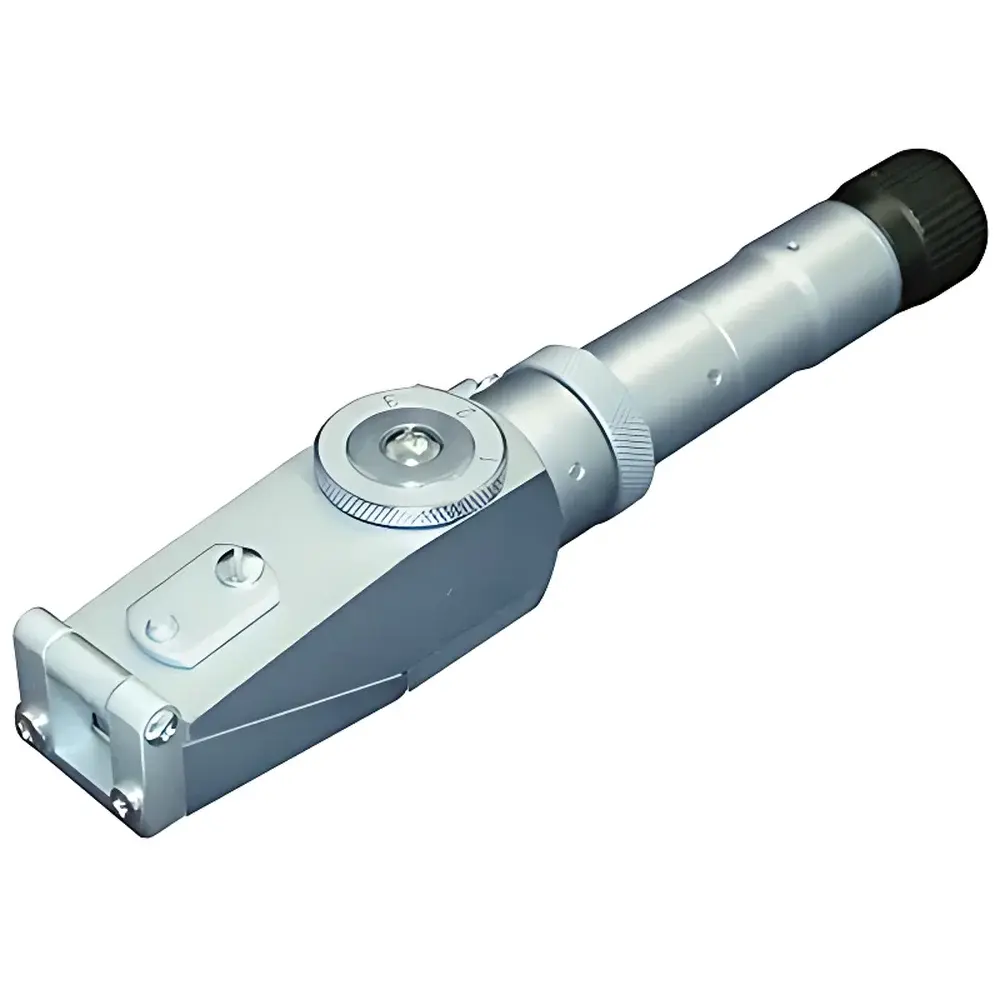
ATAGO HSR-500 Handheld Refractometer (Wide-Range Brix)
| Brand | ATAGO |
|---|---|
| Origin | Japan |
| Model | HSR-500 |
| Product Type | Handheld Refractometer |
| Measurement Range | 0.0–90.0% Brix |
| Resolution | 0.2% Brix |
| Dimensions | 4 × 4 × 20 cm |
| Weight | 600 g |
| Temperature Compensation | None |
| Digital Display | None |
| Compliance | ISO 2173, AOAC 985.16, ICUMSA Methods |
Overview
The ATAGO HSR-500 Handheld Refractometer (Wide-Range Brix) is a precision optical instrument engineered for rapid, field-deployable measurement of soluble solids concentration—expressed as % Brix—in liquid samples via refractive index determination. Based on the fundamental physical principle that the refractive index of aqueous sugar solutions increases linearly with solute concentration under controlled temperature conditions, the HSR-500 employs a high-contrast optical transmission system to deliver clear, parallax-free scale readings across an extended range. Unlike digital or temperature-compensated instruments, the HSR-500 operates entirely on ambient light and mechanical optics—eliminating battery dependency, electronic drift, and calibration complexity. Its robust all-metal housing and sealed prism assembly ensure long-term stability in demanding environments such as food processing lines, agricultural harvest sites, beverage production floors, and quality control laboratories where portability and operational simplicity are critical.
Key Features
- Extended Brix measurement range of 0.0–90.0%, enabling accurate assessment of both low-sugar beverages (e.g., fruit juices, soft drinks) and highly concentrated solutions (e.g., honey, syrups, condensed milk, molasses)
- High-contrast optical scale with 0.2% Brix graduation—engineered for visual readability without magnification under typical industrial lighting conditions
- Compact, ergonomic handheld form factor (4 × 4 × 20 cm; 600 g) optimized for one-handed operation and repeated use during shift-based sampling
- Fixed-focus Abbe-type prism system with high-refractive-index glass, delivering consistent optical performance across its full range without recalibration
- No electronics, no batteries, no firmware—minimizing maintenance requirements and eliminating risk of electromagnetic interference or software obsolescence
- Prism surface compatible with standard cleaning protocols using lens tissue and distilled water or mild ethanol solution
Sample Compatibility & Compliance
The HSR-500 is validated for use with homogeneous, non-turbid, non-viscous aqueous solutions containing sucrose, glucose, fructose, or mixed sugars. It is not suitable for emulsions, suspensions, or highly viscous media without prior dilution and homogenization. The instrument conforms to internationally recognized standard methods for refractometric Brix determination, including ISO 2173 (fruit and vegetable products), AOAC Official Method 985.16 (sugar content in foods), and ICUMSA Method GS4/3-11 (sugar cane and beet processing). While it lacks built-in temperature compensation, users are advised to perform measurements at 20 °C ± 2 °C—or apply manual correction per published temperature-Brix conversion tables (e.g., ICUMSA SPS-1a) when ambient conditions deviate significantly. As a Class I optical measuring device, it requires no regulatory registration under FDA 21 CFR Part 860 or EU MDR Annex VIII.
Software & Data Management
The ATAGO HSR-500 operates independently of software or external data systems. All measurements are recorded manually by the operator directly from the optical scale. For traceability in GLP- or GMP-regulated environments, users integrate the HSR-500 into paper-based or electronic laboratory notebooks (ELN) using standardized SOPs that specify observation procedure, environmental temperature, sample identification, and observer signature. No audit trail, electronic record, or 21 CFR Part 11 compliance is provided or required, as the device generates no electronic output. Calibration verification is performed periodically using certified sucrose reference standards (e.g., NIST-traceable 10%, 30%, and 60% Brix solutions), with results documented in instrument logbooks per ISO/IEC 17025 clause 7.7.
Applications
- Quality assurance of incoming raw materials (e.g., fruit pulp, grape must, maple sap, whey permeate)
- In-process monitoring of evaporation, concentration, and blending stages in juice, jam, and confectionery manufacturing
- Final product release testing for honey purity, syrup consistency, and soft drink formulation adherence
- Agricultural field testing for crop maturity estimation (e.g., sugarcane, pineapple, mango)
- Educational demonstration of optical principles and solution thermodynamics in chemistry and food science curricula
- Third-party inspection and certification services requiring portable, vendor-neutral Brix verification
FAQ
Does the HSR-500 require calibration before each use?
No—calibration is only required at startup, after significant temperature shifts (>5 °C), or following prism cleaning. A single-point zero check using distilled water at ambient temperature is sufficient for routine verification.
Can the HSR-500 measure non-sugar solutions such as salt brines or glycerol solutions?
Not directly. Its scale is calibrated exclusively for sucrose-equivalent Brix. For non-sugar solutes, users must apply empirically derived conversion factors or refer to ATAGO’s supplementary scale charts (e.g., NaCl or glycerol-specific nomograms), which are available upon request.
Is the prism replaceable if damaged?
Yes—the RE-2340-91H temperature probe is not part of the optical path; however, the prism assembly (part number RE-2340-01) is a field-replaceable component serviced by authorized ATAGO distributors.
What is the recommended cleaning procedure for the prism surface?
Wipe gently with lint-free lens tissue moistened with distilled water or 70% ethanol. Avoid abrasive cloths, acetone, or prolonged solvent exposure, which may degrade prism cement or anti-reflective coatings.
How does ambient lighting affect measurement accuracy?
The HSR-500 relies on incident daylight or white LED illumination. Low-light conditions reduce contrast and increase reading uncertainty. Use under uniform, glare-free lighting—never under colored or pulsed light sources.




