
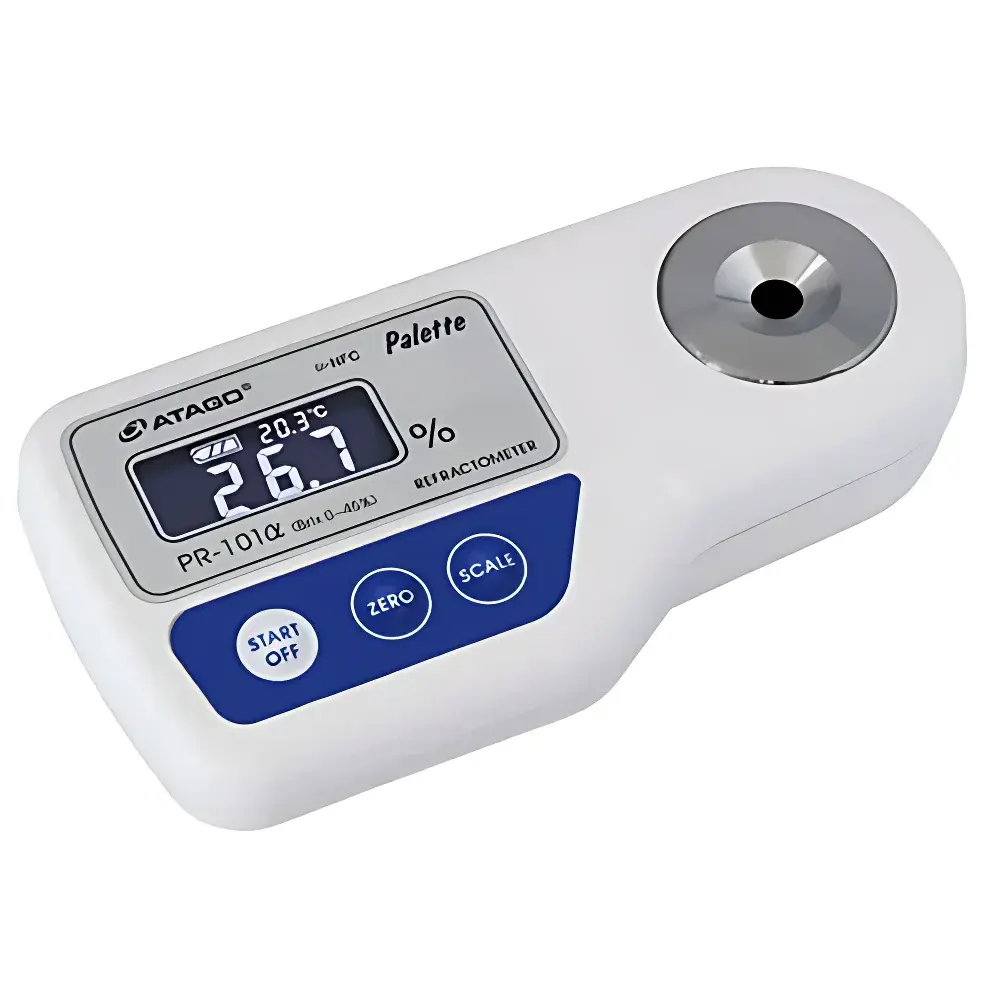
ATAGO PR-101α Digital Handheld Refractometer (Low-to-Medium Concentration Range)
| Brand | ATAGO |
|---|---|
| Origin | Japan |
| Product Type | Handheld Refractometer |
| Model | PR-101α |
| Measurement Range | 0.0–45.0% Brix |
| Accuracy | ±0.1% Brix |
| Resolution | 0.1% Brix |
| Temperature Compensation | Automatic (ATC), 5–40°C |
| Operating Ambient Temperature | 5–40°C |
| Power Supply | 9V Alkaline Battery (006P) |
| IP Rating | IP64 |
| Dimensions & Weight | 17 × 9 × 4 cm, 300 g (main unit only) |
Overview
The ATAGO PR-101α is a precision-engineered digital handheld refractometer designed for rapid, field-deployable concentration measurement of aqueous solutions in low-to-medium Brix ranges (0.0–45.0%). It operates on the fundamental optical principle of total internal reflection: incident light passes through a sample placed on the sapphire prism, and the critical angle of refraction—directly correlated to the solution’s refractive index—is detected by an integrated linear CCD sensor. This refractive index value is then converted to % Brix using built-in calibration curves traceable to NIST-standard sucrose solutions. The instrument features Automatic Temperature Compensation (ATC) across 5–40°C, eliminating manual correction and ensuring consistent accuracy under variable ambient conditions typical in production floors, QC labs, and field environments. Unlike benchtop or Abbe-style refractometers, the PR-101α delivers laboratory-grade repeatability (±0.1% Brix) in a rugged, pocket-sized form factor—enabling real-time process verification without sample dilution or thermal equilibration delays.
Key Features
- High-precision measurement with ±0.1% Brix accuracy and 0.1% resolution, validated per ISO 2173:2003 for fruit juice analysis and compatible with ASTM D1074 and AOAC 932.12 methodologies.
- Triple-user-defined scale functionality: users may program up to three custom concentration scales (Scale 2, 3, 4) via linear conversion coefficients (Concentration = Brix × Coefficient), supporting non-sucrose matrices such as glycol-based coolants, pharmaceutical excipients, or detergent formulations.
- Enhanced Light Immunity (ELI) optical system: engineered anti-glare prism coating and optimized LED illumination reduce photometric interference from ambient lighting—including direct sunlight—ensuring stable readings in uncontrolled environments.
- IP64-rated enclosure: dust-tight and protected against water splashing from any direction, enabling reliable operation in humid food processing lines, metalworking shops, or outdoor agricultural settings.
- Intuitive single-button workflow: press START/OFF → apply 2–3 drops to prism → result displayed after three LED flashes; zero calibration performed in <10 seconds using distilled water.
- Low-power architecture: powered by a single 9V alkaline battery (006P), delivering >5,000 measurements per charge with auto-shutdown after 3 minutes of inactivity.
Sample Compatibility & Compliance
The PR-101α is optimized for transparent, low-viscosity aqueous liquids including fruit juices, soft drinks, syrups, water-soluble cutting fluids, industrial cleaning agents, antifreeze/coolant concentrates (ethylene/propylene glycol), and aqueous pharmaceutical preparations. It is not suitable for opaque suspensions, highly viscous oils, or volatile solvents that may damage the sapphire prism surface. Calibration follows traceable protocols aligned with GLP requirements: factory calibration uses certified sucrose reference standards (0.0%, 10.0%, 20.0%, 30.0%, 40.0% Brix); user zeroing with distilled water satisfies daily verification per ISO 5725-2 precision criteria. While not FDA 21 CFR Part 11 compliant out-of-the-box (lacking audit trail or electronic signature), its measurement records are exportable via optional RS-232 interface (PR-101α-PC Kit) for integration into validated LIMS or QMS platforms.
Software & Data Management
The PR-101α operates as a standalone instrument with no embedded firmware update capability or onboard data logging. However, when paired with the optional ATAGO PR-101α-PC Interface Kit (sold separately), it supports ASCII-mode serial communication at 9600 bps for real-time transmission of Brix values, selected scale ID, temperature reading, and measurement timestamp to Windows-based PCs. Compatible software includes ATAGO’s free “Refractometer Utility” (v3.2+) for CSV export, statistical summary (mean, SD, CV%), and compliance reporting aligned with ISO/IEC 17025 documentation requirements. All coefficient settings and scale configurations are retained in non-volatile memory—even after battery replacement—ensuring continuity across shifts and operators.
Applications
- Food & Beverage QA/QC: rapid Brix verification of orange juice concentrate, apple puree, tea extracts, and sports drink premixes pre-bottling.
- Industrial Fluid Management: monitoring glycol concentration in HVAC chillers and engine coolant systems to prevent freezing or overheating.
- Pharmaceutical Manufacturing: verifying active ingredient dilutions in oral liquid formulations and excipient solutions during batch release testing.
- Automotive & Metalworking: quantifying water-soluble cutting fluid concentration to maintain optimal lubricity and corrosion inhibition.
- Agricultural Support: assessing sugar content in harvested sugarcane or beet juice prior to processing, supporting yield estimation models.
FAQ
What is the recommended calibration frequency?
Zero calibration with distilled water is required before first use each day, after significant ambient temperature shifts (>5°C), and following battery replacement—per ATAGO’s Technical Bulletin TB-PR101α-02.
Can the PR-101α measure non-Brix units like NaCl % or specific gravity?
Yes—via user-defined scales. For example, entering a coefficient of 0.98 converts Brix to approximate NaCl wt% for brine solutions; coefficients must be empirically determined for each matrix using reference titration or density data.
Is the sapphire prism resistant to chemical etching?
The prism is sapphire (Al₂O₃, Mohs hardness 9), offering excellent resistance to scratching and mild acid/base exposure; however, prolonged contact with strong oxidizers (e.g., nitric acid) or hydrofluoric acid will cause irreversible damage.
Does ATC compensate for sample temperature or ambient temperature?
ATC corrects based on the actual temperature of the prism surface (measured via integrated thermistor), which rapidly equilibrates with the applied sample—ensuring compensation reflects true sample thermal state, not ambient air.
How does ELI improve measurement stability?
ELI combines spectral filtering of the detection path with pulse-width-modulated LED drive and synchronized CCD sampling to reject broadband ambient photons—reducing standard deviation by up to 40% under 10,000 lux illumination compared to legacy PR-100 series units.




