
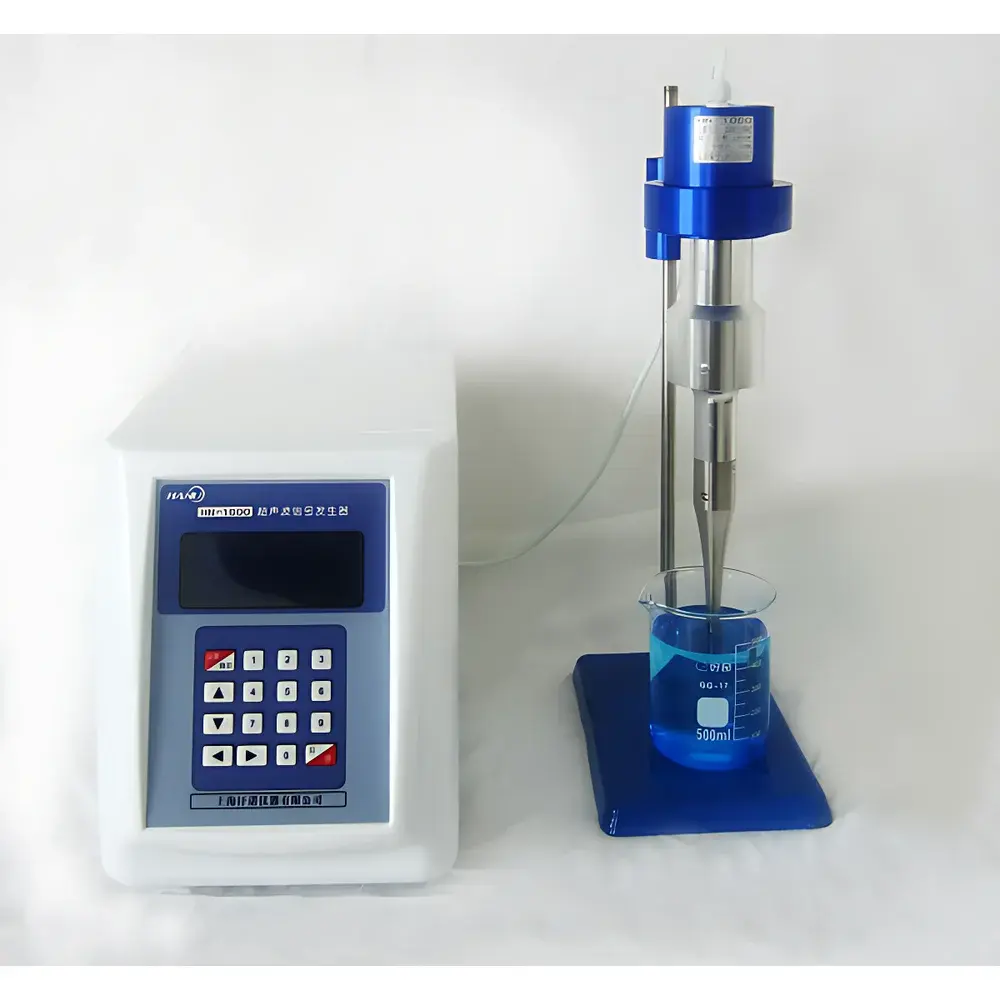
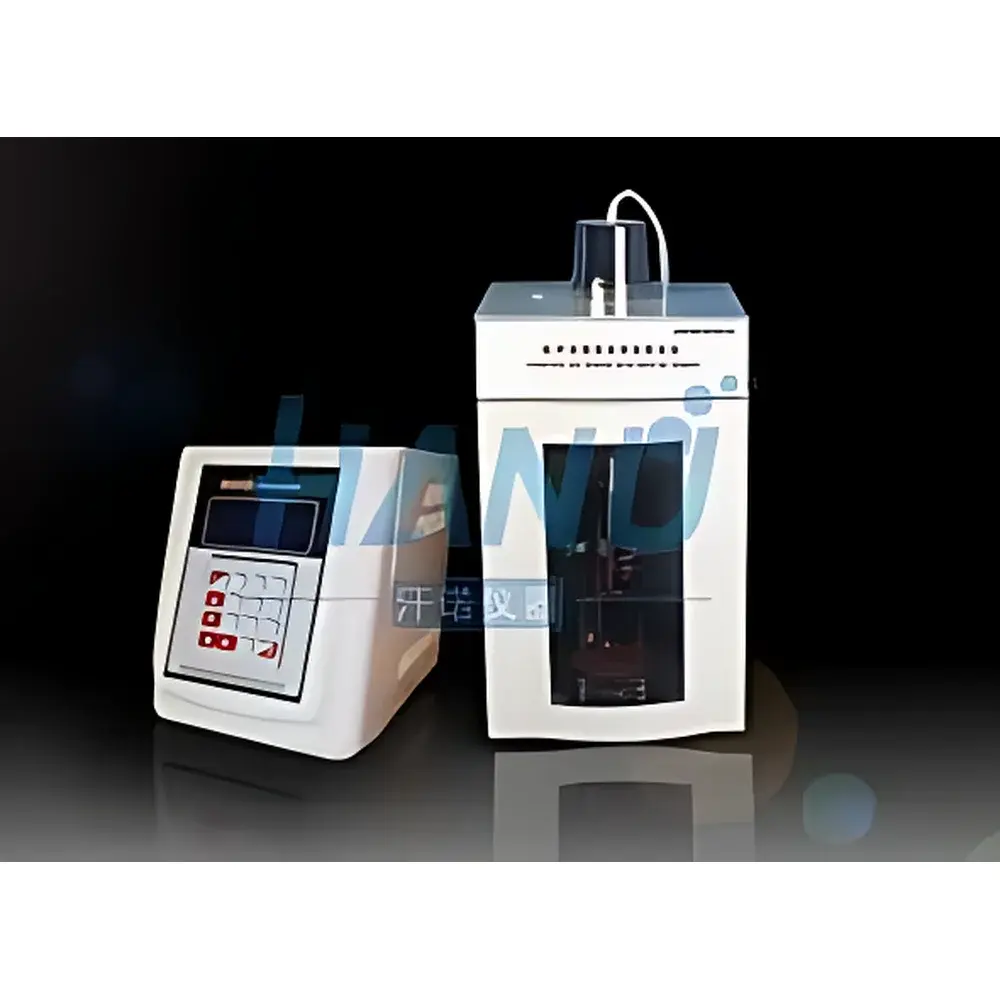
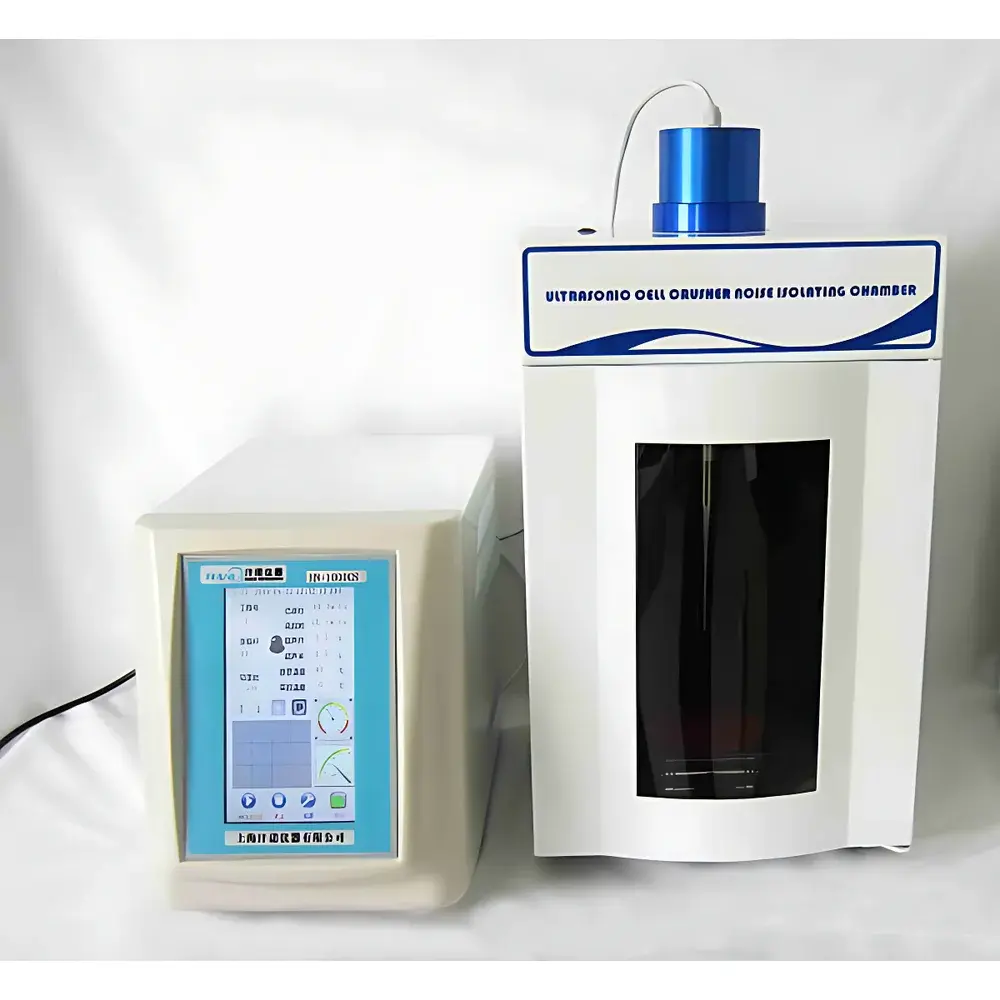
Hanuo HN-2500 High-Power Ultrasonic Nanomaterial Disperser
| Brand | Hanuo |
|---|---|
| Model | HN-2500 |
| Instrument Type | Ultrasonic Cell Disruptor |
| Ultrasonic Output Power | 2500 W (adjustable) |
| Operating Frequency | 20–25 kHz (auto-frequency tracking) |
| Sample Volume Capacity | 1000 mL |
| Temperature Control Range | Ambient to 90 °C (optional extended range: −5 °C to 100 °C with chiller) |
| Pulse Mode Interval | 0.1–99.9 s (adjustable) |
| Total Processing Time | 0–99 h 59 min 59 s |
| Data Storage | 20 programmable protocols |
| Probe Material | Ti-6Al-4V titanium alloy |
| Input Voltage | AC 220 V ±5%, 50 Hz |
Overview
The Hanuo HN-2500 High-Power Ultrasonic Nanomaterial Disperser is an engineered solution for controlled, reproducible ultrasonic energy delivery in life science and nanomaterial research laboratories. It operates on the principle of high-intensity acoustic cavitation—where rapid pressure fluctuations generated by 20–25 kHz ultrasonic waves induce transient microbubble formation, growth, and violent collapse in liquid media. This process delivers localized shear forces exceeding 109 Pa and transient temperatures above 5000 K, enabling efficient deagglomeration of nanoparticles, disruption of cellular membranes, and homogenization of viscous or heterogeneous suspensions. Unlike bath-type sonicators, the HN-2500 employs a focused, probe-based (cup-horn or direct-contact) configuration, ensuring >85% energy transfer efficiency to the sample volume. Its architecture supports both continuous and pulsed ultrasonic output, minimizing thermal accumulation during sensitive applications such as protein extraction or exosome isolation.
Key Features
- Touchscreen interface with 4.3-inch TFT display for real-time monitoring of power (%), temperature (°C), elapsed time, and pulse parameters
- Microprocessor-controlled ultrasonic generator with auto-frequency tracking to maintain resonance stability across varying load impedances and temperature drift
- Ti-6Al-4V titanium alloy probe (standard Φ25 mm, optional Φ28/Φ32 mm or multi-stage elongated variants) offering superior acoustic transmission, corrosion resistance, and fatigue endurance
- Adjustable amplitude modulation: maintains consistent vibrational displacement (±2%) under variable sample viscosity or volume loads
- Programmable pulse mode with independent control over on-time (0.1–99.9 s) and off-time (0.1–99.9 s), critical for heat-sensitive biomolecules and thermolabile nanocarriers
- Integrated temperature sensor with real-time feedback and configurable upper-limit alarm (default 90 °C; extendable to −5 °C with external recirculating chiller)
- 20-user-programmable protocols with password protection (ISO/IEC 27001-aligned access control), supporting GLP-compliant experimental traceability
- Overload, overtemperature, and impedance-mismatch fault detection with automatic shutdown and error-code logging
Sample Compatibility & Compliance
The HN-2500 accommodates single-batch processing of up to 1000 mL aqueous or organic-phase suspensions—including lipid nanoparticles (LNPs), metal oxide colloids (e.g., TiO2, SiO2), carbon nanotube dispersions, and biological lysates. Its design complies with IEC 61000-6-3 (EMC emission limits) and IEC 61000-6-2 (immunity to electrostatic discharge and RF fields). When operated with validated protocols and calibrated probes, it supports method adherence to ASTM E2810 (standard guide for ultrasonic dispersion of nanomaterials) and ISO/TS 21356-1 (nanotechnologies — characterization of nanomaterials in suspension). Optional integration with a double-jacketed glass reactor enables precise temperature regulation per USP and FDA 21 CFR Part 11 requirements for aseptic formulation development.
Software & Data Management
No proprietary PC software is bundled; however, the instrument provides RS-232 and optional USB-to-serial interfaces for third-party data acquisition systems (e.g., LabVIEW, MATLAB, or custom Python scripts via PySerial). All runtime parameters—including timestamped power profiles, temperature logs, and fault events—are stored in non-volatile memory and exportable as CSV files via USB flash drive. Audit trails include operator ID (via password entry), protocol name, start/stop timestamps, and final system status—meeting ALCOA+ principles for data integrity in regulated environments. Firmware updates are performed offline using signed binary packages to prevent unauthorized modification.
Applications
- Nanoparticle dispersion and stabilization for drug delivery systems (e.g., PLGA, liposomes, polymeric micelles)
- Cell lysis and subcellular fractionation in proteomics and metabolomics workflows
- Extraction of intracellular enzymes, nucleic acids, and secondary metabolites from plant or microbial biomass
- Preparation of uniform colloidal suspensions for DLS, TEM sample grid coating, or rheological characterization
- Emulsification of oil-in-water or water-in-oil nanoemulsions for food-grade or cosmetic formulations
- Surface functionalization assistance via sonochemical grafting of silanes or phospholipids onto nanomaterial surfaces
- Accelerated solvent extraction (ASE) for environmental analysis of persistent organic pollutants (POPs)
FAQ
What is the maximum recommended duty cycle for continuous operation?
For optimal transducer longevity and thermal management, continuous mode is rated for ≤30 minutes at full 2500 W output. Above this duration, use pulsed mode (e.g., 5 s on / 5 s off) to limit average power and maintain sample temperature below 40 °C.
Can the HN-2500 be used with corrosive solvents such as chloroform or concentrated acids?
The standard titanium probe is compatible with most organic solvents and neutral aqueous solutions. For halogenated solvents or pH 12 media, consult the chemical compatibility chart and consider optional PTFE-coated probe sleeves or quartz immersion horns.
Is validation documentation available for GMP-compliant installation qualification (IQ) and operational qualification (OQ)?
Yes—Hanuo provides IQ/OQ templates aligned with Annex 15 and ASTM E2500, including probe calibration certificates (traceable to NIST standards), frequency sweep reports, and temperature uniformity mapping protocols for the optional double-jacketed reactor.
How does amplitude control differ from simple power percentage adjustment?
Amplitude regulation dynamically adjusts voltage gain to maintain constant peak-to-peak displacement (microns) regardless of acoustic load changes—ensuring mechanical consistency across sample volumes or viscosities. Power % alone varies displacement nonlinearly and risks probe erosion or inconsistent cavitation intensity.
What safety certifications apply to the electrical subsystem?
The unit carries CE marking per EN 61010-1:2010 (Safety Requirements for Electrical Equipment for Measurement, Control, and Laboratory Use) and meets RoHS 2011/65/EU restrictions on hazardous substances. UL/cUL listing is available upon request for North American installations.




