
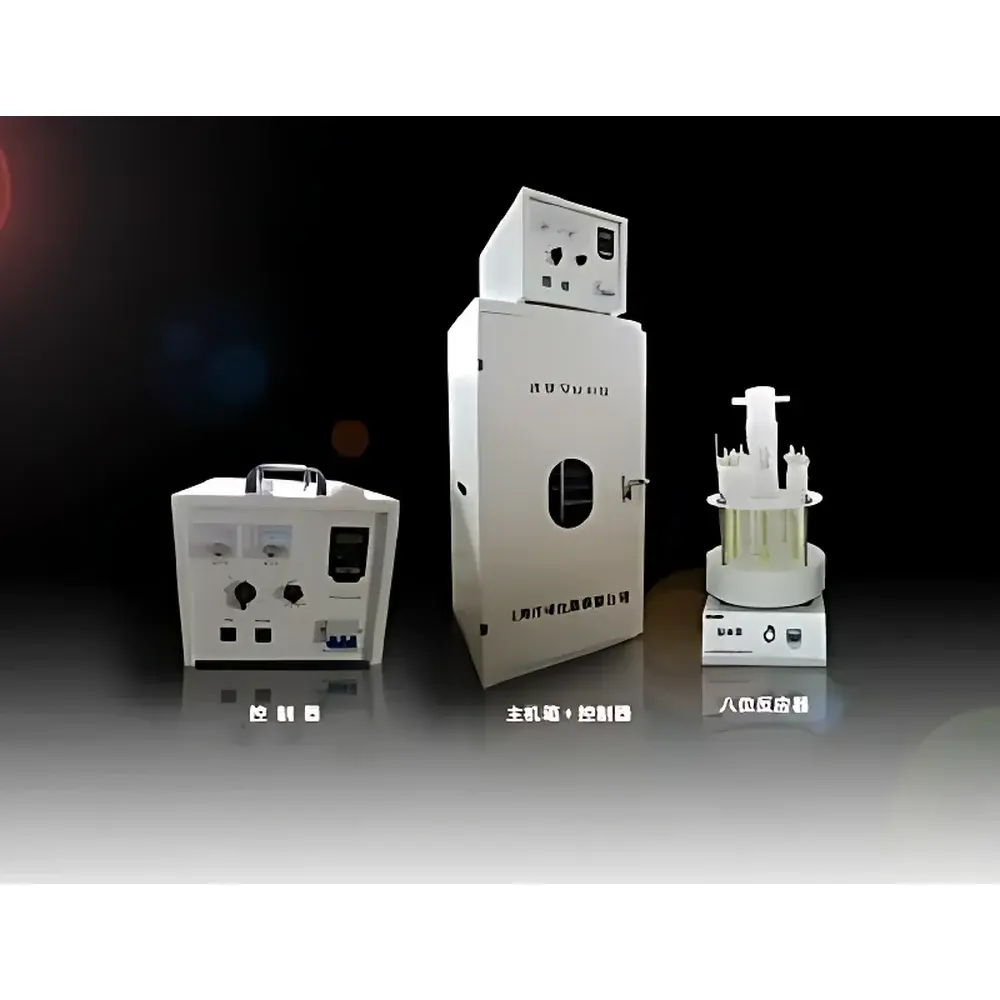
Hanuo HANUO-IV Photoreaction Instrument
| Brand | Hanuo |
|---|---|
| Origin | Shanghai, China |
| Manufacturer Type | Authorized Distributor |
| Product Origin | Domestic (China) |
| Model | HANUO-IV |
| Light Source Module | High-Intensity Tunable Arc Lamp System |
| Lamp Power Range | Hg Lamp 100–1000 W, Xe Lamp 100–1000 W, Metal Halide Lamp 100–450 W |
| Sample Capacity | 8 Parallel Reaction Vessels |
| Stirring | Synchronized 8-Channel Magnetic Stirring |
| Quartz Reactor Vessels | 30 mL and 50 mL (standard), custom volumes available |
| Cooling | Integrated Quartz Cold Finger with Circulating Chiller Interface |
| Compliance | Designed for ISO/IEC 17025-aligned laboratory environments, compatible with GLP documentation workflows |
Overview
The Hanuo HANUO-IV Photoreaction Instrument is an engineered platform for controlled, reproducible photochemical experimentation under precisely regulated irradiation conditions. It operates on the principle of controlled photon delivery to reaction media—enabling quantitative investigation of photoinduced processes in gas-phase, liquid-phase, heterogeneous (e.g., TiO₂-coated substrates), or flow-through configurations. The system supports spectral flexibility through interchangeable high-intensity arc lamps (mercury, xenon, and metal halide), each independently power-tunable to modulate photon flux density without altering spectral output distribution. This capability is essential for quantum yield determination, kinetic profiling of transient species (e.g., hydroxyl radicals, singlet oxygen), and mechanistic studies requiring wavelength- and intensity-resolved data. Unlike fixed-wavelength LED arrays, the HANUO-IV preserves broad-spectrum continuity—critical for simulating solar irradiance or replicating literature-standard UV–vis excitation profiles (e.g., ASTM G154 Cycle 1 for UV-A exposure).
Key Features
- Modular lamp architecture supporting Hg, Xe, and metal halide lamps with independent, continuous power regulation (100–1000 W for Hg/Xe; 100–450 W for metal halide) via integrated digital controller
- Eight-position parallel reaction station with synchronized magnetic stirring—each channel independently adjustable from 0 to 1200 rpm, ensuring uniform mass transfer and thermal homogeneity across all vessels
- Optically optimized dark chamber constructed from high-opacity steel with electromagnetic shielding and interlocked safety door—meets IEC 61000-6-3 EMC requirements for laboratory instrumentation
- Quartz cold finger assembly with standardized 1/4″ NPT coolant ports, compatible with external recirculating chillers (−10 °C to +25 °C operating range) to maintain isothermal reaction conditions during prolonged irradiation
- Standard quartz reactor set includes sixteen vessels (eight 30 mL and eight 50 mL), fabricated from synthetic fused silica (OH⁻ content 90% at 254 nm)
- Mobility-enabled design with industrial-grade locking casters and cable management tray—facilitates reconfiguration within ISO Class 7 cleanroom or fume hood environments
Sample Compatibility & Compliance
The HANUO-IV accommodates a wide range of sample formats: sealed or vented quartz tubes, gas-permeable membrane reactors, immobilized catalyst coatings (e.g., sol-gel TiO₂ films on quartz slides), and micro-volume flow cells (with optional adapter kit). All wetted components comply with USP Class VI biocompatibility standards. The system’s optical enclosure meets EN 60598-1 requirements for luminaires used in laboratory settings. When operated with calibrated radiometers traceable to NIST SRM 2271, the instrument supports quantitative actinometry per ISO 105-B02 and ASTM E2069 protocols. Data acquisition logs—including lamp runtime, power setpoint, stir speed, and ambient temperature—are timestamped and exportable for audit-ready GLP/GMP documentation.
Software & Data Management
While the HANUO-IV operates as a hardware-centric platform (no embedded OS or touchscreen), it provides analog/digital I/O interfaces (0–10 V, RS-485 Modbus RTU) for integration into centralized lab control systems (e.g., LabVIEW, DeltaV, or custom SCADA). Lamp power, stir speed, and chamber temperature (via optional PT100 sensor) can be logged at user-defined intervals (1 s to 60 min resolution) using third-party DAQ hardware. All configuration parameters are retained after power cycling. Audit trail functionality—including operator ID, parameter changes, and error events—is supported when interfaced with LIMS platforms compliant with FDA 21 CFR Part 11 via electronic signature modules.
Applications
- Photocatalytic degradation kinetics of organic pollutants (e.g., methylene blue, phenol) under simulated solar or germicidal UV irradiation
- Photo-Fenton and persulfate activation studies requiring precise control over radical generation rates
- Synthesis of photoresponsive polymers and MOFs where monomer conversion correlates nonlinearly with photon dose
- Photosensitizer screening in photodynamic therapy research (PDT), including triplet-state lifetime correlation with singlet oxygen quantum yield
- Atmospheric chemistry simulation—heterogeneous reactions on mineral dust or soot surfaces under tunable UV–vis spectra
- Accelerated photostability testing of pharmaceuticals per ICH Q1B guidelines using controlled irradiance profiles
FAQ
What lamp types are supported, and how is spectral output verified?
The system accepts standard 200–1000 W medium-pressure arc lamps (Hg, Xe, metal halide) with ANSI-coded bases. Spectral validation requires external calibration using a NIST-traceable spectroradiometer; recommended annual verification per ISO/IEC 17025 Clause 5.10.
Can the system be used for gas-phase reactions with controlled humidity or O₂ concentration?
Yes—quartz reactors support inlet/outlet gas manifolds (Swagelok SS-4-UT fittings); optional mass flow controllers and humidity sensors integrate via the system’s analog I/O ports.
Is the quartz cold finger compatible with dry ice/acetone cooling?
No—the cold finger is designed exclusively for liquid coolant circulation; direct cryogen contact may induce thermal shock fracture in fused silica.
Does the instrument include radiometric calibration certificates?
No—calibration is performed by end users or accredited third-party labs using traceable reference detectors; Hanuo provides lamp alignment templates and collimation guides.
What maintenance intervals are recommended for lamp electrodes and quartz components?
Electrode inspection every 200 h of operation; quartz reactor replacement every 1000 h under UV-C exposure or after visible etching/scattering is observed.




