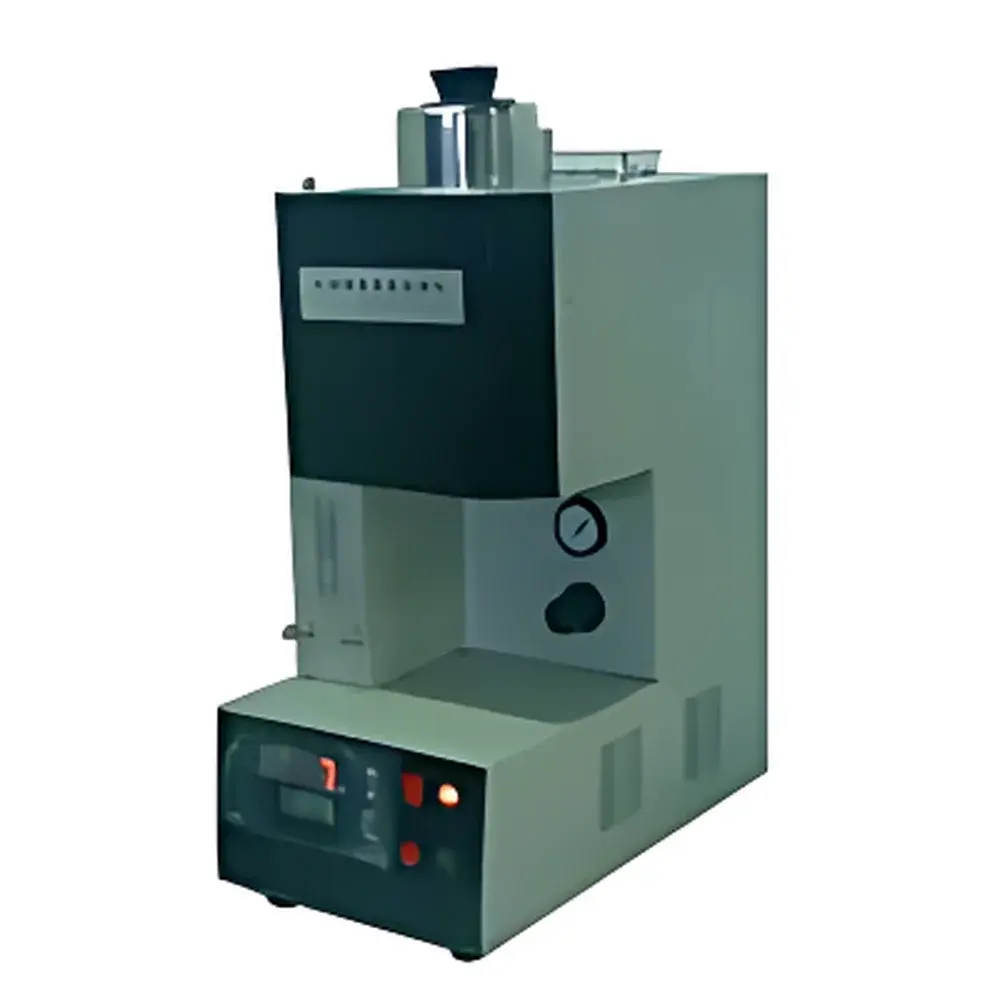
Xufeng CR-M12 Automatic Micro Carbon Residue Tester
| Brand | Xufeng |
|---|---|
| Origin | Shanghai, China |
| Model | CR-M12 |
| Standards Compliance | GB/T 17144-2008, ASTM D4530, ISO 10370, GB/T 268, GB/T 18610.2-2016 |
| Carbon Residue Range | 0.10–30.0 % (m/m) |
| Combustion Chamber Temp | Ambient to 500 °C |
| Temp Stability | ±2.0 °C at 500 °C (15 min hold) |
| Gas Flow Control | 100–1000 mL/min, auto-switching between 150 and 600 mL/min |
| Pressure Regulation | 0–392 kPa (0–4 kg/cm²) |
| Sample Tube Dimensions | Φ12×35 mm (small), Φ12×72 mm (large) |
| Waste Bottle Capacity | 200 mL, threaded glass |
| Exhaust Tubing Diameter | Φ12 mm |
| Heater Power | 1000 W |
| Instrument Weight | 15 kg |
| Dimensions (Analyzer Unit) | 230×320×425 mm (W×D×H) |
| (Controller Unit) | 230×400×110 mm (W×D×H) |
| Nitrogen Consumption | ~100 tests per standard 14.7 MPa (150 kg/cm²) cylinder |
Overview
The Xufeng CR-M12 Automatic Micro Carbon Residue Tester is a precision-engineered laboratory instrument designed for the quantitative determination of carbon residue in petroleum products using the micro-method principle defined in GB/T 17144-2008, ASTM D4530, and ISO 10370. This method relies on controlled thermal decomposition under inert nitrogen atmosphere, followed by gravimetric analysis of the non-volatile carbonaceous residue remaining after pyrolysis. Unlike the traditional Conradson carbon residue (CCR) test (GB/T 268), the micro-method requires only 0.7–1.0 g of sample, significantly reducing operator exposure, energy consumption, and analytical turnaround time while maintaining metrological equivalence for samples with carbon residue ≥0.10 % (m/m). For low-residue distillates (<0.10 %), the CR-M12 supports pre-concentration via ASTM D6536 distillation to isolate the 10 % (v/v) bottom fraction prior to analysis — enabling trace-level residue quantification with high reproducibility and minimal inter-laboratory variability.
Key Features
- Integrated vertical architecture with front-access combustion chamber and directly aligned 200 mL threaded-glass waste collection bottle — eliminating bent tubing and preventing condensate accumulation or cross-contamination.
- Dedicated gas manifold design featuring compact layout, Japanese-sourced mass flow control components (electromagnetic valves, micro-needle valves, and calibrated rotameters), and pressure-regulated nitrogen delivery (0–392 kPa) for precise inert atmosphere management.
- Microprocessor-based controller with fully automated sequence execution: temperature ramping, dwell timing (±0.1 s accuracy), dual-flow switching (150/600 mL/min), real-time fault diagnostics, and thermal cut-off protection.
- High-stability heating system delivering ±2.0 °C uniformity at 500 °C over 15-minute isothermal holds — verified per ASTM E74 and ISO/IEC 17025 calibration protocols.
- Modular sample handling: includes dual-position tube racks (6× large / 12× small), standardized Φ12 mm quartz tubes (35 mm and 72 mm lengths), and ergonomic stainless-steel tweezers for safe hot-tube manipulation.
- Ventilation-flexible exhaust interface: compatible with fume hood integration or direct outdoor venting via included 3 m high-temp silicone exhaust hose (Φ12 mm ID), supporting lab-space optimization without compromising safety or regulatory compliance.
Sample Compatibility & Compliance
The CR-M12 is validated for use across a broad spectrum of petroleum-based materials including diesel fuels, lubricating oils, residual fuel oils, crude oil fractions (per GB/T 18610.2-2016), and cracked feedstocks. It meets the essential performance criteria outlined in ASTM D4530 Annex A1 for repeatability (r ≤ 0.05 % for residues 0.5 %) and reproducibility (R ≤ 0.10 % and R ≤ 0.30 %, respectively). The instrument’s design conforms to GLP requirements for audit-ready operation: all critical parameters (temperature setpoint, hold duration, gas flow rates, and start/stop timestamps) are internally logged and exportable. While not inherently 21 CFR Part 11 compliant, its data output format supports integration into validated LIMS environments where electronic records and signature controls are implemented externally.
Software & Data Management
The CR-M12 operates via embedded firmware with an intuitive LED/LCD interface — no external PC or proprietary software required. All operational parameters are configured locally via membrane keypad navigation, and test results (residue mass, % m/m, run ID, date/time stamp) are displayed and stored in non-volatile memory for up to 100 recent analyses. Data export is supported through RS-232 serial output (optional USB-to-serial adapter), enabling CSV-formatted transfer to laboratory information systems or Excel-based QA/QC tracking. Calibration logs, maintenance alerts, and error codes are retained separately to support internal quality audits and ISO/IEC 17025 documentation requirements.
Applications
- Refinery QC labs performing routine carbon residue monitoring on distillate and residual fuel streams per ASTM D974 and API RP 99.
- R&D laboratories evaluating thermal stability of new lubricant formulations or alternative fuels (e.g., bio-diesel blends, synthetic hydrocarbons).
- Independent testing facilities conducting third-party certification under CNAS-accredited methods (GB/T 17144, ASTM D4530).
- Crude assay laboratories determining coke-forming tendency of heavy crudes and bitumen fractions in accordance with ASTM D524 and IP 143.
- EPA-regulated environmental labs assessing carbon residue as a surrogate indicator for polycyclic aromatic hydrocarbon (PAH) content in used oils and sludges.
FAQ
What standards does the CR-M12 comply with?
The instrument is manufactured and verified against GB/T 17144-2008, ASTM D4530, ISO 10370, GB/T 268, and GB/T 18610.2-2016.
Can the CR-M12 analyze samples with carbon residue below 0.10 % (m/m)?
Yes — when combined with ASTM D6536 distillation to generate the 10 % (v/v) bottom fraction, the CR-M12 achieves reliable quantification down to 0.01 % (m/m) residue levels.
Is nitrogen the only acceptable purge gas?
Nitrogen is specified per all referenced standards; argon may be used if validated per internal SOP, but hydrogen or air must never be introduced due to explosion risk and oxidation artifacts.
How often does the combustion chamber require cleaning?
Under normal usage (≤10 tests/day), visual inspection and light wiping with ceramic fiber cloth every 50 runs is sufficient; full chamber de-coking is recommended every 500 cycles or when residue buildup exceeds 1 mm thickness.
Does the CR-M12 support remote monitoring or network connectivity?
No — it is a standalone benchtop instrument with local control and serial data export only; Ethernet/WiFi modules are not available nor certified for this model.