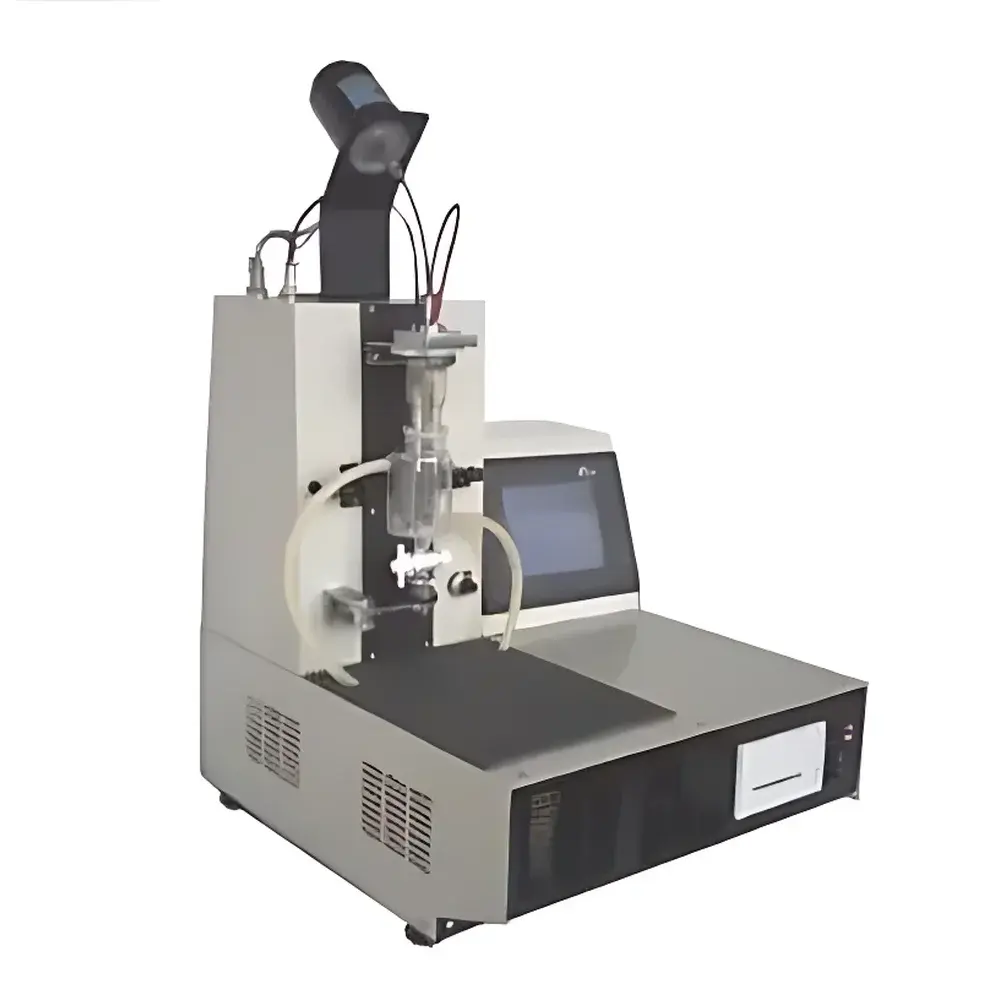
Xufeng AP-L2 Automatic Low-Temperature Aniline Point Tester
| Brand | Xufeng |
|---|---|
| Origin | Shanghai, China |
| Model | AP-L2 |
| Temperature Range | 0 °C to 170 °C |
| Aniline Point Repeatability | ±0.2 °C (light-colored oils), ±0.4 °C (dark-colored oils |
| Temperature Sensor | Pt100 Platinum Resistance Thermometer |
| Heating Power | 30 W |
| Stirring Motor Power | 6 W |
| Display | Large Touchscreen LCD |
| Data Storage Capacity | 99 test records |
| Interface | RS-232C serial port |
| Dimensions (Controller) | 230 W × 430 D × 110 H mm |
| Dimensions (Testing Unit) | 230 W × 340 D × 540 H mm |
| Weight | 20 kg |
| Compliance | GB/T 262, ASTM D611, ISO 2977 |
Overview
The Xufeng AP-L2 Automatic Low-Temperature Aniline Point Tester is a precision-engineered instrument designed for the standardized determination of aniline point and mixed aniline point in petroleum products and hydrocarbon solvents. Based on the principle of visual phase transition detection—where the sample and aniline form a homogeneous solution upon heating—the instrument precisely identifies the lowest temperature at which complete miscibility occurs. Unlike conventional manual methods, the AP-L2 integrates thermoelectric cooling (Peltier-based), programmable thermal control, and real-time optical monitoring to deliver reproducible results across a wide range of feedstocks—including light naphthas, diesel fractions, lubricating base oils, and highly colored residual fuels (ASTM Color Number > 8.0). Its extended low-temperature capability (0 °C to 170 °C) enables accurate characterization of high-paraffin or low-volatility samples that may exhibit ambiguous cloud points near ambient conditions, making it particularly suitable for refinery QC labs, fuel formulation centers, and third-party testing facilities operating under GB/T 262, ASTM D611, and ISO 2977 protocols.
Key Features
- Four configurable test modes: Standard Protocol (SP), Quick Protocol (QP), Search Protocol (SR), and Special Oil Protocol (TP)—each optimized for distinct sample matrices and regulatory reporting requirements.
- Integrated Peltier cooling module ensures stable sub-ambient temperature control (down to 0 °C), eliminating dependency on external chillers or cryogenic media.
- Automated thermal profiling: precise ramping, isothermal holding, and controlled cooling—all synchronized with real-time optical transmittance monitoring via calibrated photodetector.
- Self-diagnostic firmware continuously monitors sensor integrity, heater/stirrer functionality, and thermal uniformity; triggers system-level fault logging and safety shutdown if deviations exceed preset thresholds.
- Large capacitive touchscreen interface supports multilingual UI (English default), intuitive parameter entry, and real-time visualization of temperature curve, light transmission %, and phase transition event marker.
- Built-in thermal line printer with RS-232C interface enables direct hardcopy output compliant with GLP documentation standards—including timestamp, sample ID, test mode, measured aniline point, and operator-defined metadata.
Sample Compatibility & Compliance
The AP-L2 accommodates both transparent and opaque petroleum samples without pre-treatment or dilution. Its optical detection system compensates for varying turbidity by dynamically adjusting photodetector gain and baseline referencing, enabling reliable endpoint detection even in dark-colored distillates (e.g., cracked gas oils, heavy fuel oils). The instrument fully complies with the procedural rigor of GB/T 262 (Chinese National Standard), ASTM D611 (American Society for Testing and Materials), and ISO 2977 (International Organization for Standardization). All thermal calibration traces are referenced to NIST-traceable Pt100 sensors, and temperature stability is maintained within ±0.1 °C during isothermal phases. Data audit trails—including raw sensor outputs, user actions, and system events—are time-stamped and stored locally, supporting FDA 21 CFR Part 11 readiness when integrated with validated LIMS environments.
Software & Data Management
No external PC software is required for routine operation; all control logic, data acquisition, and result calculation reside onboard the embedded ARM Cortex-M7 processor. Test records—including date/time stamp, sample identifier, selected protocol, expected and measured aniline point, optical signal profile, and diagnostic status—are stored in non-volatile memory (99-entry capacity). Each record is uniquely indexed and exportable via RS-232C using ASCII-delimited format compatible with Excel, LabWare, or Watson LIMS. Optional firmware updates are delivered via USB flash drive and include version-controlled change logs aligned with ISO/IEC 17025 clause 5.9.2 requirements for method validation traceability.
Applications
- Refinery process control: Monitoring aromatic content trends in hydrotreated naphthas and kerosene cuts to optimize reformer feed quality.
- Fuel blending verification: Confirming compatibility between bio-derived esters (e.g., FAME) and conventional diesel streams based on aniline point depression behavior.
- Lubricant base stock classification: Differentiating Group I, II, and III oils per API base oil interchangeability guidelines.
- Research & development: Correlating aniline point with cetane number, ignition delay, and sooting propensity in advanced combustion studies.
- Contract testing laboratories: Delivering auditable, standards-compliant reports for ASTM-certified product certification and customs clearance documentation.
FAQ
What is the minimum sample volume required for analysis?
A single test requires 1.0 mL of sample and 1.0 mL of reagent-grade aniline, loaded into the standardized borosilicate glass cell.
Can the AP-L2 be used for mixed aniline point determination?
Yes—the SR (Search) and TP (Special Oil) modes support sequential addition of multiple aniline variants (e.g., ortho-, meta-, para-substituted derivatives) to determine mixed aniline point per ASTM D611 Section 8.
Is calibration verification traceable to national standards?
The Pt100 sensor is factory-calibrated against NIST SRM 1750a (Standard Reference Material for Industrial Platinum Resistance Thermometers); users may perform field verification using certified dry-block calibrators with ±0.05 °C uncertainty.
Does the instrument support remote monitoring or network integration?
While the AP-L2 operates as a standalone unit, its RS-232C interface allows integration with SCADA systems or centralized lab networks via standard Modbus RTU or custom ASCII command sets (protocol documentation available upon request).
How often does the optical window require cleaning or replacement?
Under normal usage, the fused silica observation window remains contamination-free for ≥500 tests; cleaning is recommended only after visible residue accumulation using lint-free wipes and spectroscopic-grade isopropanol.