
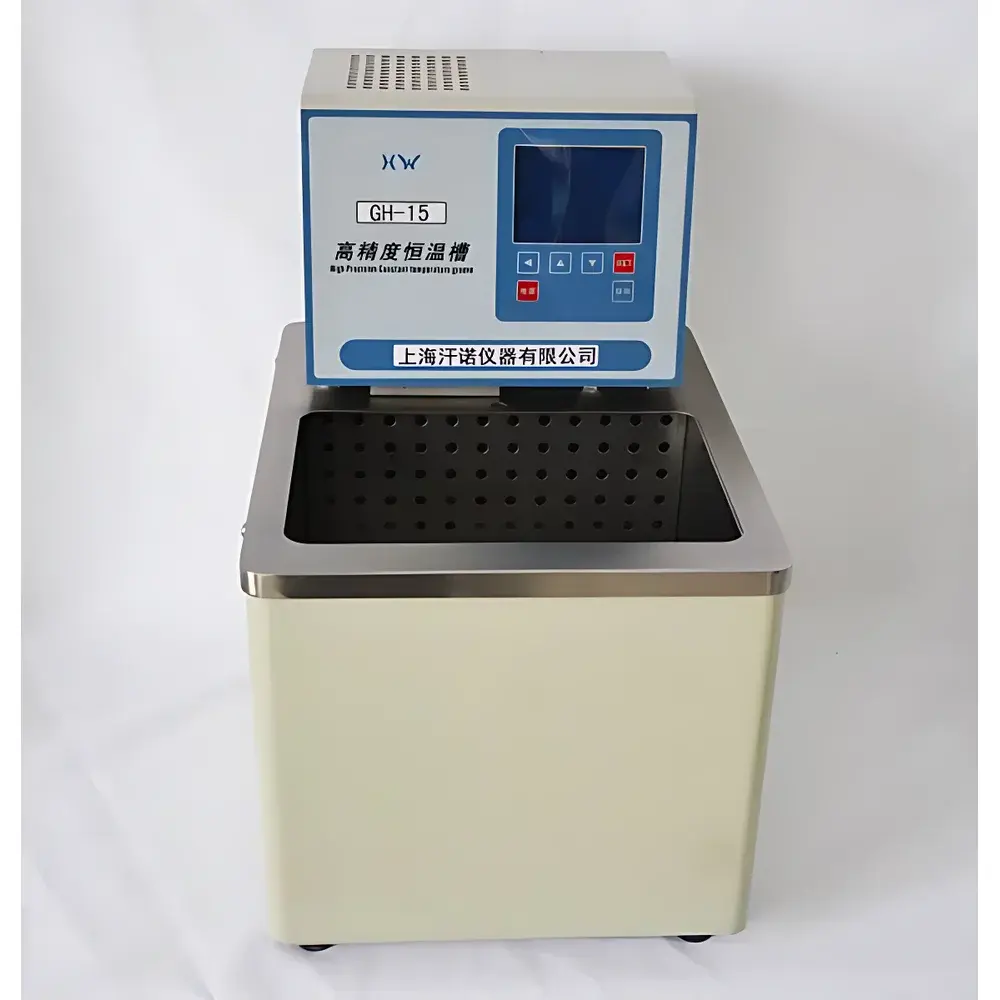
Hanuo GH-15A High-Precision Constant-Temperature Circulating Bath
| Brand | Hanuo |
|---|---|
| Origin | Shanghai, China |
| Model | GH-15A |
| Bath Volume | 15 L |
| Temperature Range | Ambient to 200 °C |
| Temperature Stability | ±0.01 °C |
| Control Mode | Heating-Only PID |
| Circulation Type | Internal Recirculation |
| Display | Dual LED (Setpoint & Actual Temperature) |
| Resolution | 0.001 °C |
| Temperature Uniformity | ≤±0.02 °C across bath volume |
| Working Chamber Dimensions | 300 × 250 × 200 mm (W × D × H) |
| Opening Size | 235 × 160 mm |
| Power Supply | 220 VAC, 50/60 Hz |
Overview
The Hanuo GH-15A High-Precision Constant-Temperature Circulating Bath is an engineered thermal stability platform designed for laboratories requiring tight temperature control in applications ranging from calibration of reference thermometers and sensor validation to controlled reaction monitoring and material property testing. Operating on a resistive heating principle with high-efficiency immersion heaters and a thermally optimized stainless-steel bath chamber, the GH-15A maintains setpoint stability within ±0.01 °C under static load conditions—achievable through a multi-stage PID algorithm that dynamically adjusts power output based on real-time feedback from a calibrated Pt100 platinum resistance thermometer (PRT) probe. Unlike basic water baths, this unit supports both aqueous and silicone oil media, enabling operation across ambient to 200 °C without hardware modification. Its compact desktop footprint (W380 × D320 × H420 mm) integrates seamlessly into analytical workstations while maintaining sufficient thermal mass for low-drift performance.
Key Features
- High-resolution dual LED display showing simultaneous setpoint and actual bath temperature (0.001 °C resolution)
- Intelligent adaptive PID temperature controller with auto-tuning capability and programmable ramp/soak profiles
- Stainless-steel working chamber (300 × 250 × 200 mm) with corrosion-resistant finish and precisely machined opening (235 × 160 mm) for optimal probe or vessel access
- Dedicated internal recirculation pump (flow rate: ~8 L/min) ensuring uniform thermal distribution (≤±0.02 °C spatial deviation at 100 °C)
- Over-temperature protection circuitry with independent mechanical cutoff (cut-off threshold: 210 °C) compliant with IEC 61010-1 safety standards
- Low-noise operation (<45 dB(A)) suitable for shared laboratory environments and vibration-sensitive instrumentation setups
- Optional external cooling interface compatible with chilled water supply (e.g., refrigerated circulators) for rapid cooldown from elevated temperatures
Sample Compatibility & Compliance
The GH-15A accommodates standard laboratory glassware including 1000 mL beakers, 500 mL jacketed reactors, and calibration wells up to Ø150 mm diameter. Its open-bath configuration allows direct immersion of thermocouples, RTDs, infrared sensors, and optical cells. The unit complies with ISO/IEC 17025 requirements for temperature-controlled equipment used in accredited testing laboratories. It supports traceable calibration per ASTM E74 and ISO 17034 when operated with NIST-traceable reference probes. For regulated environments—including pharmaceutical QC labs—the system supports GLP-compliant operation when paired with validated data logging software (see Software & Data Management). No hazardous substances are used in construction; all wetted parts meet USP Class VI biocompatibility criteria.
Software & Data Management
While the GH-15A operates as a standalone instrument, it features an RS232 serial interface (optional USB-to-RS232 adapter) for integration into centralized lab management systems. Third-party software such as LabVIEW, MATLAB, or custom Python scripts can acquire real-time temperature readings and control setpoints via ASCII command protocol. Audit trail functionality—including operator ID, timestamped parameter changes, and alarm events—is enabled when connected to compliant electronic lab notebooks (ELNs) or LIMS platforms. The device meets foundational requirements for FDA 21 CFR Part 11 compliance when deployed with appropriate system validation documentation and user access controls.
Applications
- Calibration and verification of temperature sensors (thermocouples, RTDs, thermistors) against reference standards
- Thermal stability testing of polymers, adhesives, and phase-change materials under controlled isothermal conditions
- Enzyme kinetics studies requiring precise incubation at physiological or elevated temperatures
- Viscometry support: pre-conditioning of samples prior to rotational or capillary viscosity measurement
- Reflux and distillation support in synthetic organic chemistry workflows
- Temperature-dependent spectroscopic measurements (UV-Vis, FTIR) where thermal drift affects baseline stability
- Accelerated aging tests per IEC 60068-2-2 (dry heat) and MIL-STD-810G Method 501.6
FAQ
What is the maximum recommended operating temperature using water versus silicone oil?
Water is rated up to 95 °C for prolonged use; above this, silicone oil (e.g., Dow Corning 200 Fluid, 50 cSt) must be used to prevent boiling, oxidation, and vapor pressure issues.
Does the GH-15A support external temperature feedback from a sample probe?
No—it uses only its built-in Pt100 bath sensor for control. External probe input requires optional retrofit or integration with external PID controllers.
Is the internal circulation pump adjustable in flow rate?
Flow is fixed at optimal velocity for thermal homogeneity; variable-speed pumping is not implemented to preserve long-term reliability and minimize cavitation risk.
Can the unit be used for cryogenic applications?
No—the GH-15A is a heating-only system. For sub-ambient operation, consider Hanuo’s complementary GH-LT series low-temperature circulating chillers.
How often should the bath fluid be replaced for optimal performance?
With distilled water and regular deionization maintenance, replacement intervals exceed 6 months; with silicone oil, annual replacement is recommended under continuous 150–200 °C operation.



