
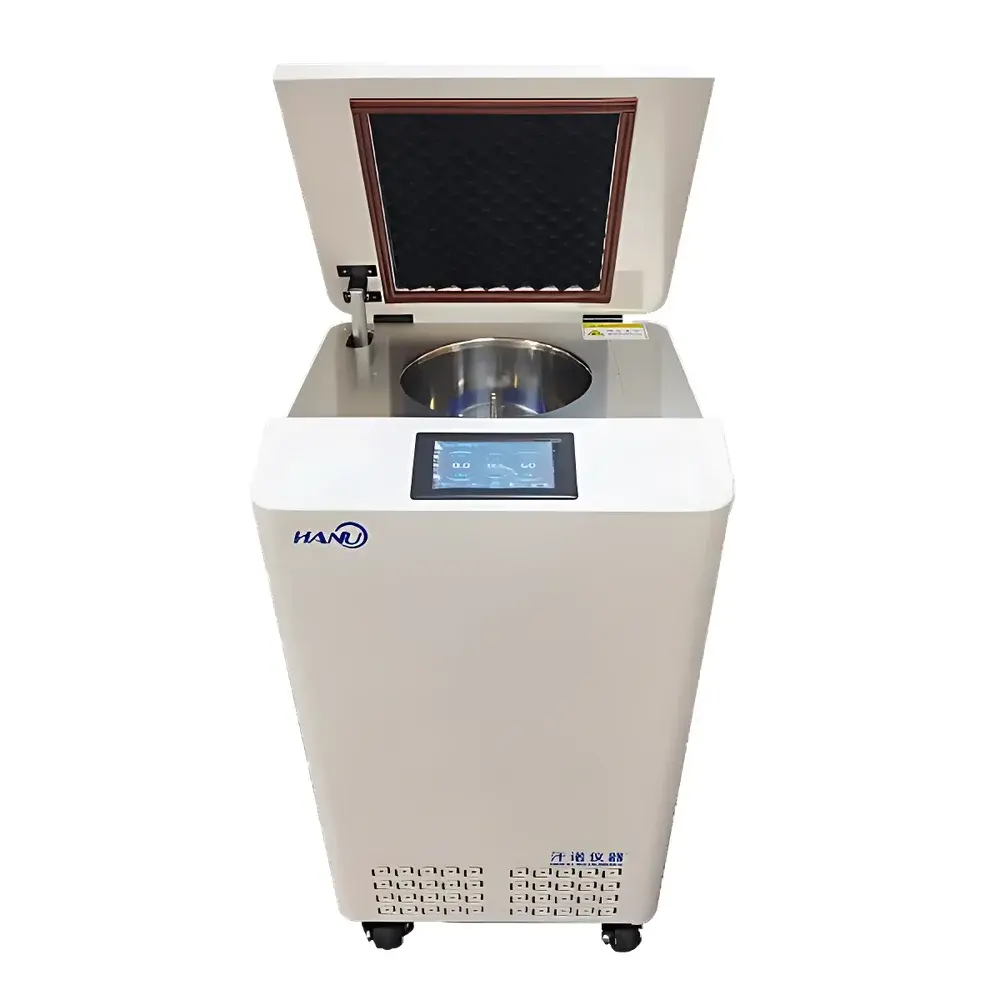
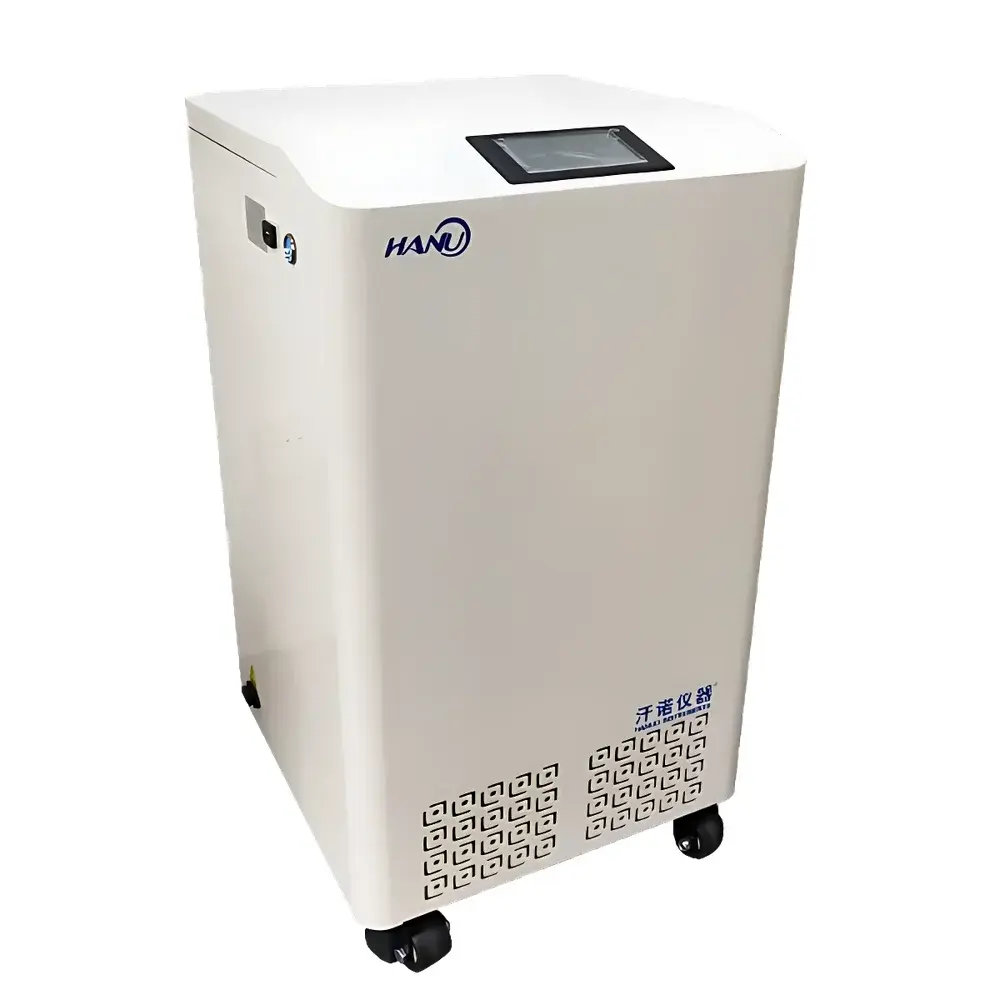
Hanuo Daxluot-192C Cryogenic High-Throughput Tissue Grinder
| Brand | Hanuo |
|---|---|
| Origin | Shanghai, China |
| Model | Daxluot-192C |
| Throughput | Up to 192 × 2 mL samples per run |
| Cryogenic Range | –50 °C to ambient |
| Frequency Range | 0–70 Hz |
| Final Particle Size | ~5 µm |
| Sample Compatibility | 192 × 2 mL, 96 × 2 mL, 12 × 5 mL, 8 × (7–15) mL, 2 × 25 mL, 2 × 50 mL |
| Display | Touchscreen interface with 10 programmable protocols |
| Safety | Auto-centering clamping system with mechanical safety lock |
| Grinding Modes | Dry, wet, and cryogenic grinding |
| Noise Level | <55 dB(A) |
| Acceleration/Deceleration | ≤2 s to max/min speed |
| Grinding Media | Stainless steel, chrome steel, zirconia, tungsten carbide, quartz sand (Ø 0.1–30 mm) |
Overview
The Hanuo Daxluot-192C is a high-throughput, cryogenically enabled tissue grinder engineered for reproducible, scalable mechanical lysis of biological and environmental samples under controlled thermal conditions. It operates on the principle of high-frequency vertical vibration—distinct from orbital or horizontal motion—to deliver uniform kinetic energy transfer across all sample positions simultaneously. This architecture eliminates inter-row variability inherent in arc-motion grinders, ensuring statistically comparable lysis efficiency across all 192 wells in a single run. The integrated closed-loop refrigeration system maintains sample temperatures between –50 °C and ambient, preserving labile biomolecules (e.g., RNA, phosphoproteins, metabolites) during homogenization and minimizing enzymatic degradation or thermal denaturation. Designed for compliance-critical workflows—including nucleic acid extraction, microbiome profiling, and biobanking—the instrument supports GLP-aligned operation through traceable parameter logging and protocol-based execution.
Key Features
- Vertical vibration drive mechanism ensures zero batch-to-batch positional bias and eliminates cross-contamination risk associated with horizontal shaking.
- Cryogenic cooling down to –50 °C via sealed compressor-based system; temperature is continuously monitored and adjustable in 1 °C increments.
- Programmable frequency range (0–70 Hz) with ramp-up/ramp-down control (≤2 s), enabling precise optimization for fragile vs. robust matrices (e.g., yeast cell walls vs. fibrous plant stems).
- Touchscreen HMI with 10 user-defined protocol slots, real-time status feedback, and automatic parameter recall for audit-ready repeatability.
- Auto-centering dual-clamp system with mechanical safety lock prevents tube ejection during operation—even at maximum amplitude—and conforms to IEC 61000-4-2 ESD and IEC 61010-1 safety standards.
- Modular adapter compatibility: standardized mounting for 192 × 2 mL tubes, 96-well plates, 5 mL, 7–15 mL, 25 mL, and 50 mL vessels; custom adapters available for 96-well PCR plates and ISO-standard microtubes.
Sample Compatibility & Compliance
The Daxluot-192C accommodates diverse sample types without modification: soft tissues (liver, muscle), fibrous plant material (wheat straw, cotton fibers), mineral-rich matrices (bone, soil), microbial cultures (Gram-positive bacteria, fungal spores), and cryopreserved specimens. Its sub-zero operational envelope meets ASTM D7279 and ISO 17025 requirements for low-temperature sample preparation prior to downstream molecular analysis. For regulated environments, the instrument’s parameter-lock function and non-volatile protocol storage support FDA 21 CFR Part 11 compliance when paired with validated LIMS integration. All grinding media—zirconia, tungsten carbide, stainless steel—are certified free of DNase/RNase and heavy-metal leachables per USP particulate matter testing.
Software & Data Management
The embedded firmware logs timestamped records of frequency, duration, temperature setpoint, actual chamber temperature, and cycle count for each run. Data export is supported via USB 2.0 to CSV format, compatible with laboratory information management systems (LIMS) and electronic lab notebooks (ELN). Protocol templates can be duplicated, versioned, and password-protected to enforce SOP adherence. No cloud connectivity or remote access is implemented—ensuring full data sovereignty and alignment with institutional cybersecurity policies governing sensitive biological data.
Applications
- High-yield genomic DNA and total RNA isolation from >192 clinical or field-collected samples in parallel—reducing hands-on time by >85% versus manual mortar-and-pestle or bead-beating methods.
- Metabolite stabilization in plant phenotyping studies where flash-freezing alone fails to inhibit rapid enzymatic turnover (e.g., polyphenol oxidase in apple tissue).
- Pre-analytical processing for spatial transcriptomics, where intact nuclei must be liberated without nuclear membrane rupture—achievable via low-frequency, cryo-optimized cycles.
- Soil microbiome characterization requiring simultaneous disruption of gram-positive bacterial spores and fungal hyphae while retaining archaeal community integrity.
- GMP-compliant raw material homogenization for biopharmaceutical QC, including lyophilized cell pellets and excipient blends.
FAQ
What is the minimum and maximum sample volume per tube?
Standard configurations support 0.1–2 mL (2 mL tubes), 3–5 mL (5 mL tubes), and 7–50 mL (larger vessels); optimal fill volume is 10–30% of tube capacity to ensure effective bead collision.
Can the instrument be used without cryogenic cooling?
Yes—ambient-temperature grinding is fully supported; the refrigeration system is independently controllable and may be disabled for non-thermosensitive applications.
Is validation documentation available for GxP environments?
Factory-issued IQ/OQ documentation is provided; PQ templates aligned with ISO/IEC 17025 are included for user-specific method qualification.
How is cross-contamination prevented between runs?
All contact surfaces (adapter plates, clamps, housing interior) are autoclavable or compatible with 70% ethanol and RNaseZap® decontamination; no internal airflow pathways exist.
What regulatory standards does the grinding media comply with?
Zirconia and stainless-steel beads are supplied with CoA confirming absence of detectable RNase/DNase activity (limit of detection: <0.01 U/mL) and compliance with USP Class VI biocompatibility testing.



