
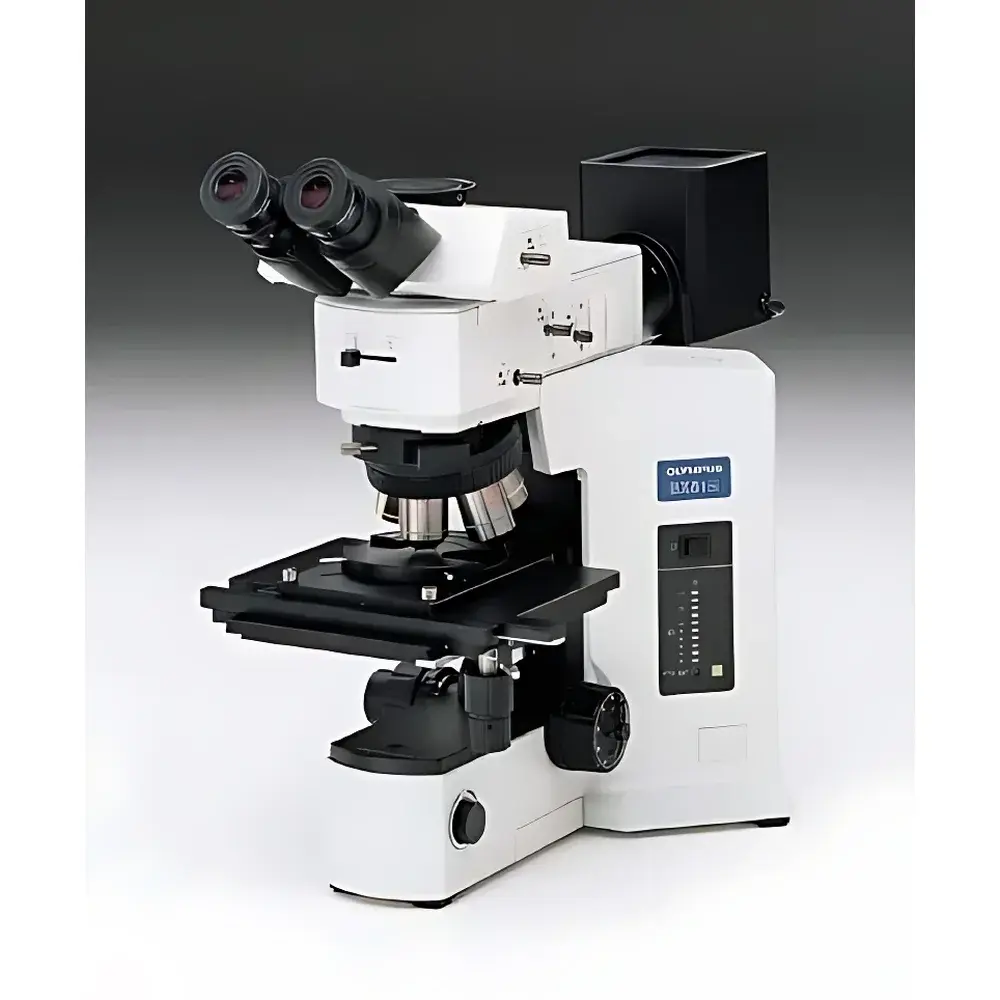
Olympus BX51/BX51M Research-Grade Upright Metallurgical Microscope
| Brand | Olympus |
|---|---|
| Origin | Japan |
| Manufacturer Type | Original Equipment Manufacturer (OEM) |
| Product Origin | Imported |
| Model | BX51 / BX51M |
| Pricing | Available Upon Request |
Overview
The Olympus BX51/BX51M is a high-precision upright metallurgical microscope engineered for advanced materials science research, quality control in metallography, and failure analysis laboratories. Designed around the UIS2 (Universal Infinity System 2) optical platform—an industry-standard infinite-conjugate optical architecture—the system delivers diffraction-limited resolution, exceptional flatness across the entire field of view (FOV), and chromatic and spherical aberration correction essential for quantitative microstructural characterization. The microscope supports multiple contrast mechanisms—including brightfield, darkfield, differential interference contrast (DIC), simple polarized light, and fluorescence—enabling comprehensive multimodal analysis of polished, etched, or coated metallic, ceramic, and composite specimens. Its modular mechanical design accommodates both reflected-light (epi-illumination) and transmitted-light observation configurations, with dedicated optical pathways optimized for high-NA imaging and low-noise signal capture. The BX51M variant is specifically configured for reflected-light-only applications, while the BX51 supports dual illumination modes, making it suitable for hybrid sample workflows involving transparent or semi-transparent inclusions within opaque matrices.
Key Features
- UIS2 optical system with fully corrected infinity-corrected objectives (PLAPON series), delivering consistent MTF performance from 5× to 100× magnification and enabling seamless integration with digital cameras and spectroscopic accessories.
- Modular upright stand with split-body construction: accommodates specimens up to 65 mm in height (BX51M) or 25 mm (standard BX51 configuration), supporting large castings, cross-sectioned welds, and wafer-scale samples.
- Ergonomic tilt-angle binocular and trinocular observation tubes (incl. FOV number 22 and 26.5 variants), reducing cervical strain during extended analytical sessions; all tubes maintain parfocality and parcentricity across magnifications.
- Motorized and manual objective turrets available: 5–7 position turrets with DIC-compatible alignment, center-output options for rapid high-magnification repositioning, and integrated DIC prism sliders (U-DICR, U-DICRH, U-DICRHC) for adjustable contrast/resolution trade-offs.
- Reflected-light illumination system with interchangeable lamp housings (100 W halogen, 100 W mercury, 75 W xenon, or fiber-optic coupling); ND filter linkage with brightfield/darkfield switching ensures stable photopic adaptation and operator eye safety during intensity transitions.
- Adjustable fine-focus mechanism: rubber-coated coaxial fine-adjustment knob with 0.1 mm/rev sensitivity and 35 mm total travel; detachable and repositionable to left/right side per user preference.
Sample Compatibility & Compliance
The BX51/BX51M accommodates diverse specimen geometries via interchangeable mechanical stages: standard U-MSSP4 (100 × 100 mm), wafer-handling U-WHP2 (compatible with 4-inch semiconductor wafers), and transmission-capable U-MSSPG glass plate stage. Specimen height clearance, stage travel range (up to 100 × 105 mm XY), and robust Z-axis stability meet ASTM E3-22 and ISO 4967 requirements for metallographic evaluation. All optical components comply with JIS B 7152 and DIN EN 61000-6-3 electromagnetic compatibility standards. When equipped with certified DIC prisms and polarization modules, the system supports ISO 10816-3 surface roughness correlation studies and ASTM E112 grain size analysis workflows under GLP-compliant documentation protocols.
Software & Data Management
The microscope integrates natively with Olympus cellSens™ Digital Imaging Software (v2.4+), supporting automated acquisition, multi-channel fluorescence registration, DIC vector analysis, and measurement traceability compliant with FDA 21 CFR Part 11 when deployed with audit trail and electronic signature modules. Image metadata—including objective ID, illumination mode, exposure parameters, and stage coordinates—is embedded in TIFF and OME-TIFF formats. Optional hardware synchronization enables time-lapse acquisition synchronized with external environmental chambers or tensile testers. All calibration data (e.g., pixel-to-µm scaling, intensity linearity) is stored in instrument-specific profiles, ensuring reproducibility across multi-user lab environments.
Applications
- Quantitative metallography: phase fraction analysis, inclusion rating (ASTM E45), grain size determination (ASTM E112), and carbide distribution mapping in steels and superalloys.
- Failure analysis: crack propagation path identification, intergranular corrosion assessment, and solder joint integrity evaluation in electronics packaging.
- Thin-film and coating metrology: thickness uniformity assessment via interference contrast, delamination detection using polarized light, and stress-induced birefringence quantification.
- Semiconductor process control: defect inspection on polished silicon wafers, CMP residue analysis, and gate oxide integrity screening using fluorescence-enhanced DIC.
- Geological and mineralogical research: anisotropic crystal identification, twin boundary mapping, and refractive index correlation in polished thin sections.
FAQ
Is the BX51 compatible with third-party digital cameras and software?
Yes—via C-mount adapter and USB 3.0/Thunderbolt interface; Olympus provides SDK support for custom API integration.
Can the BX51 perform quantitative image analysis without cellSens?
Basic measurements (length, area, angle) are supported through the built-in eyepiece graticule and stage micrometer calibration; full statistical analysis requires cellSens or compatible第三方 platforms like ImageJ/Fiji with Olympus plugin libraries.
What maintenance is required for long-term optical performance?
Annual alignment verification of Köhler illumination and DIC shear direction; biannual cleaning of objective rear elements and condenser optics using ISO-certified lens tissue and reagent-grade ethanol.
Does the BX51M support transmitted-light observation?
No—the BX51M is exclusively configured for reflected-light microscopy; only the BX51 model includes optional transmitted-light illumination capability.
Are DIC prisms interchangeable between BX51 and BX53 platforms?
Yes—U-DICR-series prisms are mechanically and optically compatible across UIS2-based Olympus upright microscopes, including BX51, BX53, and BX63 models.





