
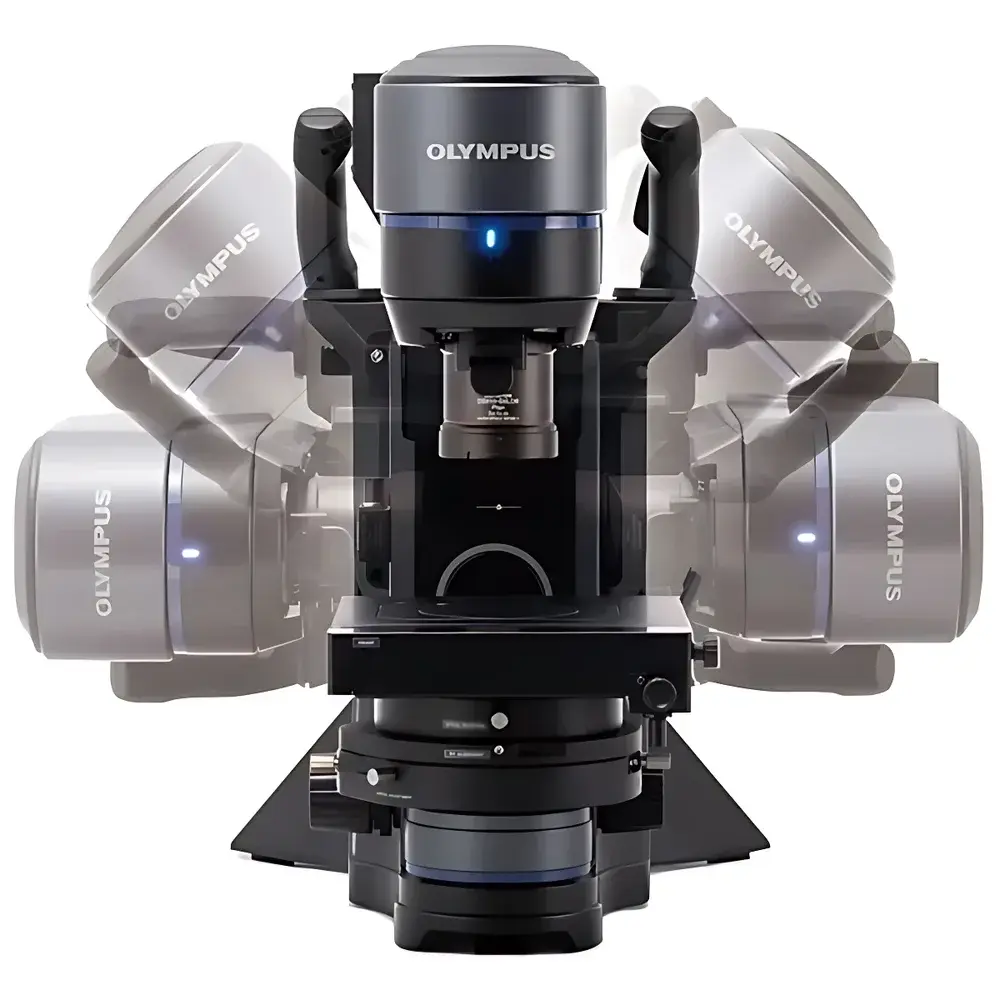
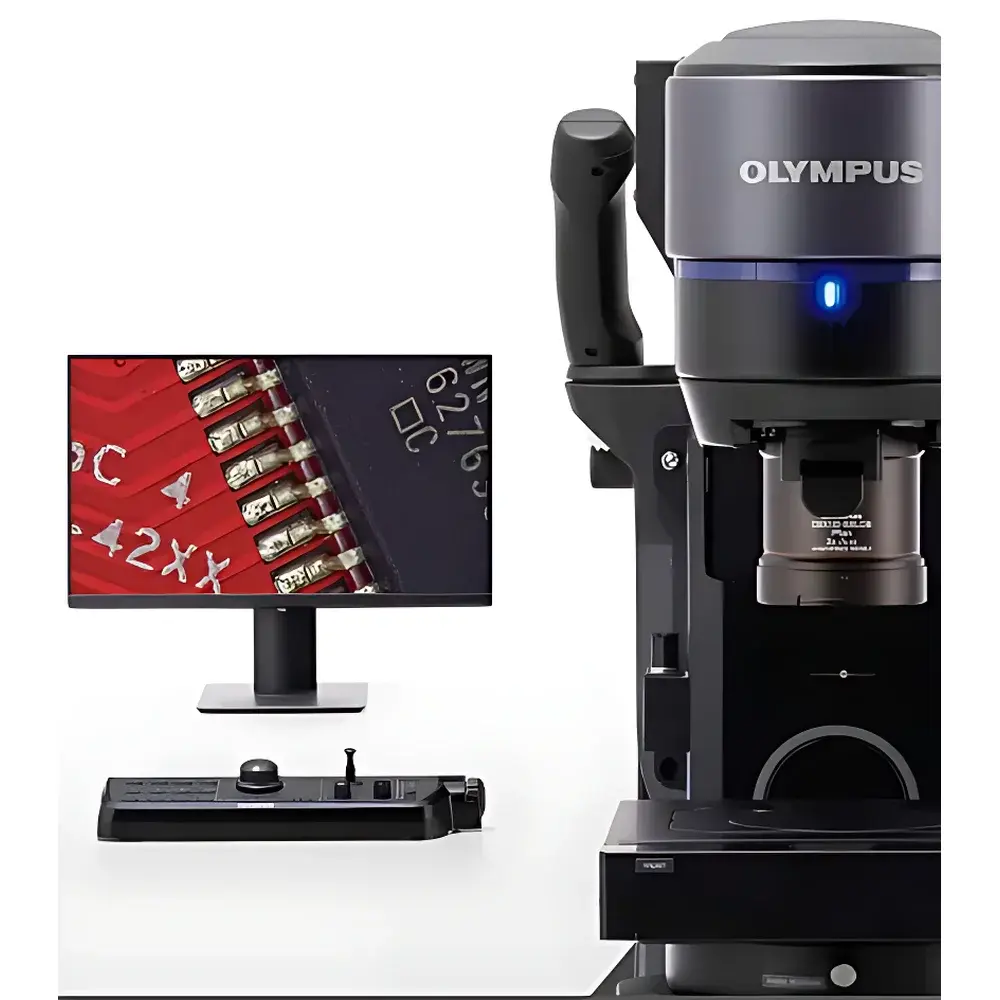
Olympus DSX1000 Digital Microscope
| Brand | Olympus |
|---|---|
| Origin | Japan |
| Manufacturer | Olympus Corporation |
| Product Type | Imported Digital Microscope |
| Model | DSX1000 |
| Pricing | Upon Request |
Overview
The Olympus DSX1000 is a high-performance industrial digital microscope engineered for precision inspection, metrology, and materials analysis in R&D, quality control, and failure analysis laboratories. Built upon a telecentric optical architecture, the DSX1000 eliminates perspective distortion across its full 20–7,000× magnification range—ensuring geometric fidelity essential for quantitative measurement and comparative morphological assessment. Unlike conventional microscopes with angular-dependent magnification, the telecentric design maintains consistent pixel-to-length calibration regardless of focus position or working distance, enabling traceable, repeatable measurements compliant with ISO 9022-3 (optical instruments — environmental testing) and ASTM E2859 (standard guide for digital imaging in microscopy). The system integrates a motorized zoom optical path, 15 objective lenses—including long-working-distance (LWD) optics—and six simultaneous observation modes, allowing seamless transitions between qualitative visualization and quantitative evaluation without mechanical reconfiguration.
Key Features
- Ultra-Broad Magnification Range: 20× to 7,000× continuous zoom, achieved via 15 interchangeable objectives—including specialized LWD lenses optimized for tall, irregular, or reflective samples such as PCBs, machined components, wafers, and automotive assemblies.
- 6 Integrated Observation Methods: Motorized switching between brightfield, darkfield, MIX (composite illumination), polarized light, simplified polarization, and differential interference contrast (DIC)—each calibrated for optimal signal-to-noise ratio and surface topography enhancement.
- Biaxial Articulation System: Independent ±90° tilt capability for both the objective head and XY-stage, facilitating oblique-angle imaging, cross-sectional profiling, and multi-faceted inspection of complex geometries without sample repositioning.
- Accelerated 3D Imaging Algorithm: Proprietary depth-scanning engine reduces Z-stack acquisition time by up to 9× versus prior Olympus digital microscope platforms, supporting rapid surface reconstruction and volumetric metrology.
- Factory-Calibrated Telecentric Optics: Each unit undergoes on-site installation calibration by Olympus-certified engineers, aligning magnification scaling, stage movement, and illumination uniformity to the user’s specific environmental conditions (e.g., vibration profile, ambient temperature stability, and lighting setup).
Sample Compatibility & Compliance
The DSX1000 accommodates diverse sample classes—from silicon wafers and photovoltaic cells to injection-molded polymers and metal fatigue specimens—without requiring conductive coating or vacuum environments. Its long-working-distance objectives (up to 100 mm) permit unobstructed access for probes, manipulators, or thermal stages. The system supports ISO/IEC 17025-compliant workflows through audit-trail-enabled software logging, user-access controls, and instrument parameter locking. All measurement data adhere to NIST-traceable calibration protocols, and optional validation packages support FDA 21 CFR Part 11 compliance for regulated manufacturing environments (e.g., medical device or semiconductor fabrication).
Software & Data Management
Olympus DSX Manager software provides a unified interface for image capture, annotation, measurement (length, area, angle, roughness, step height), automated report generation (PDF/Excel), and database archiving. Measurement functions include edge detection with sub-pixel interpolation, dynamic threshold adjustment, and multi-point reference calibration. Raw image metadata—objective ID, magnification, illumination mode, stage coordinates, and timestamp—is embedded in TIFF and proprietary .dsx files. Exported datasets retain full metrological context for third-party statistical process control (SPC) integration or GLP/GMP documentation requirements.
Applications
- Failure analysis of semiconductor interconnects and solder joints using polarized and DIC contrast to reveal micro-cracks and grain boundary anomalies.
- Surface defect mapping on solar cell wafers, distinguishing micron-scale scratches from contamination via MIX-mode illumination differentiation.
- Dimensional verification of micro-machined features in aerospace components, leveraging telecentric magnification stability for GD&T-conformant reporting.
- Non-destructive inspection of coated surfaces (e.g., anodized aluminum, PVD films) where traditional SEM preparation would compromise integrity.
- Education and training in materials science labs, where intuitive interface design and real-time image annotation accelerate student competency development.
FAQ
Does the DSX1000 require external calibration standards for routine measurement verification?
No—each system includes a certified calibration slide with NIST-traceable line-pair and step-height standards. Daily verification can be performed using built-in software routines that auto-validate pixel scaling and Z-axis linearity.
Can the DSX1000 integrate with existing laboratory information management systems (LIMS)?
Yes—via configurable API and standardized file export (CSV, XML, TIFF with EXIF tags), enabling bidirectional data exchange with major LIMS platforms including LabWare, Thermo Fisher SampleManager, and STARLIMS.
Is the telecentric optical path compatible with extended-depth-of-field (EDF) image synthesis?
Yes—the motorized Z-drive and synchronized camera triggering support hardware-accelerated EDF stacking, with real-time preview and post-processing options for surface topology modeling.
What environmental conditions are required for optimal measurement repeatability?
Olympus recommends stable ambient temperature (20–25°C ±1°C/hour), low-vibration mounting (ISO 25316 Class 2 or better), and controlled ambient lighting to minimize stray reflections on reflective samples.
How does the DSX1000 handle highly reflective or transparent samples?
The six observation modes—including adjustable polarized illumination and ring-light darkfield—enable dynamic suppression of glare and enhancement of phase gradients, eliminating the need for anti-reflection coatings or immersion media.





