
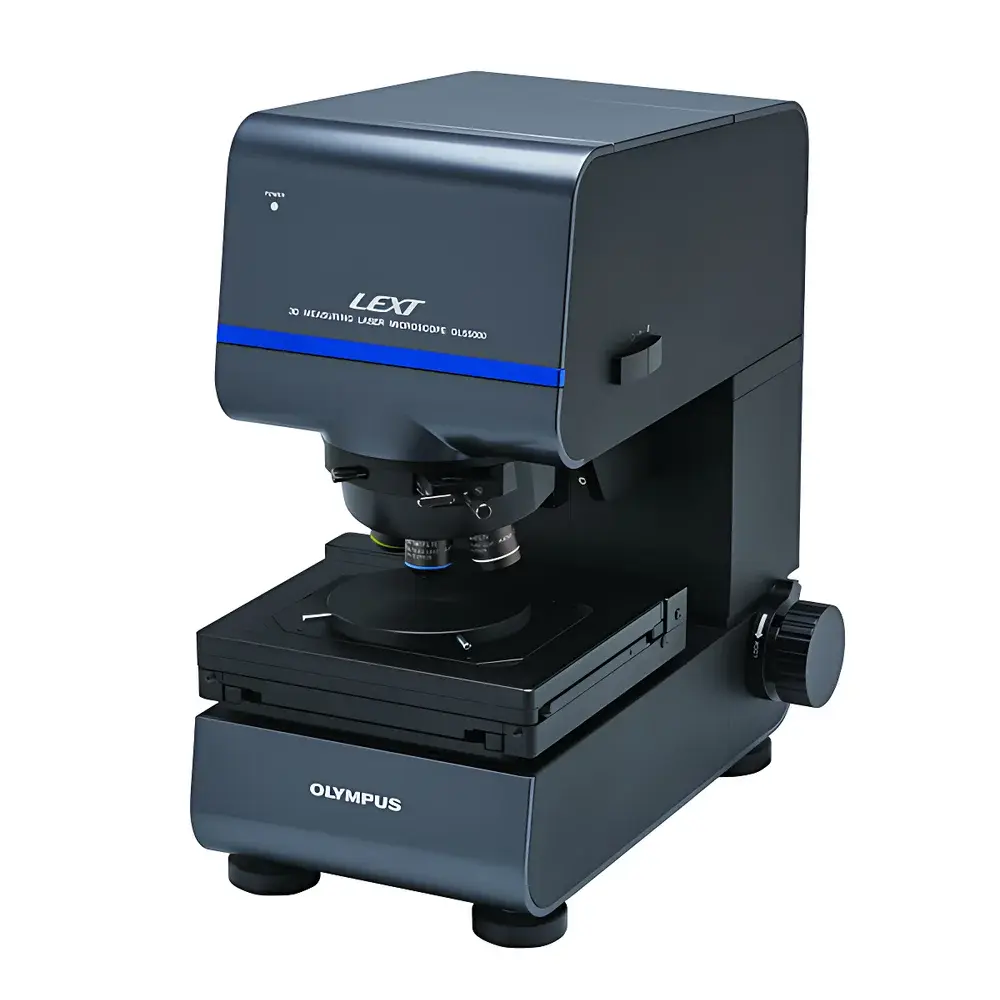
Olympus OLS5000 3D Laser Scanning Confocal Microscope
| Brand | Olympus |
|---|---|
| Origin | Japan |
| Manufacturer Type | Original Equipment Manufacturer (OEM) |
| Product Origin | Imported |
| Model | OLS5000 |
| Pricing | Upon Request |
Overview
The Olympus OLS5000 is a high-precision 3D laser scanning confocal microscope engineered for non-contact, sub-micrometer surface topography and roughness characterization. It operates on the principle of laser confocal point scanning—using a focused 405 nm violet laser beam and pinhole-based optical sectioning—to reject out-of-focus light and deliver true axial resolution. Unlike conventional brightfield or white-light interferometric systems, the OLS5000 achieves superior lateral resolution (< 120 nm) and vertical resolution down to ~0.5 nm (typical), enabling reliable detection of nanoscale features such as grain boundaries, machining marks, micro-cracks, and thin-film step heights. Its dual-optical architecture integrates a full-color CMOS imaging path with a dedicated confocal laser path, allowing simultaneous acquisition of photorealistic color images and quantitative height maps—critical for correlating visual appearance with dimensional metrology in R&D and quality control environments.
Key Features
- 4K-resolution scanning: 4096-pixel lateral sampling along the X-axis—four times the pixel density of prior-generation models—enhances height fidelity, improves signal-to-noise ratio by 2×, and enables robust measurement of steep slopes up to 87.5° without shadowing artifacts.
- Dual-optical system: Independent color imaging optics and confocal laser optics ensure concurrent capture of RGB texture data and calibrated Z-height data—eliminating registration errors between visual and metrological datasets.
- LEXT-optimized objective lens suite: Includes long-working-distance (LWD) and standard-working-distance objectives (e.g., MPLFLN10×LEXT), all rigorously validated for traceable height measurement performance per ISO 25178-601 and JIS B 0601 standards.
- PEAK algorithm for rapid 3D reconstruction: A proprietary peak-detection-based height calculation method that maintains accuracy across magnifications—from 10× to 100×—while reducing scan time by up to 75% compared to conventional centroid or intensity-threshold algorithms.
- Extended sample capacity: Optional height extension stage supports specimens up to 210 mm tall while preserving factory-calibrated measurement repeatability (σ < 0.15 nm for repeated 80 nm VLSI reference step measurements).
Sample Compatibility & Compliance
The OLS5000 accommodates diverse sample geometries—including reflective metals, semiconductors, ceramics, polymers, and coated substrates—without requiring conductive coating or vacuum. Its non-destructive, ambient-air operation complies with ISO/IEC 17025 requirements for calibration laboratories and supports GLP/GMP documentation workflows via audit-trail-enabled software. Measurement traceability is maintained through NIST-traceable step-height standards (e.g., 80 nm SiO₂-on-Si VLSI wafers), and all height data conform to ISO 25178-2 (areal surface texture parameters) and ISO 4287 (profile-based roughness). The system meets CE marking requirements under the EU Machinery Directive 2006/42/EC and EMC Directive 2014/30/EU.
Software & Data Management
Olympus Stream software (v3.5+) provides intuitive, workflow-driven operation—requiring no prior metrology expertise. “One-Touch Measurement” initiates automated focus, scan, and analysis sequences. Built-in Simple Analysis tools compute step height, line width, surface roughness (Sa, Sq, Sz), volume, and slope angle within user-defined regions of interest. Software enforces parameter stability by auto-detecting shifts in reference plane positioning or threshold settings—minimizing operator-induced variability. All measurement sessions generate timestamped, user-annotated reports with embedded metadata (lens ID, laser power, scan speed, environmental conditions). Data export supports CSV, TIFF, STL, and ISO-standard .x3p formats. For regulated industries, optional 21 CFR Part 11 compliance modules provide electronic signatures, role-based access control, and immutable audit logs.
Applications
- Semiconductor process control: Quantifying etch depth uniformity, CMP planarity, and lithographic resist profile geometry.
- Precision manufacturing: Verifying micro-machined surface finish on medical implants, MEMS components, and optical molds.
- Materials science research: Characterizing grain structure evolution, oxidation layer thickness, and wear scar morphology.
- Failure analysis labs: Correlating visual defect location (e.g., delamination, voids) with 3D topographic anomalies.
- Academic metrology: Teaching surface texture fundamentals aligned with ASME B46.1 and ISO 25178 educational benchmarks.
FAQ
What is the minimum resolvable step height on the OLS5000?
The system achieves typical vertical resolution of ≤ 0.5 nm under optimal conditions using the MPLFLN10×LEXT objective and stabilized environmental setup.
Does the OLS5000 require vibration isolation?
While not mandatory, use of an active or passive optical table is recommended for measurements below 2 nm RMS noise, especially at highest magnifications.
Can the OLS5000 measure transparent or semi-transparent films?
Yes—the 405 nm laser enhances contrast at film-substrate interfaces; however, quantitative thickness measurement requires complementary ellipsometry or reflectometry for refractive index input.
Is third-party software integration supported?
Native API support (C++/Python SDK) enables bidirectional communication with LabVIEW, MATLAB, and custom LIMS platforms for automated reporting and SPC charting.
How is calibration verified after field service?
Olympus-certified technicians perform multi-point verification using NIST-traceable step standards and issue a Certificate of Calibration compliant with ISO/IEC 17025 Annex A.2.




