
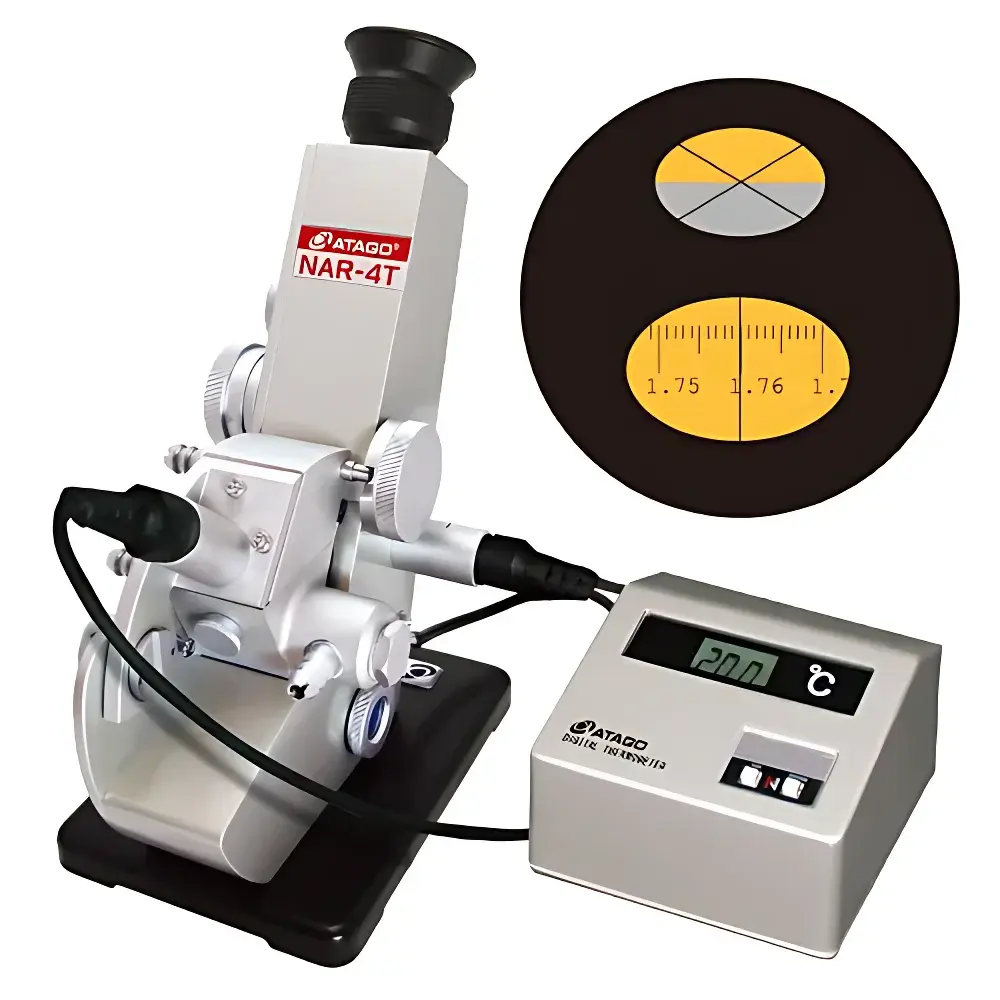
ATAGO NAR-4T High-Index Abbe Refractometer
| Brand | ATAGO |
|---|---|
| Origin | Japan |
| Model | NAR-4T High-Index Abbe Refractometer |
| Type | Benchtop Refractometer |
| Temperature Control | Yes |
| Digital Display | Yes |
| Measurement Range | nD 1.4700–1.8700 |
| Accuracy | ±0.0002 nD |
| Resolution | 0.001 nD |
| Temperature Range | 5–50 °C |
| Temperature Accuracy | ±0.2 °C (ambient) |
| Power Supply | AC 100–240 V, 50/60 Hz |
| Power Consumption | 5 VA |
| Dimensions (main unit) | 13 × 18 × 23 cm |
| Weight (main unit) | 1.8 kg |
| Dimensions (temperature display module) | 10 × 11 × 7 cm |
| Weight (temperature display module) | 0.5 kg |
Overview
The ATAGO NAR-4T High-Index Abbe Refractometer is a precision optical instrument engineered for accurate refractive index (nD) measurement of materials with exceptionally high optical density—specifically those exceeding nD 1.7000. Based on the classical Abbe principle, it utilizes collimated sodium D-line illumination (589.3 nm) and a calibrated double-prism system to determine the critical angle of total internal reflection at the sample–prism interface. This fundamental optical method ensures traceable, reproducible results aligned with ISO 21148:2021 (Optics and photonics — Refractometers — Vocabulary and performance specifications) and ASTM D1218–22 (Standard Test Method for Refractive Index of Hydrocarbon Liquids). Unlike conventional Abbe refractometers limited to nD ≤ 1.7000, the NAR-4T incorporates an optimized high-dispersion glass prism and extended-scale ocular optics, enabling stable, parallax-free readings across its full 1.4700–1.8700 range—critical for characterizing advanced polymers, optical adhesives, photoresists, liquid crystals, and specialty thin-film coatings used in semiconductor lithography and photovoltaic R&D.
Key Features
- Extended refractive index range: 1.4700–1.8700 nD, specifically validated for high-n materials including polyimides, epoxy resins, silicone gels, and fluorinated polymers
- High-resolution analog scale complemented by digital nD readout with 0.001 nD resolution and ±0.0002 nD accuracy (calibrated against NIST-traceable standards)
- Integrated Peltier-based temperature control system maintaining sample temperature between 5 °C and 50 °C, with real-time monitoring via separate digital temperature display module (±0.2 °C stability over 5–40 °C ambient)
- Benchtop configuration with rigid aluminum alloy housing, minimizing thermal drift and mechanical vibration sensitivity
- Compliant with GLP documentation requirements: all measurements include timestamped temperature-stamped nD values; no internal data storage, supporting external audit-ready recording protocols
Sample Compatibility & Compliance
The NAR-4T accommodates viscous, semi-solid, and low-volatility samples—including polymer melts, cured films (via micro-sampling), and high-boiling-point solvents—without requiring dilution or solvent exchange. Its reinforced quartz prism surface resists scratching from abrasive particulates common in filled composites. The instrument meets CE marking requirements under Directive 2014/30/EU (EMC) and 2014/35/EU (LVD), and its optical design conforms to ISO 10110-7 for surface quality and wavefront distortion control. While not FDA 21 CFR Part 11–certified as a standalone system, its output is fully compatible with validated LIMS or ELN platforms for regulated environments (e.g., pharmaceutical excipient qualification per USP , optical material certification per MIL-PRF-13830B).
Software & Data Management
The NAR-4T operates as a hardware-calibrated analog-digital hybrid instrument: temperature and nD values are displayed simultaneously on independent LCD modules but are not internally logged. For traceable data capture, users integrate the instrument into existing laboratory informatics infrastructure via RS-232 or optional USB-to-serial adapter (sold separately), enabling direct acquisition into compliant software such as LabWare LIMS, Thermo Fisher SampleManager, or custom Python/Excel automation scripts. All calibration records—including date, standard reference material ID (e.g., certified mineral oil series), and technician signature—must be maintained externally per ISO/IEC 17025:2017 clause 7.7.
Applications
- Quality control of optical-grade polymers in lens manufacturing and AR/VR waveguide production
- R&D of high-refractive-index photoresists and spin-on glass formulations for sub-10 nm node semiconductor patterning
- Characterization of encapsulant materials (e.g., silicone resins) in high-efficiency PV module lamination
- Batch verification of specialty lubricants and heat-transfer fluids in aerospace hydraulic systems
- Academic research on metamaterials, plasmonic substrates, and tunable dielectric composites
FAQ
What calibration standards are recommended for daily verification?
Use ATAGO-certified reference oils (e.g., NAR-OIL-1.7500, NAR-OIL-1.8200) traceable to NIST SRM 1484; recalibrate annually using factory service or ISO/IEC 17025-accredited lab.
Can the NAR-4T measure solid films directly?
Yes—when mounted on a temperature-controlled stage, thin films (≥10 µm thickness) may be measured in contact mode using minimal pressure; ensure uniform surface flatness and absence of air gaps.
Is the temperature display module required for operation?
Yes—the main unit lacks integrated temperature sensing; the external display module provides essential real-time thermal feedback for ISO-compliant reporting.
Does the instrument support automatic temperature ramping?
No—it maintains setpoint temperature only; programmable thermal profiles require external PID controllers interfaced via analog voltage input (not supplied).
How often should the prism surface be cleaned?
After each sample, using lint-free wipes and spectroscopic-grade toluene or acetone; avoid ultrasonic cleaning or abrasive pastes to preserve Abbe-scale fidelity.





