
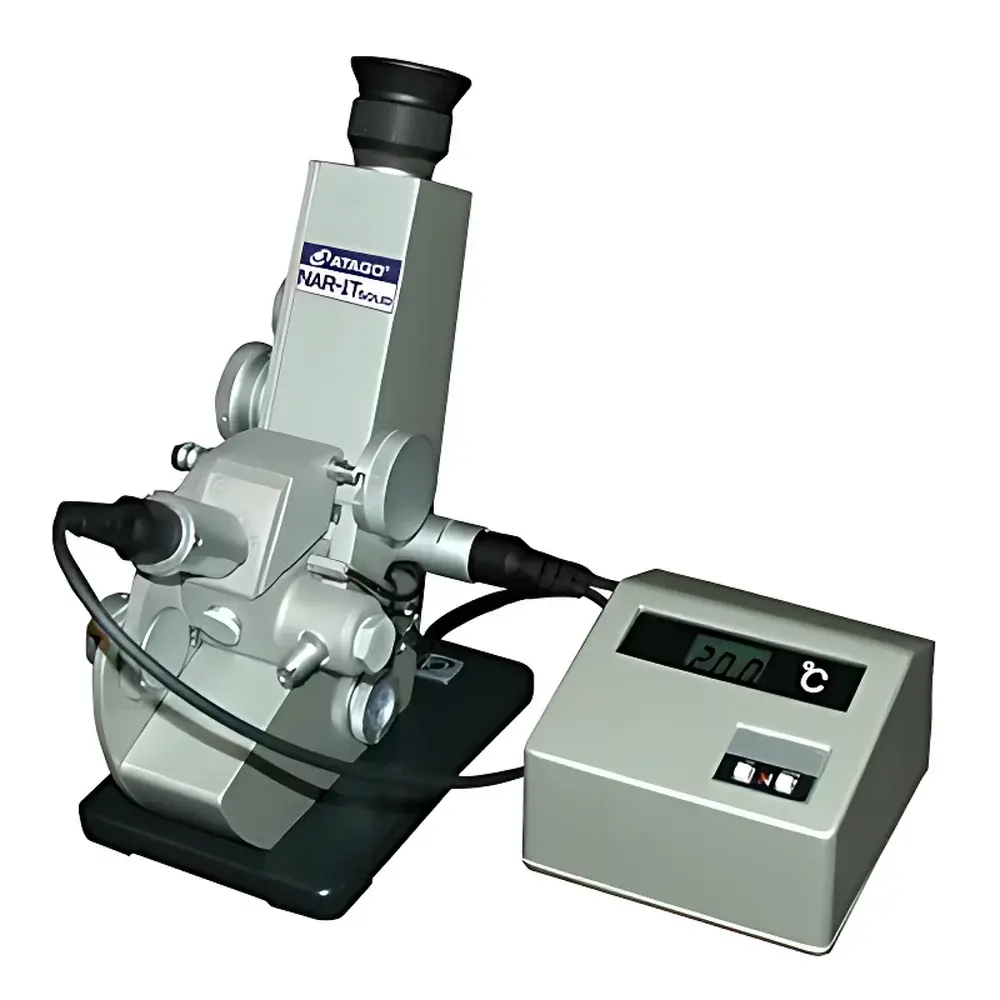
ATAGO NAR-2T-LO Abbe Refractometer
| Brand | ATAGO |
|---|---|
| Origin | Japan |
| Model | NAR-2T-LO |
| Product Type | Benchtop Abbe Refractometer |
| Display | Digital |
| Temperature Control | None |
| Refractive Index (nD) Range | 1.1500–1.4800 |
| Refractive Index (nD) Accuracy | ±0.0002 |
| Minimum Display Increment | 0.001 |
| Temperature Measurement Range | 5–120 °C |
| Digital Thermometer Accuracy | ±0.2 °C (0–100 °C), ±0.1 °C (100–120 °C) |
| Light Source | 8 V, 0.15 A Tungsten Lamp |
| Power Supply | 115 V / 220 V / 240 V, 50/60 Hz |
| Power Consumption | 5 VA |
| Dimensions (Refractometer) | 12 × 20 × 25 cm |
| Weight (Refractometer) | 5.8 kg |
| Dimensions (Thermometer, optional) | 10 × 11 × 7 cm |
| Weight (Thermometer) | 0.5 kg |
Overview
The ATAGO NAR-2T-LO is a precision benchtop Abbe refractometer engineered for high-accuracy measurement of refractive index (nD) across an extended range—from 1.1500 to 1.4800—making it uniquely suited for applications involving low-refractive-index liquids (e.g., hydrocarbons, solvents, dilute aqueous systems) and high-temperature samples up to 120 °C. Based on the classical Abbe principle, the instrument utilizes total internal reflection at the prism-sample interface, with angular deviation of the critical ray converted into a direct nD reading via calibrated optical scale interpolation. Unlike portable or digital handheld units, the NAR-2T-LO integrates a rigid optical bench architecture, temperature-stable glass prisms (BK7), and a precisely aligned collimated tungsten light source (8 V, 0.15 A) to ensure long-term repeatability and minimal thermal drift during extended QC sessions. Its design conforms to ISO 21147:2022 (Refractometers — Specifications and methods of test) and supports traceable calibration using certified reference standards such as distilled water (nD = 1.3330 at 20 °C) and bromonaphthalene (nD = 1.6584 at 20 °C).
Key Features
- Precision Abbe optical system with dual-prism configuration (illuminating and refracting prisms) for optimized light path stability and reduced parallax error
- Digital display with 0.001 resolution for refractive index (nD) and integrated digital thermometer (0.0–120.0 °C, 0.1 °C increment)
- Extended nD range (1.1500–1.4800) accommodating both low-index organics (e.g., hexane, ether, CO2 extracts) and high-index molten salts or polymer melts
- High-temperature sample compatibility: prism assembly rated for continuous operation up to 120 °C; optional external heating stage support available
- Compliance-ready design: supports GLP documentation workflows through manual logbook integration; compatible with laboratory audit requirements for raw material release testing
- Low-power consumption (5 VA) and multi-voltage input (115/220/240 V, 50/60 Hz) for global deployment in regulated manufacturing environments
Sample Compatibility & Compliance
The NAR-2T-LO accommodates a broad spectrum of homogeneous liquid and melt-phase samples—including inorganic salt solutions, alkaline electrolytes, pharmaceutical excipients, synthetic fiber spin baths, and API intermediates—provided they are optically clear and non-corrosive to BK7 glass. It is routinely deployed in accordance with ASTM D1218 (Standard Test Method for Refractive Index of Hydrocarbon Liquids) and USP (Refractometry). While the instrument itself does not include active temperature control, its integrated digital thermometer enables manual temperature correction per ISO 17025-compliant SOPs. Users may apply standard nD-to-concentration conversion tables (e.g., for NaCl, KOH, H2SO4) or generate custom calibration curves using certified reference solutions. Optional immersion media—such as monobromonaphthalene (RE-1196) or methylene iodide (RE-1199)—are supplied separately to extend upper-range measurement capability for high-nD solids.
Software & Data Management
The NAR-2T-LO operates as a standalone optical-electronic instrument without embedded microprocessor control or USB/RS-232 connectivity. All measurements are manually recorded, aligning with traditional QC laboratories operating under paper-based or hybrid electronic lab notebook (ELN) systems. To support 21 CFR Part 11 compliance, users may integrate readings into validated LIMS platforms via secondary data entry with full audit trail linkage. ATAGO provides calibration certificates (traceable to NMIJ/AIST), user manuals in English, and application notes covering method validation protocols—including intermediate precision (repeatability across operators/days) and linearity assessment over the full nD span.
Applications
- Quality control of raw materials in fine chemical synthesis: verification of solvent purity (e.g., acetone, THF, DMF) and concentration of caustic soda or sodium silicate solutions
- Pharmaceutical manufacturing: incoming inspection of excipients (propylene glycol, glycerin, PEGs) and final product release testing of liquid dosage forms per EP 2.2.7
- Chemical fiber production: real-time monitoring of coagulation bath composition (e.g., H2SO4/Na2SO4 mixtures) and spinning dope consistency
- Academic and industrial R&D: characterization of novel ionic liquids, bio-based solvents, and thermosensitive polymer solutions where thermal stability during measurement is critical
- Environmental analysis labs: determination of salinity and total dissolved solids (TDS) proxies in wastewater effluents and desalination brines
FAQ
Does the NAR-2T-LO support automatic temperature compensation (ATC)?
No. The instrument requires manual temperature recording using the integrated digital thermometer; nD values must be corrected to 20 °C using published temperature coefficients or laboratory-specific regression models.
Can it measure solid or opaque samples?
No. The Abbe principle requires optical transparency and homogeneity. Solids must be melted or dissolved; turbid or particulate-laden samples require filtration or centrifugation prior to analysis.
Is the tungsten lamp user-replaceable?
Yes. The 8 V, 0.15 A lamp is a standard OEM part (ATAGO P/N: LAMP-01); replacement instructions and alignment procedures are detailed in Section 4.2 of the English-language operation manual.
What calibration standards are recommended for routine verification?
Distilled water (nD = 1.3330 at 20 °C) and certified bromonaphthalene (nD = 1.6584 at 20 °C) are primary references; secondary checks may use 10 wt% and 25 wt% NaCl solutions with documented nD–concentration relationships.
Is technical support available outside Japan?
Yes. ATAGO maintains authorized service partners in North America, EMEA, and APAC regions; calibration and repair services are provided under ISO/IEC 17025-accredited facilities upon request.




