
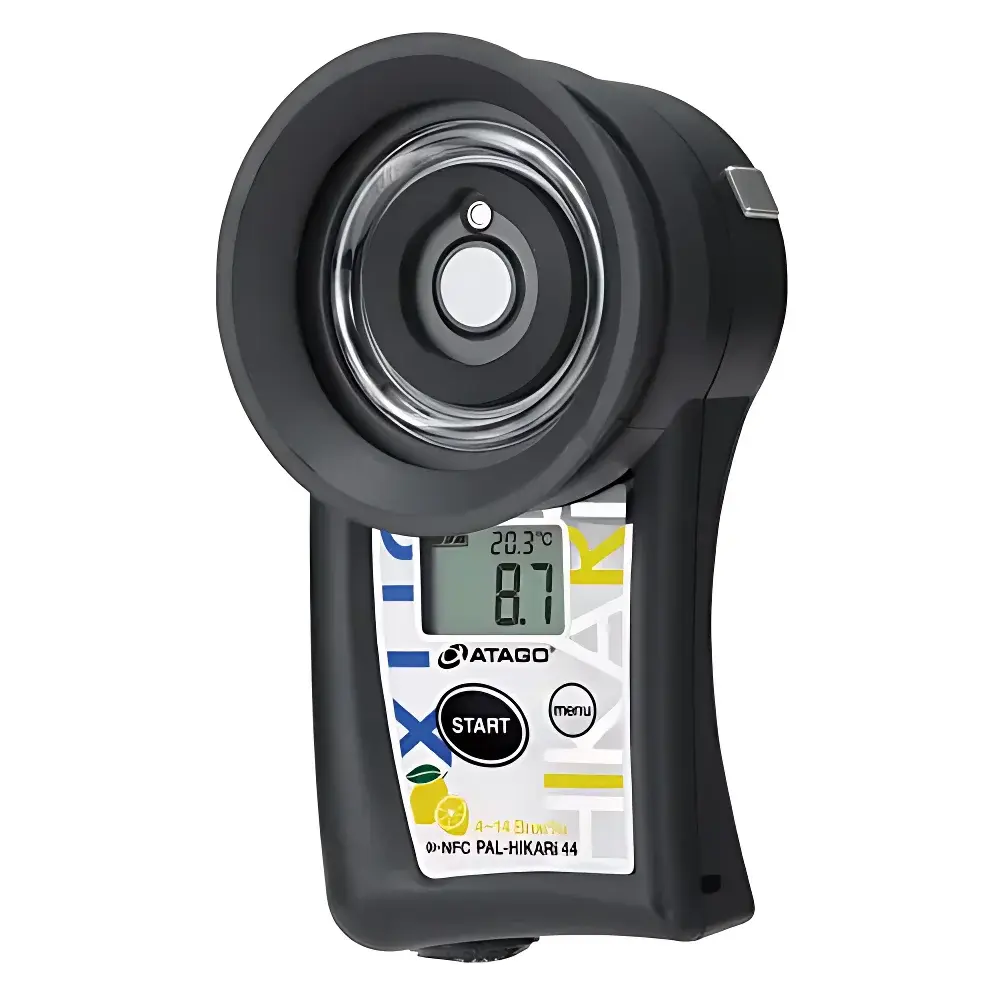
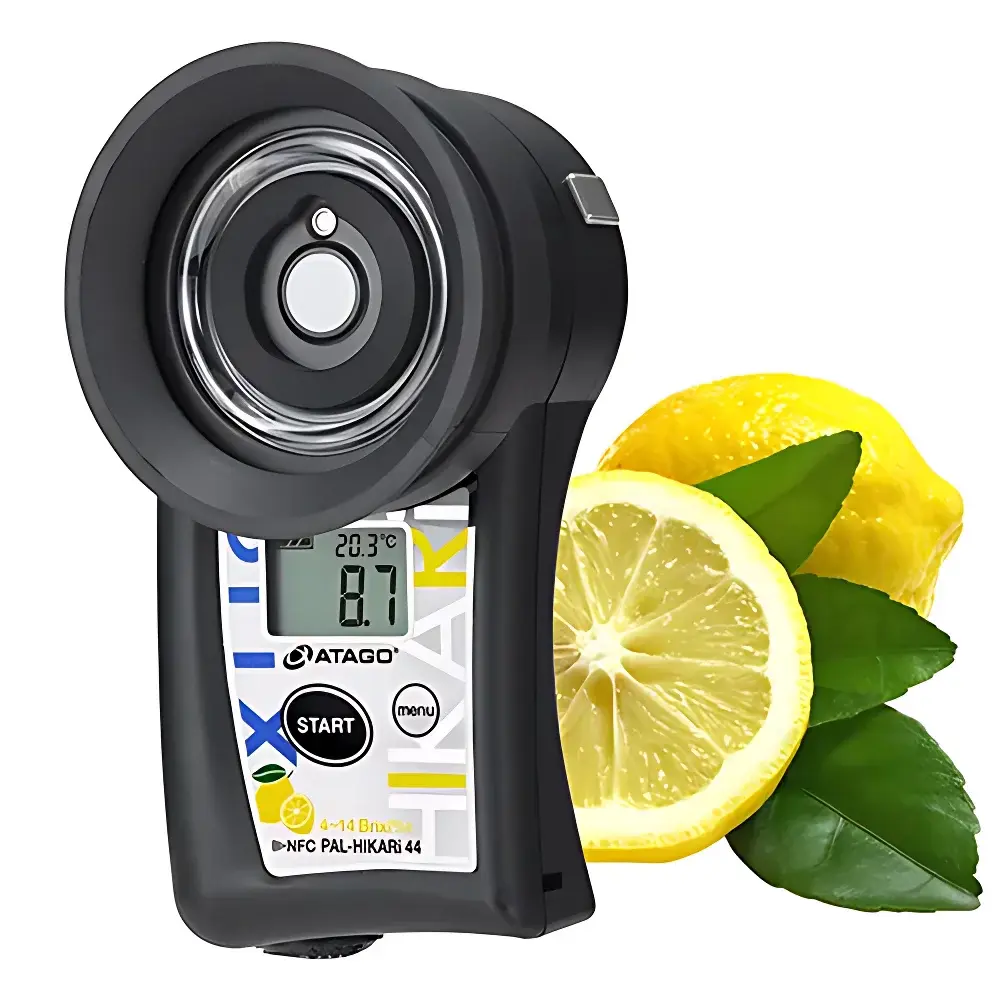
ATAGO PAL-HIKARi 44 Non-Destructive Citrus Refractometer for Lemon Brix Measurement
| Brand | ATAGO |
|---|---|
| Origin | Japan |
| Model | PAL-HIKARi 44 (Lemon-Specific) |
| Instrument Type | Non-Destructive Saccharimeter |
| Measurement Range | Brix 4.0–14.0% |
| Accuracy | ±2.0% Brix (varies by cultivar and ambient conditions) |
| Resolution | 0.1% Brix |
| Automatic Temperature Compensation | 5.0–35.0°C |
| IP Rating | IP64 |
| Power | Two AAA alkaline batteries |
| Dimensions | 6.1 × 4.4 × 11.5 cm |
| Weight | 120 g (instrument only) |
Overview
The ATAGO PAL-HIKARi 44 is a handheld, non-destructive refractometer engineered specifically for in-situ Brix measurement on intact lemon fruit. Unlike conventional destructive methods requiring juice extraction or tissue homogenization, the PAL-HIKARi 44 employs near-infrared (NIR) optical reflectance technology to estimate soluble solids content (SSC) through the intact rind. The device operates on a calibrated spectral model optimized for lemon peel thickness, surface curvature, and typical chromatic properties of mature Citrus limon. This enables rapid, repeatable field assessment without compromising fruit integrity—critical for pre-harvest quality monitoring, harvest timing optimization, and post-harvest grading consistency in commercial citrus operations.
Key Features
- Lemon-specific optical calibration validated across multiple commercial cultivars including Eureka, Lisbon, and Meyer
- Non-invasive measurement: no piercing, cutting, or juice expression required—preserves fruit marketability and shelf-life integrity
- Integrated automatic temperature compensation (ATC) spanning 5.0–35.0°C, minimizing thermal drift during orchard or packinghouse use
- Rugged, ergonomic housing rated IP64 for dust resistance and protection against water splashes—suitable for humid greenhouse and open-field environments
- High-contrast LCD display with backlight for readability under variable lighting conditions (e.g., canopy shade or direct sun)
- Low-power design: two standard AAA alkaline batteries support >5,000 measurements per set under typical usage conditions
- Zero-point verification via built-in reference check function prior to each measurement session
Sample Compatibility & Compliance
The PAL-HIKARi 44 is designed exclusively for intact, mature lemons with intact, unblemished rinds and typical surface waxing levels. It is not intended for use on green/unripe fruit, mechanically damaged specimens, or fruits treated with heavy post-harvest coatings that alter NIR reflectance. While not certified to ISO 2173 or AOAC 932.12 (which apply to laboratory refractometers using extracted juice), the instrument conforms to JIS Z 8015:2019 for portable optical measurement devices and meets CE marking requirements for electromagnetic compatibility (EMC Directive 2014/30/EU) and low-voltage safety (LVD Directive 2014/35/EU). Its non-destructive methodology supports Good Agricultural Practice (GAP) and sustainability protocols by eliminating sample waste.
Software & Data Management
The PAL-HIKARi 44 operates as a standalone instrument with no embedded memory or Bluetooth/Wi-Fi connectivity. All measurements are displayed in real time and must be manually recorded. For traceability in regulated environments (e.g., export-certified orchards or GMP-aligned packing facilities), users are advised to integrate readings into external digital logbooks compliant with FDA 21 CFR Part 11—requiring electronic signatures, audit trails, and secure data archiving. ATAGO provides optional CSV-compatible data logging accessories (e.g., PAL-LogLink interface kit, sold separately) for batch-level export to LIMS or farm management platforms such as Cropio or AgriWebb.
Applications
- Pre-harvest maturity assessment to determine optimal harvest windows aligned with target Brix/acid ratios for juice processing or fresh-market specifications
- In-field quality screening during thinning or selective harvesting to segregate high- and low-sugar lots
- Post-harvest quality assurance at receiving stations, reducing reliance on destructive sampling and accelerating throughput
- Research applications in horticultural physiology—including irrigation scheduling trials, rootstock performance evaluation, and fertilizer response studies—where repeated longitudinal measurements on the same fruit are required
- Extension and training programs supporting smallholder citrus growers in adopting precision agronomy practices
FAQ
Can the PAL-HIKARi 44 be used on other citrus varieties such as oranges or grapefruit?
No. The optical algorithm and hardware configuration are strictly calibrated for lemon morphology and spectral response. Cross-use on other species introduces systematic bias exceeding ±3.5% Brix and is not supported by ATAGO.
Does surface moisture affect measurement accuracy?
Yes. Condensation, dew, or rinse water must be gently blotted from the rind prior to measurement. Residual moisture alters NIR reflectance and may cause underestimation of true Brix.
Is calibration verification required before each use?
ATAGO recommends performing the built-in zero-point check using the provided reference cap before initiating any measurement session—especially after temperature shifts exceeding 5°C or extended storage.
What is the expected service life of the optical sensor?
The NIR LED and photodetector assembly is rated for >100,000 measurement cycles under normal operating conditions. No user-serviceable optical recalibration is available; return-to-factory service is required if drift exceeds specification limits.
How does ambient light impact readings?
The instrument incorporates ambient light rejection circuitry. However, direct sunlight incident on the sensor aperture during measurement may introduce noise. Use the included shade hood or conduct readings in shaded conditions for maximum reproducibility.





