
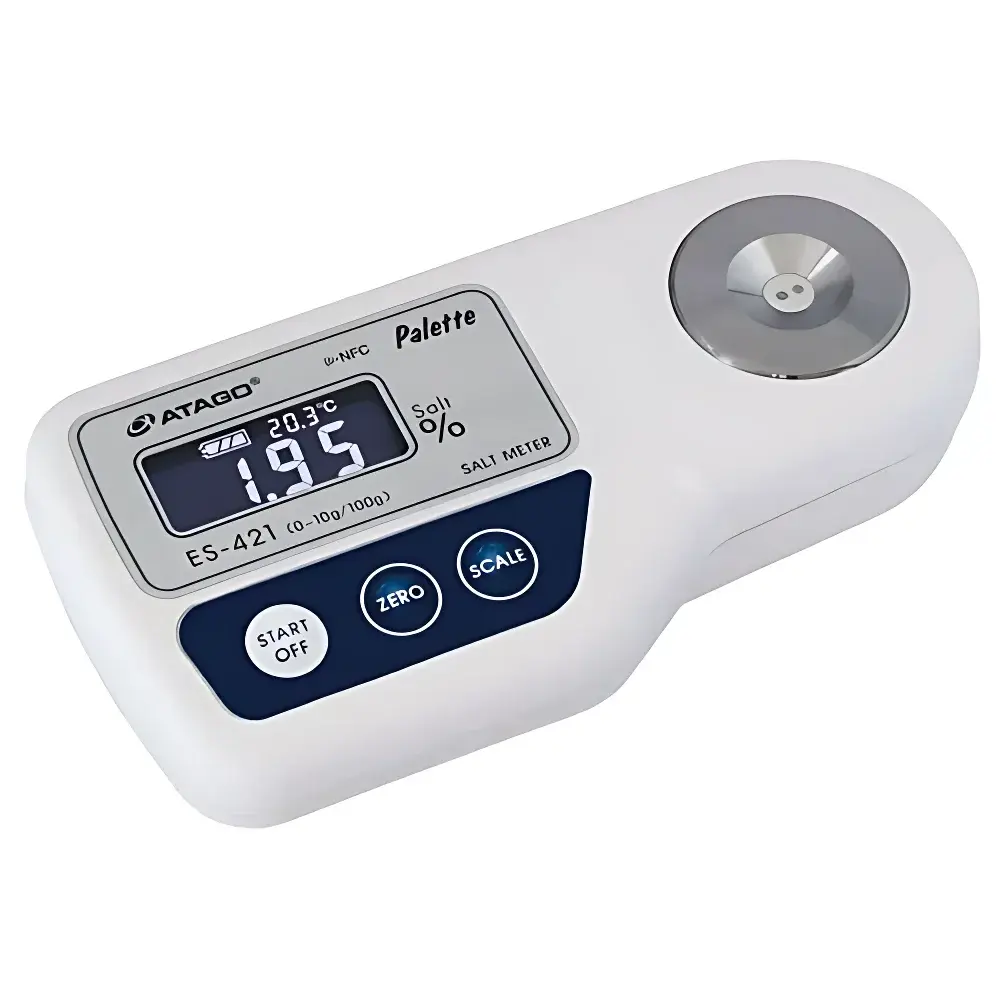
ATAGO ES-421 Soy Sauce Salinometer
| Brand | ATAGO |
|---|---|
| Origin | Japan |
| Model | ES-421 Soy Sauce Salinometer |
| Measurement Principle | Conductivity-based |
| Range | 0.00–10.0% (g/100g) |
| Accuracy | ±0.05% (0.00–0.99%), ±5% relative (1.00–10.0%) |
| ATC Range | 10–40°C |
| Resolution | 0.01% (0.00–0.99%), 0.1% (3.0–10.0%) |
| Power | 9V alkaline battery (006P) |
| IP Rating | IP64 |
| Dimensions | 17 × 9 × 4 cm |
| Weight | 220 g (host only) |
Overview
The ATAGO ES-421 Soy Sauce Salinometer is a compact, benchtop-conductive salinity analyzer engineered for rapid, reagent-free quantification of sodium chloride concentration in viscous, high-solids food matrices. Unlike optical refractometers—whose readings are susceptible to interference from non-ionic solutes, pigments, or suspended particles—the ES-421 employs a calibrated two-electrode conductivity cell to measure electrical conductance, which correlates directly with ionic strength under controlled temperature conditions. This principle ensures robust performance across complex condiments where traditional titration or refractive index methods yield inconsistent results. Designed specifically for the Japanese and global fermented food industry, the instrument targets routine QC/QA applications in soy sauce production, miso manufacturing, pickling brine management, and seasoning formulation. Its integrated Automatic Temperature Compensation (ATC) algorithm applies ISO 2173-compliant correction across 10–40°C, eliminating manual calibration drift associated with ambient thermal fluctuations.
Key Features
- Conductivity-based measurement architecture optimized for high-viscosity, high-turbidity samples including soy sauce, tamari, dashi, kimchi brine, cheese whey, and fermented bean pastes.
- Low-volume sample requirement: only ~10 mL per measurement, minimizing material waste and enabling analysis of precious pilot-batch formulations.
- Patented funnel-shaped prism chamber facilitates rapid filling, complete electrode immersion, and efficient residue removal—critical for preventing cross-contamination between high-salt and low-salt test sequences.
- IP64-rated enclosure provides dust resistance and protection against incidental water splashes during wet-lab operation.
- True benchtop stability: ergonomic low-center-of-gravity chassis allows secure placement on production line counters or QC lab benches without mounting hardware.
- Battery-powered operation (9V alkaline, 006P) enables mobility across multiple testing stations without reliance on fixed power outlets—ideal for factory-floor deployment.
Sample Compatibility & Compliance
The ES-421 demonstrates validated repeatability (RSD < 1.2% at 5.0% NaCl) across matrices meeting AOAC 982.21 and JIS Z 8401 criteria for conductometric salt determination. It complies with GLP documentation requirements through traceable serial-numbered calibration logs (performed using certified KCl standard solutions). While not FDA 21 CFR Part 11–compliant out-of-the-box due to lack of electronic audit trail, its measurement output satisfies ISO/IEC 17025 accreditation prerequisites when paired with laboratory-controlled calibration SOPs and manual recordkeeping. The device is routinely deployed in facilities operating under HACCP, FSSC 22000, and SQF Level 2 certification frameworks for critical control point monitoring of brine salinity and finished-product consistency.
Software & Data Management
The ES-421 operates as a standalone instrument with no embedded firmware or connectivity interface. All data acquisition is manual: users record displayed values directly into paper-based logbooks or LIMS-integrated spreadsheets. Calibration verification is performed biweekly using NIST-traceable 1.00% and 5.00% (w/w) KCl reference standards; certificates of analysis accompany each standard batch. For laboratories requiring digital traceability, ATAGO recommends pairing the ES-421 with its optional RS-232 data logger (model DL-201), which captures timestamped readings and exports CSV-formatted reports compatible with Excel and statistical process control (SPC) platforms such as Minitab or JMP.
Applications
- Real-time monitoring of fermentation brine salinity during soy sauce koji and moromi stages to ensure optimal microbial activity and enzymatic hydrolysis.
- Final product release testing of pasteurized soy sauce batches against JAS Standard No. 108 (Japan Agricultural Standards) limits of 15–18% total solids and corresponding salt equivalence.
- QC screening of imported tamari and gluten-free soy alternatives where label claims of “low sodium” (< 400 mg Na/15 mL) must be verified against actual NaCl content.
- Batch-to-batch consistency validation for OEM sauce manufacturers supplying private-label products to retail chains with strict spec limits (e.g., ±0.3% tolerance).
- Research applications in food science departments studying salt diffusion kinetics in marinated meats or osmotic pressure effects on vegetable texture during pickling.
FAQ
Is the ES-421 suitable for measuring undiluted soy sauce?
Yes—the instrument is calibrated for direct analysis of undiluted commercial and artisanal soy sauces without pre-dilution, provided viscosity remains below 200 mPa·s at 25°C.
Does it require daily recalibration?
No—ATAGO specifies calibration verification every 48 hours of active use or prior to first measurement each day, using certified KCl standards.
Can it measure sea salt or rock salt solutions?
It is validated only for NaCl-dominated systems; significant presence of Ca²⁺, Mg²⁺, or sulfate ions (e.g., in unrefined sea salts) may introduce bias exceeding ±8% without matrix-matched calibration.
What maintenance is required for the conductivity cell?
Rinse thoroughly with deionized water after each use; soak in 10% nitric acid for 5 minutes weekly to remove organic film buildup; avoid abrasive cleaning tools that may scratch platinum electrodes.
Is there a CE or UKCA mark on the device?
The ES-421 carries CE marking per Directive 2014/30/EU (EMC) and 2011/65/EU (RoHS); UKCA compliance is maintained via identical technical documentation and conformity assessment pathways.




