
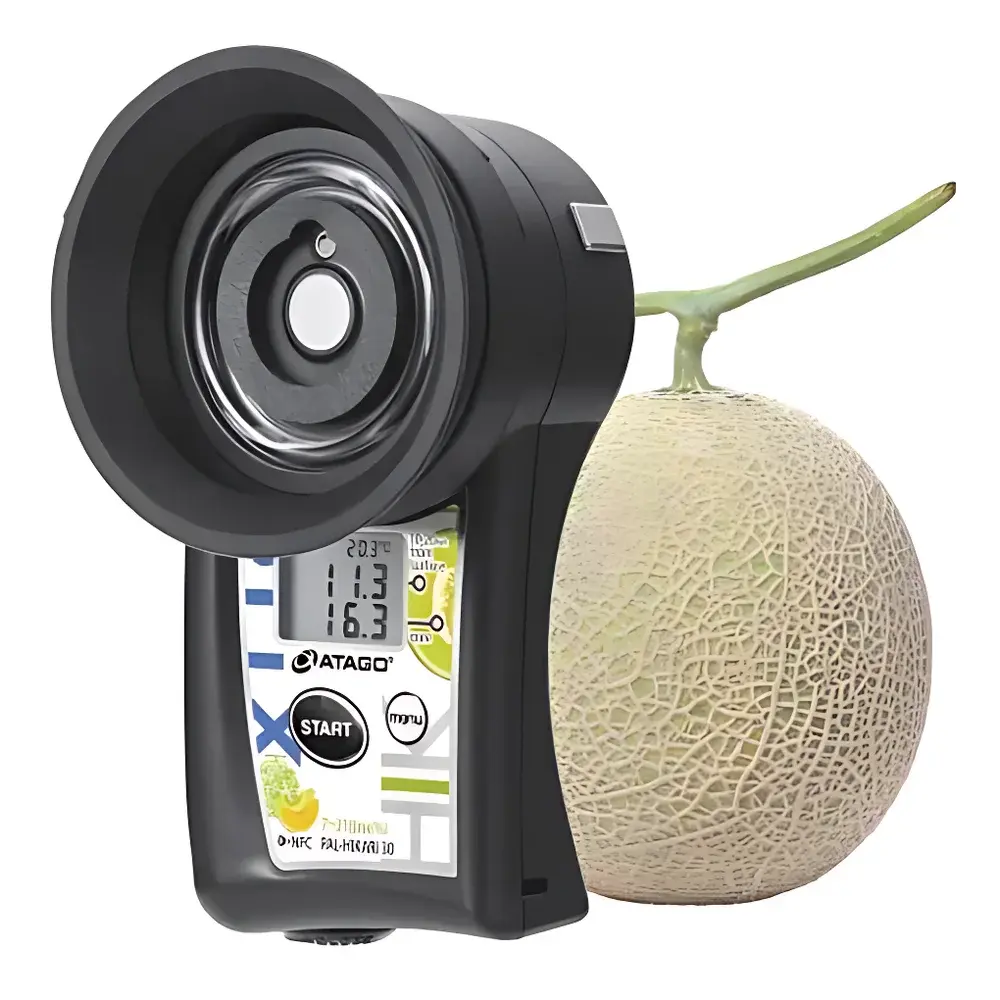
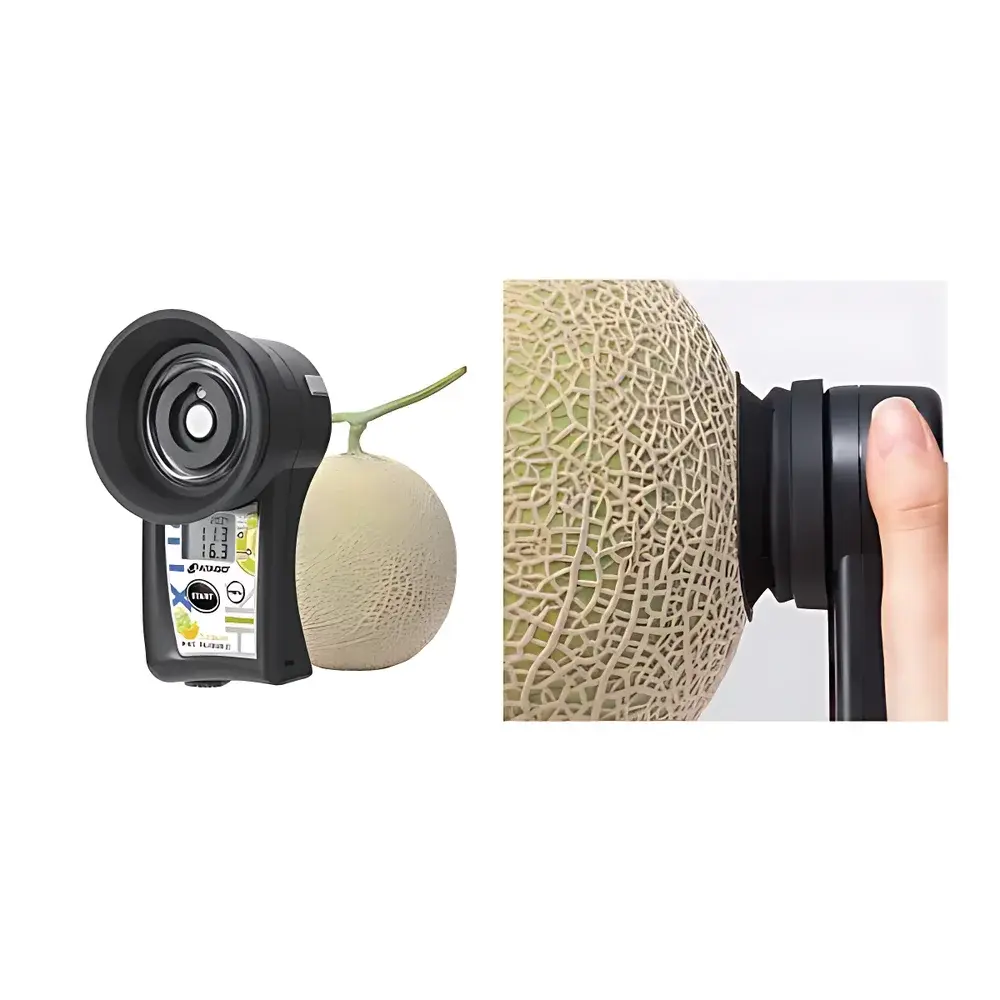
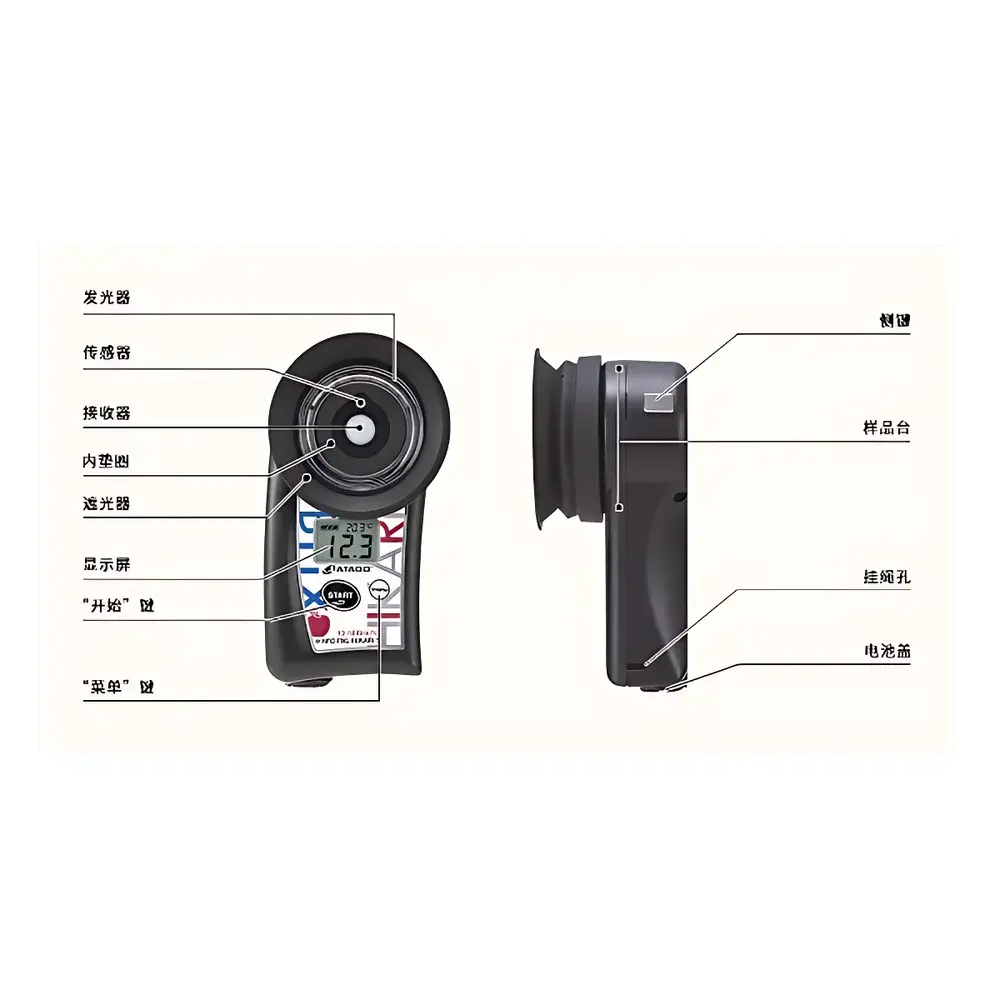
ATAGO PAL-HIKARi 30 Non-Destructive Melon Refractometer
| Brand | ATAGO |
|---|---|
| Origin | Japan |
| Model | PAL-HIKARi 30 |
| Instrument Type | Non-Destructive |
| Measurement Range (Rind, 10–20 mm) | Brix 7.0–16.0% |
| Measurement Range (Core) | Brix 7.0–21.0% |
| Accuracy | ±2.0% Brix (varies by cultivar and ambient conditions) |
| Resolution | 0.1% Brix |
| Repeatability | ±1.0% Brix |
| Automatic Temperature Compensation | 10.0–40.0°C |
| IP Rating | IP64 |
| Power | Two AAA alkaline batteries |
| Dimensions | 6.1 × 4.4 × 11.5 cm |
| Weight | 120 g (main unit only) |
Overview
The ATAGO PAL-HIKARi 30 is a handheld, non-destructive refractometer engineered specifically for in-situ Brix measurement in intact melons—without piercing the rind, excising tissue, or extracting juice. It operates on the principle of near-infrared (NIR) light absorption spectroscopy, calibrated to correlate optical attenuation at specific wavelengths with soluble solids concentration (SSC) in the fruit’s mesocarp and core regions. Unlike conventional contact refractometers requiring juice extraction, the PAL-HIKARi 30 employs a precision optical probe that couples evanescent wave transmission through the intact epidermis, enabling quantitative estimation of sugar content while preserving structural integrity and post-harvest shelf life. This makes it uniquely suited for longitudinal monitoring across agricultural value chains—from field-based phenotyping and harvest timing decisions to cold-chain quality assurance and retail-grade sorting.
Key Features
- True non-invasive measurement: No fruit damage, no sample preparation, no cross-contamination risk
- Dual-region calibration: Independent Brix quantification for rind-proximal tissue (10–20 mm depth) and central core zones
- Real-time digital readout: Stable Brix value displayed within 3 seconds of probe contact
- On-device averaging function: Supports up to 10 consecutive measurements with automatic mean calculation and standard deviation output
- Integrated automatic temperature compensation (ATC): Compensates for fruit surface temperature fluctuations between 10.0°C and 40.0°C, minimizing thermal drift in field environments
- Rugged portable architecture: IP64-rated enclosure resists dust ingress and water splashes; optimized ergonomics for extended orchard use
- Battery-powered operation: Dual AAA alkaline cells provide >5,000 measurements per set under typical usage conditions
Sample Compatibility & Compliance
The PAL-HIKARi 30 is validated exclusively for muskmelon (Cucumis melo var. reticulatus) and related netted melon cultivars, including but not limited to Galia, Cantaloupe, and Honey Dew varieties. Its optical calibration accounts for typical rind thickness (10–20 mm), cuticle density, and internal heterogeneity common in mature melons. While not intended for other fruit species, its measurement protocol aligns with ISO 2173:2003 (fruit and vegetable products — determination of soluble solids content — refractometric method) for reference correlation, and supports GLP-compliant data collection when paired with ATAGO’s optional data logging accessories. The device meets IEC 60529 for IP64 environmental protection and conforms to RoHS Directive 2011/65/EU for hazardous substance restrictions.
Software & Data Management
The PAL-HIKARi 30 operates as a standalone instrument with no embedded Bluetooth or USB interface. However, it supports traceable manual documentation via standardized field logs aligned with FDA 21 CFR Part 11 principles—specifically, user-defined measurement IDs, timestamped entries (via external logbook or LIMS integration), and operator initials. For laboratories requiring electronic data capture, ATAGO recommends pairing the unit with the PAL-PRINT series thermal printer (sold separately) to generate auditable hard-copy reports containing measurement number, date/time stamp, Brix value, temperature reading, and operator code. All firmware updates and calibration verification procedures are performed exclusively at authorized ATAGO service centers in accordance with ISO/IEC 17025-accredited metrological practices.
Applications
- Agricultural R&D: Enables high-frequency, non-lethal sugar profiling during breeding trials, irrigation scheduling studies, and canopy management optimization
- Harvest readiness assessment: Provides objective Brix thresholds to guide selective picking, reducing post-harvest losses from premature or over-mature harvesting
- Post-harvest quality control: Used at packinghouses for lot-level screening prior to cold storage, ensuring compliance with export Brix specifications (e.g., JAS Standard for Japanese melons)
- Supply chain traceability: Facilitates batch-level sugar mapping for premium branding (e.g., “Brix ≥14.5%” labeling), supporting price differentiation in wholesale and retail markets
- Academic horticulture: Serves as a field-deployable tool for undergraduate viticulture and pomology labs studying carbohydrate partitioning dynamics under varying climate stressors
FAQ
Is the PAL-HIKARi 30 suitable for fruits other than melons?
No. Its optical model and calibration are specific to melon anatomy, rind optical properties, and internal SSC distribution. Using it on apples, grapes, or citrus will yield non-representative results.
Does surface moisture affect measurement accuracy?
Yes. Excess condensation or dew must be gently wiped from the rind prior to measurement to avoid erroneous refraction at the air–skin interface.
How often does the instrument require recalibration?
ATAGO recommends annual verification against NIST-traceable sucrose standards at an authorized service center. Field validation using certified reference melon samples is advised before each daily use session.
Can measurements be exported to Excel or LIMS?
Not directly—the unit has no data port. Manual transcription or thermal-printed records must be entered into external systems; third-party barcode-scanning workflows may be implemented via printed labels.
What is the warranty coverage for the PAL-HIKARi 30?
ATAGO provides a 12-month limited warranty covering defects in materials and workmanship under normal use, excluding probe lens abrasion or battery compartment corrosion due to improper maintenance.




