
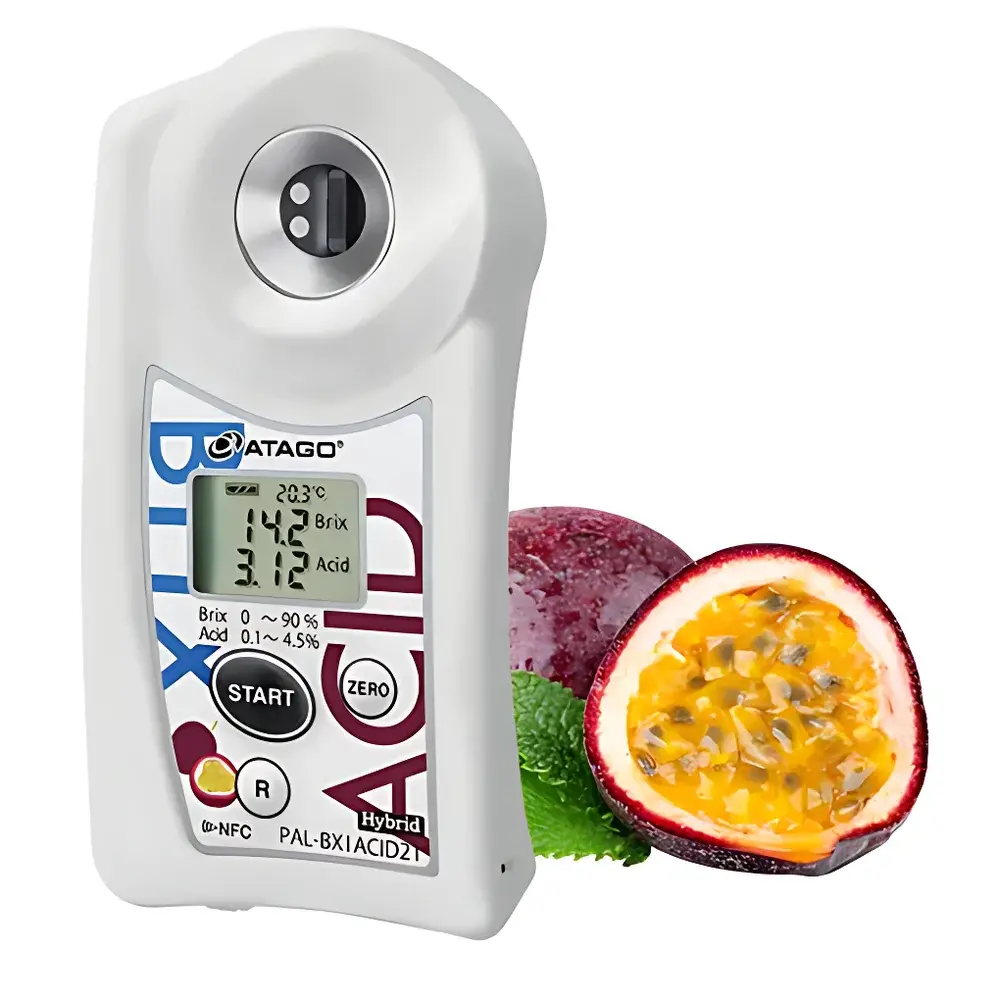
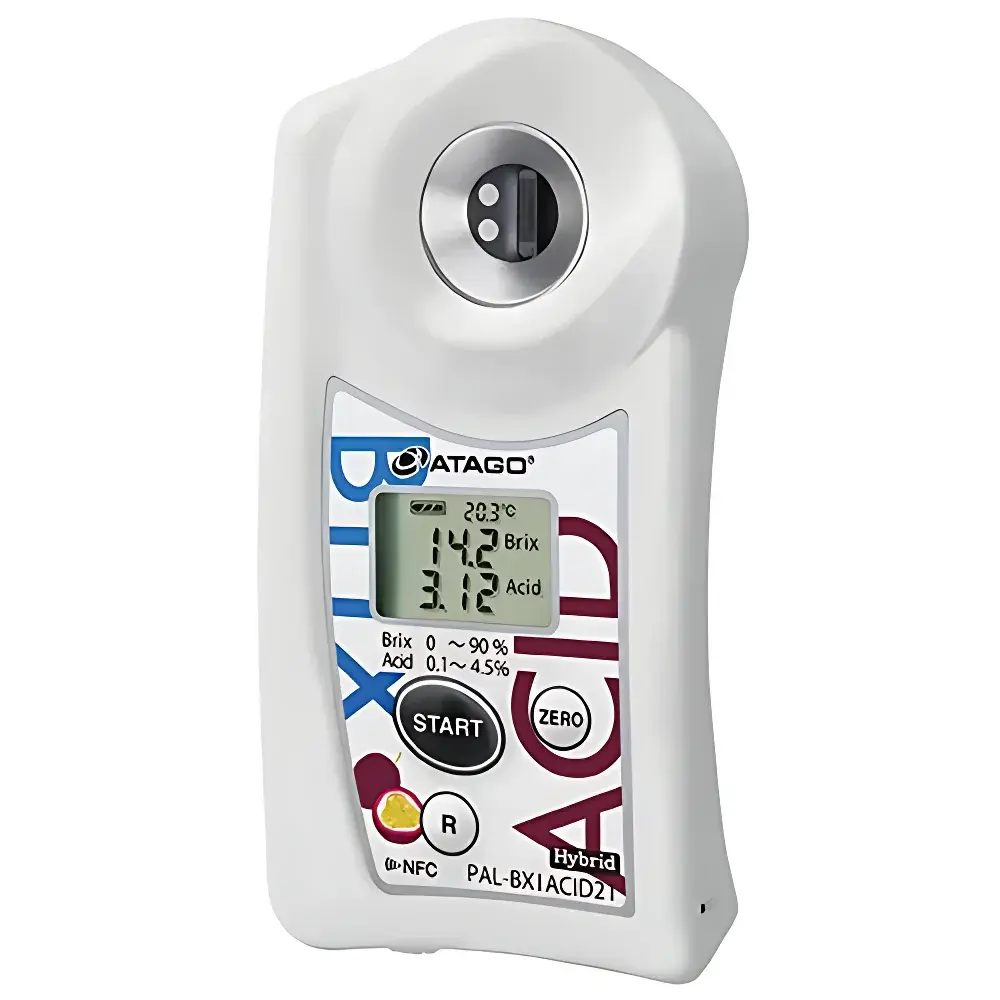
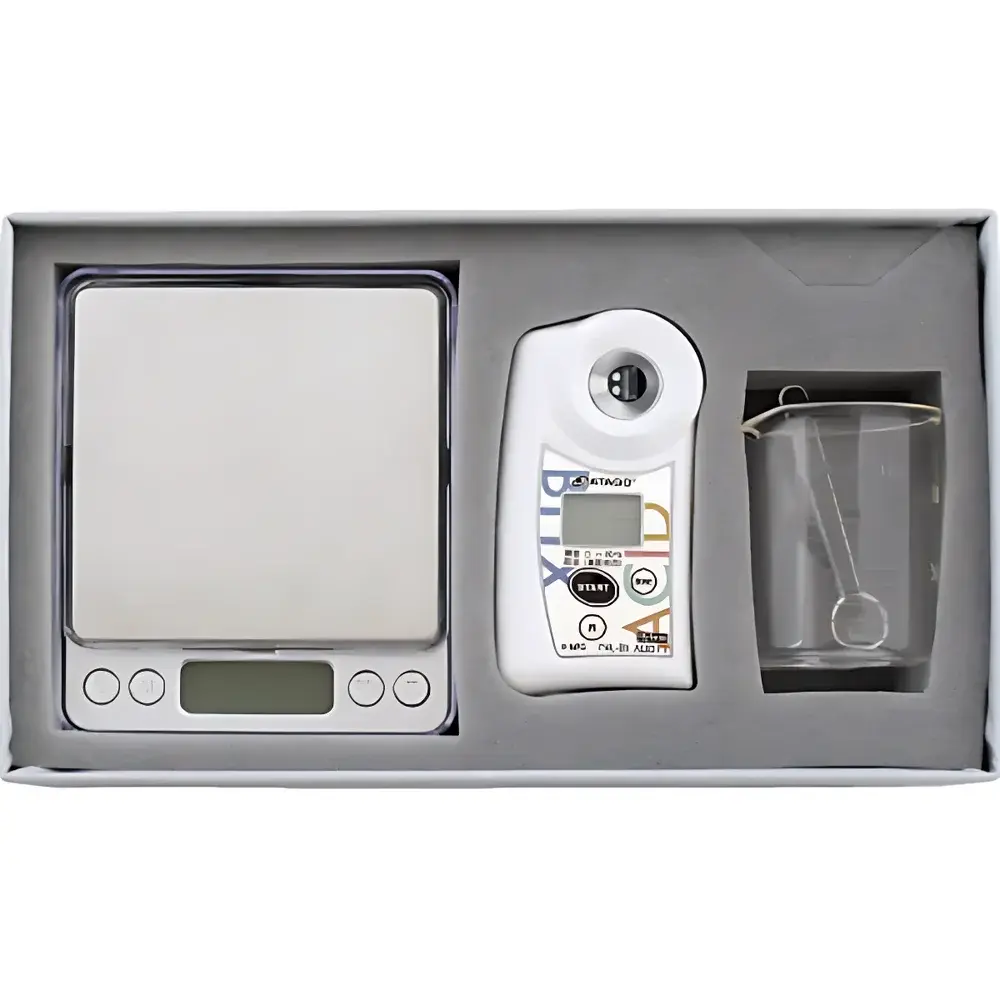
ATAGO PAL-BX/ACID 21 Passion Fruit Refractometer & Acidity Meter
| Brand | ATAGO |
|---|---|
| Origin | Japan |
| Model | PAL-BX/ACID 21 |
| Measurement Principle | Refractive Index (Brix) + pH-based Acid Titration Simulation |
| Brix Range | 0.0–90.0% |
| Acid Range | 0.10–4.50% (as citric acid) |
| Brix Accuracy | ±0.2% |
| Acid Accuracy | ±0.10% (0.10–1.00%), ±10% rel. (1.01–4.50%) |
| Temp. Compensation | 10–40°C |
| IP Rating | IP65 |
| Dimensions | 5.5 × 3.1 × 10.9 cm |
| Weight | 100 g (host only) |
| Power | 2 × AAA alkaline batteries |
Overview
The ATAGO PAL-BX/ACID 21 is a handheld, dual-parameter optical instrument engineered for rapid, field-deployable assessment of soluble solids content (Brix) and titratable acidity in passion fruit (Passiflora edulis) and related tropical pulps. Unlike conventional benchtop systems requiring sample dilution, filtration, and standardized titration protocols, this device integrates Abbe-type refractometry with an embedded electrochemical-acid calibration algorithm to estimate total acidity—expressed as % citric acid—based on conductivity and pH-correlated response curves. The instrument computes the Acid-Sugar Ratio (ASR) in real time upon pressing the dedicated “R” key, providing an objective, unitless metric critical for horticultural quality control, harvest timing decisions, and postharvest grading. Its design adheres to the metrological principles underlying ISO 2173 (fruit juice Brix determination) and aligns with empirical validation frameworks used in tropical fruit research (e.g., FAO/WHO Codex Alimentarius guidelines for passion fruit standards). The PAL-BX/ACID 21 is not a replacement for laboratory-grade potentiometric titration per AOAC 973.45 but serves as a validated screening tool where speed, portability, and operator independence are prioritized.
Key Features
- Simultaneous Brix and acidity measurement in a single handheld platform, eliminating sequential instrument use or manual data reconciliation.
- Proprietary OFFSET curve correction function enables traceable alignment with reference titration results or alternative acid quantification methods—essential for method transfer across QC labs and field stations.
- Automatic temperature compensation (10–40°C) using integrated thermistor, ensuring stable refractive index readings per ASTM D1218 and ISO 5725 repeatability requirements.
- IP65-rated enclosure provides dust-tight and water-jet resistant operation, suitable for humid greenhouse environments, packinghouse floors, and roadside sampling points.
- High-resolution LCD display with 0.1% Brix / 0.01% acid resolution supports visual verification of measurement stability prior to ASR calculation.
- Minimal sample preparation: Brix requires direct juice drop; acidity measurement uses 1:50 (w/w) dilution with distilled water—no reagents, no glassware, no fume hood.
Sample Compatibility & Compliance
The PAL-BX/ACID 21 is factory-calibrated exclusively for passion fruit pulp and juice matrices, leveraging ATAGO’s proprietary spectral database derived from over 1,200 validated samples across cultivars (e.g., Purple Giant, Golden Yellow). It is incompatible with clarified or fermented derivatives (e.g., vinegar, wine) without recalibration. While not certified under FDA 21 CFR Part 11, its audit trail–capable firmware (v3.2+) supports GLP-compliant record-keeping when paired with ATAGO’s optional PC interface software. The device complies with IEC 61010-1 for electrical safety and meets RoHS Directive 2011/65/EU for hazardous substance restrictions. Its Brix accuracy (±0.2%) satisfies ISO 2173’s requirement for routine quality assurance in fresh fruit processing, and its acidity reporting protocol conforms to the citric acid equivalence convention adopted by the International Society for Horticultural Science (ISHS) for tropical fruits.
Software & Data Management
Data export is supported via optional USB-to-serial adapter (ATAGO Part No. UCB-01), enabling raw Brix, acidity, ASR, temperature, and timestamp logging into CSV or Excel-compatible formats. The included ATAGO Data Manager v2.4 software allows batch normalization against lab-reference titration values, generation of control charts per ISO 7870-2, and export of PDF reports compliant with internal QA documentation standards. All measurements retain embedded metadata—including serial number, firmware version, and calibration date—to satisfy traceability requirements under ISO/IEC 17025 Clause 7.7. No cloud connectivity or remote firmware updates are implemented, preserving data sovereignty and minimizing cybersecurity exposure in regulated agricultural settings.
Applications
- On-tree maturity assessment: Correlating ASR shifts (e.g., 12–22 range) with ethylene evolution and peel colorimetry to optimize harvest windows.
- Postharvest sorting: Segregating lots by ASR thresholds for juice concentrate vs. frozen pulp production streams.
- Cultivar evaluation trials: Quantifying genotype-by-environment interaction effects on flavor balance under controlled irrigation or nutrient regimes.
- Supply chain quality audits: Verifying vendor compliance with contractual ASR specifications (e.g., ≥18.0 for premium export grades).
- Educational use in viticulture and pomology programs: Demonstrating non-destructive phenotyping techniques aligned with FAO’s Climate-Smart Agriculture toolkit.
FAQ
Is the PAL-BX/ACID 21 suitable for measuring acidity in other fruits?
No—this model is calibrated specifically for passion fruit matrix characteristics (viscosity, pigment interference, organic acid profile). Other PAL-BX/ACID variants exist for citrus, grape, tomato, etc., each with unique optical and algorithmic tuning.
Does the device require periodic recalibration?
Yes—ATAGO recommends annual verification against NIST-traceable sucrose standards (Brix) and certified citric acid solutions (acidity), documented per ISO/IEC 17025 Clause 6.6.
Can ASR values be exported directly to LIMS systems?
Via CSV export and manual import; native HL7 or ASTM E1384 integration is not supported.
What does “relative accuracy ±10%” mean for acidity above 1.00%?
It reflects expanded uncertainty due to nonlinearity in low-conductivity pulp dilutions—consistent with ISO 5725-2 repeatability estimates for heterogeneous biological matrices.
Is distilled water mandatory for dilution?
Yes—tap or deionized water introduces ionic interference that biases the acidity algorithm; ASTM D1193 Type II specification is required.



