
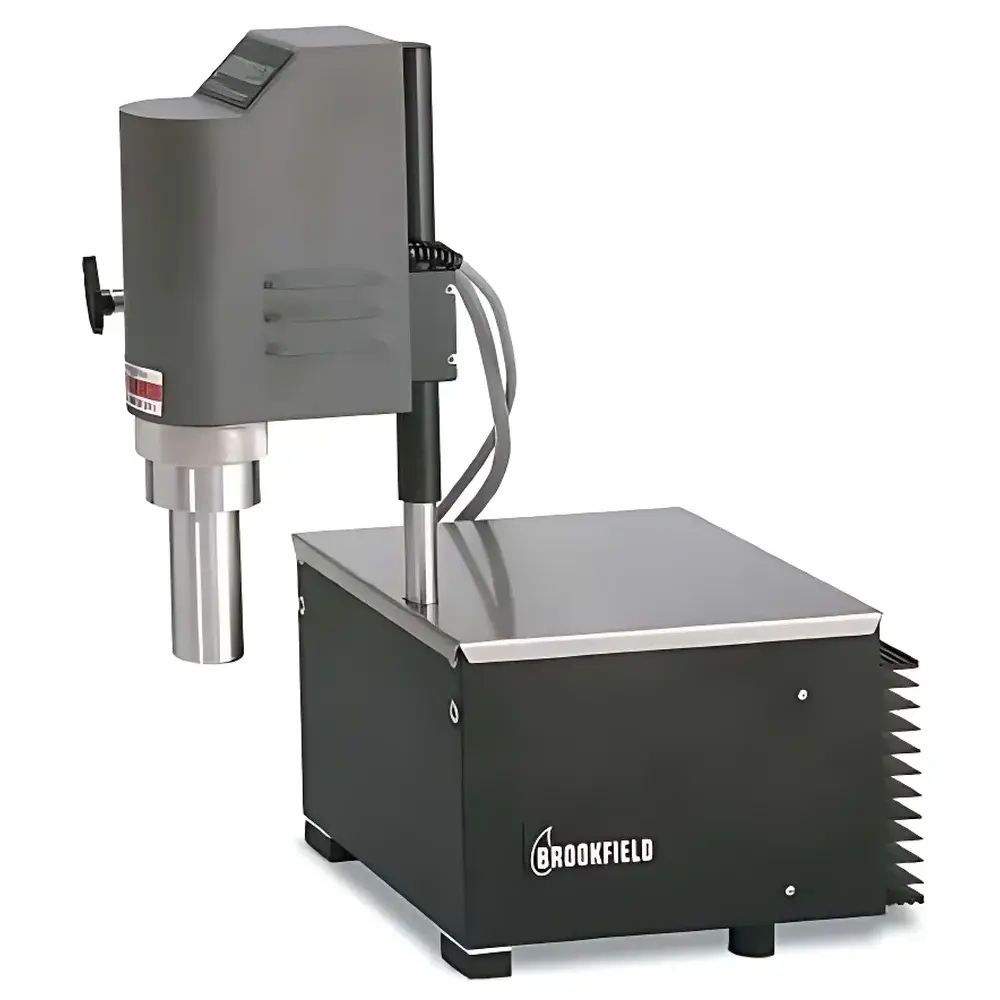
Brookfield PVS Advanced Rotational Rheometer
| Brand | Brookfield |
|---|---|
| Origin | USA |
| Manufacturer Type | Direct Manufacturer |
| Origin Category | Imported |
| Model | PVS |
| Instrument Type | Rotational Rheometer |
| Bearing Type | Mechanical |
| Minimum Speed | 0.05 rpm |
| Maximum Speed | 1000 rpm |
| Sample Volume Range | 23–175 mL |
| Shear Rate Range | 0.38–1.70 s⁻¹ |
| Viscosity Range | 0.5 cP to 36 million cP (mPa·s) |
| Spindle/Geometry Options | BOB, Triple Annulus (TA5), Hastelloy C (HC) construction |
| Optional Accessories | Thermo Heater with PID Temperature Control, Portable Field Carry Case |
| Software | RheoVision® (optional, USB/RS232 interface) |
Overview
The Brookfield PVS Advanced Rotational Rheometer is a high-stability, mechanically bearing-supported rotational rheometer engineered for rigorous viscosity and yield stress characterization of complex fluids under demanding field and laboratory conditions. Based on Couette flow geometry, the PVS employs a controlled-rate (CR) methodology—applying defined rotational speeds to generate precise shear rates—and measures resulting torque to calculate dynamic viscosity, apparent viscosity, and yield point parameters. Its robust mechanical architecture ensures long-term stability and repeatability in environments where electronic or air-bearing systems may be compromised, including offshore platforms, drilling sites, and pilot-scale process facilities. Designed specifically for non-Newtonian fluid analysis, the PVS delivers reliable data across six decades of viscosity (0.5–36 × 10⁶ mPa·s) and supports both steady-state and time-dependent measurements—including creep recovery, thixotropy loops, and step-shear protocols—when paired with RheoVision® software.
Key Features
- Mechanically supported motor bearing system for enhanced durability and minimal maintenance in high-vibration or remote operational settings
- Wide speed range from 0.05 rpm to 1000 rpm, enabling accurate low-shear-rate characterization critical for yield stress evaluation and sedimentation modeling
- Interchangeable spindle and cup geometries—including BOB (bob-and-cup), Triple Annulus (TA5), and Hastelloy C–lined configurations—for optimized sensitivity across diverse sample viscosities and chemical compatibility requirements
- Integrated Thermo Heater option featuring PID temperature control, calibrated for operation within confined sample volumes and narrow thermal gradients (±0.1 °C stability)
- Portable field-ready carry case compliant with IP54 environmental rating, supporting deployment in mobile labs, wellsite testing units, and refinery field stations
- Modular design permitting single-computer control of multiple PVS units via RS232 or USB interfaces, reducing infrastructure overhead in multi-instrument QA/QC environments
Sample Compatibility & Compliance
The PVS accommodates aggressive and volatile samples—including fracturing fluids, drilling muds, black liquor, crude oil fractions, and solvent-based coatings—through chemically inert Hastelloy C sample cups (HC variants) and corrosion-resistant spindle assemblies. All standard geometries meet ASTM D2196 (Standard Test Methods for Rheological Properties of Non-Newtonian Materials Using a Rotational Viscometer) and ISO 3219 (Rheology — Definitions and Nomenclature). When operated with validated RheoVision® software configurations, the system supports audit-trail generation, electronic signature capability, and user-access controls aligned with FDA 21 CFR Part 11 and GLP/GMP documentation requirements. Sample volume flexibility—from 23 mL (PVS-B1-D-HC) to 175 mL (PVS-TA5B5-D-HC)—ensures representative measurement of heterogeneous suspensions while minimizing material waste.
Software & Data Management
RheoVision® is a modular, SQL-based rheological analysis platform designed for traceable, reproducible test execution. It enables automated scripting of multi-step protocols—including ramped shear rate sweeps, oscillatory start-up tests, and time-sweep sequences—with built-in equation solvers for Bingham, Herschel–Bulkley, and Power Law model fitting. The Microsoft SQL Server backend allows structured metadata tagging (e.g., product ID, batch number, operator, location, ambient conditions), facilitating cross-test querying and longitudinal trend analysis. Real-time curve plotting, automatic torque coefficient calibration, linear verification routines, and integrated mathematical modeling tools ensure measurement integrity without post-acquisition manipulation. Historical data linkage preserves full contextual provenance—linking raw torque/speed values to original test parameters, instrument configuration logs, and calibration certificates.
Applications
The PVS is routinely deployed in upstream oilfield services for real-time rheological profiling of bentonite-based muds and synthetic-based drilling fluids under simulated downhole temperatures. In pulp and paper manufacturing, it quantifies black liquor consistency and fiber suspension stability during evaporation and recovery cycles. Chemical formulation labs apply it to screen polymer-thickened fracturing gels, evaluating temperature-dependent yield behavior and thermal degradation thresholds. Regulatory and quality assurance teams utilize its repeatable low-shear performance to verify compliance with API RP 13B-1 (for drilling fluid rheology) and ISO 10426-2 (cement slurry rheology). Its portability and ruggedized design also support field validation of emulsion stability in asphalt binder modifiers and biopolymer suspensions in agricultural adjuvant development.
FAQ
Is the PVS compatible with ASTM D1092 and ISO 2555 viscosity standards?
Yes—the PVS meets geometric and kinematic requirements for cone-and-plate and coaxial cylinder methods referenced in these standards when configured with appropriate spindles and sample cups.
Can RheoVision® export data directly to LIMS or ERP systems?
Yes—via ODBC-compliant SQL queries or CSV/XML batch exports, supporting integration with enterprise data infrastructure under validated SOPs.
What calibration traceability does the PVS provide?
All torque and rotational speed calibrations are traceable to NIST-certified reference standards; factory calibration certificates include uncertainty budgets per ISO/IEC 17025.
Does the Thermo Heater option support sub-ambient cooling?
No—the Thermo Heater is a resistive heating module only; for sub-ambient control, external Peltier or chiller-coupled environmental chambers are required.
How often does mechanical bearing maintenance require intervention?
Under normal operating conditions (≤8 hrs/day, clean environment), scheduled inspection and lubrication are recommended every 12 months; no recalibration is needed following routine bearing service.



