
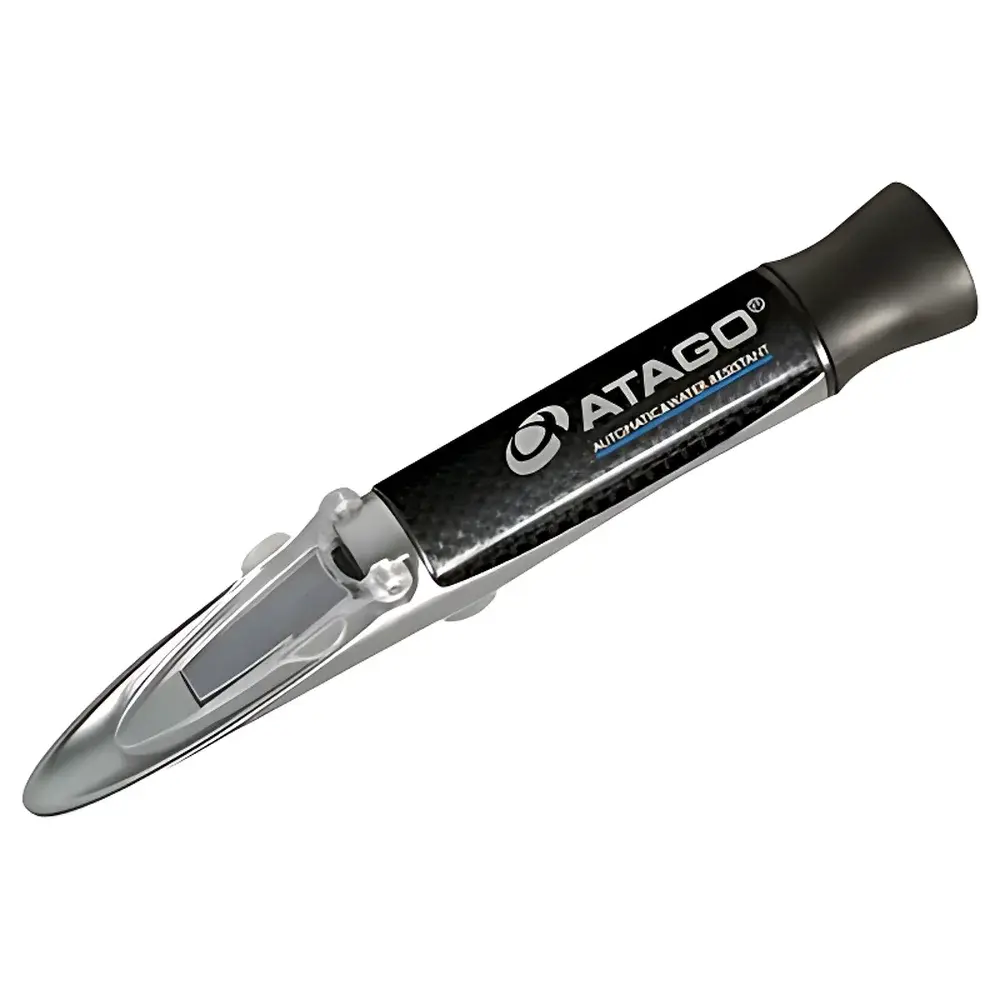
ATAGO MASTER-20M Handheld Analog Refractometer
| Brand | ATAGO |
|---|---|
| Origin | Japan |
| Model | MASTER-20M |
| Product Type | Handheld Analog Refractometer |
| Measurement Range | Brix 0.0–20.0% |
| Accuracy | ±0.1% Brix |
| Temperature Compensation | Manual (non-ATC) |
| Display Type | Analog scale with ocular eyepiece |
| Prism Housing Material | Metal (MASTER-20M) / Resin (MASTER-20PM) |
| Dimensions | 3.2 × 3.4 × 20.7 cm |
| Weight | 165 g (MASTER-20M) / 110 g (MASTER-20PM) |
Overview
The ATAGO MASTER-20M is a precision-engineered handheld analog refractometer designed specifically for rapid, field-deployable measurement of low-concentration aqueous sugar solutions in industrial quality control and laboratory environments. Based on the fundamental optical principle of critical angle refraction—where light passing through a sample-prism interface undergoes angular deviation proportional to the solution’s refractive index—the MASTER-20M converts this physical phenomenon into a direct Brix reading via a calibrated internal scale visible through its monocular eyepiece. Unlike digital or temperature-compensated instruments, the MASTER-20M operates without batteries or electronic components, ensuring mechanical reliability, long-term stability, and immunity to electromagnetic interference. Its fixed 0.0–20.0% Brix range targets applications where high sensitivity at low sugar concentrations is essential—such as soft drink formulation, post-dilution QC of fruit-based beverages, syrup blending verification, and intermediate process checks in beverage manufacturing lines. As the designated successor to the N-20E model, the MASTER-20M retains proven optical architecture while incorporating refined ergonomics and enhanced prism surface durability.
Key Features
- Optical-grade Abbe-type prism assembly with high-transmittance BK7 glass for consistent light path integrity and minimal chromatic aberration
- Mechanically robust metal housing (stainless steel-reinforced aluminum alloy) offering superior impact resistance and thermal mass for stable readings under ambient lab or production-floor conditions
- High-contrast black-on-white analog scale with 0.1% Brix graduation, optimized for visual interpolation and operator repeatability
- Integrated daylight illumination system utilizing a precisely angled daylight plate (RE-2315-60M/61M) to maximize brightness and reduce parallax error during manual observation
- Compact form factor (3.2 × 3.4 × 20.7 cm) and balanced weight distribution (165 g) enabling one-handed operation and extended use without fatigue
- Interchangeable prism covers (RE-2311-58M and RE-2391-50M) supporting both low- and medium-viscosity samples—including syrups and concentrated extracts—without cross-contamination or prism damage
Sample Compatibility & Compliance
The MASTER-20M is validated for use with aqueous sucrose solutions across its full 0.0–20.0% Brix range, with calibration traceable to ATAGO-certified reference standards (e.g., RE-110010: 10.00 ± 0.03% Brix; RE-110020: 20.00 ± 0.03% Brix). It complies with ISO 2173:2003 (“Fruit and vegetable products — Determination of soluble solids content — Refractometric method”) and supports routine adherence to internal SOPs aligned with GMP and HACCP frameworks. Due to its non-ATC (Automatic Temperature Compensation) design, users must manually correct readings using the built-in temperature correction chart (provided in instruction manual) when sample temperature deviates from 20 °C. For corrosive or saline matrices—such as electrolyte drinks, vinegar-based tonics, or brined fruit preparations—the resin-bodied MASTER-20PM variant is recommended to mitigate long-term prism housing degradation. The instrument does not meet IP67 or equivalent ingress protection standards and is not suitable for immersion or washdown environments.
Software & Data Management
As an analog optical instrument, the MASTER-20M does not incorporate embedded firmware, data logging, or digital connectivity. All measurements are recorded manually by the operator, supporting paper-based or LIMS-integrated documentation workflows. Calibration verification records—including date, standard lot number (e.g., RE-110010), observed deviation, and operator signature—must be maintained per GLP requirements. Optional calibration certificates (available upon request from authorized ATAGO representatives) provide metrological traceability to JCSS (Japanese Calibration Service System) standards. While no software is bundled, the instrument integrates seamlessly into existing QA/QC reporting structures where manual entry into Excel-based trend sheets, ELN systems, or enterprise quality management platforms (e.g., TrackWise, MasterControl) is standard practice.
Applications
- Routine Brix verification of carbonated soft drinks, flavored waters, and ready-to-drink teas during batch release
- In-line dilution control for concentrate-based beverage production lines
- Raw material screening of fruit purees, juice concentrates, and sweetener syrups prior to blending
- Educational demonstrations of refractive index principles in food science and analytical chemistry curricula
- Field inspections by regulatory auditors requiring portable, battery-free, tamper-resistant measurement tools
- Stability testing of low-sugar formulations where drift detection at sub-1% Brix increments is critical
FAQ
Does the MASTER-20M have automatic temperature compensation (ATC)?
No. The MASTER-20M requires manual temperature correction using the reference chart provided in the user manual. For ATC functionality, consider ATAGO’s PAL series or PR-101α models.
Can I measure acidic or high-salt samples with the MASTER-20M?
Prolonged exposure to acidic or saline solutions may corrode the metal prism housing. For such samples, ATAGO recommends the resin-housed MASTER-20PM variant.
What calibration standards are compatible with this model?
Certified sucrose reference solutions RE-110010 (10.00 ± 0.03% Brix) and RE-110020 (20.00 ± 0.03% Brix) are specified for routine calibration and verification.
Is the MASTER-20M waterproof or washdown-rated?
No. It lacks ingress protection rating and must be cleaned only with soft, lint-free cloth and distilled water. Avoid solvent contact or submersion.
How often should I recalibrate the instrument?
Calibration is recommended before each shift or measurement session when used in regulated environments; frequency should align with internal SOPs and risk-based validation protocols.





