
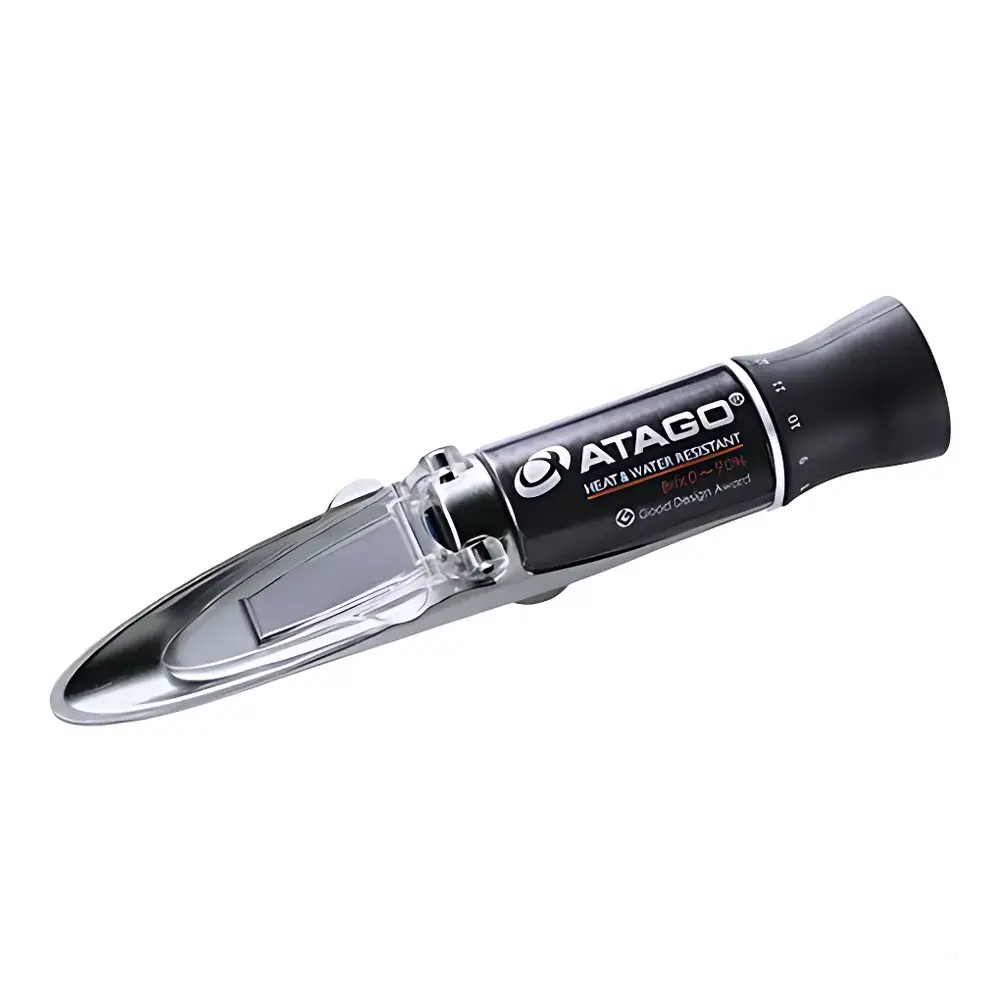
ATAGO MASTER-500 Jam-Specific Handheld Refractometer
| Brand | ATAGO |
|---|---|
| Origin | Japan |
| Model | MASTER-500 |
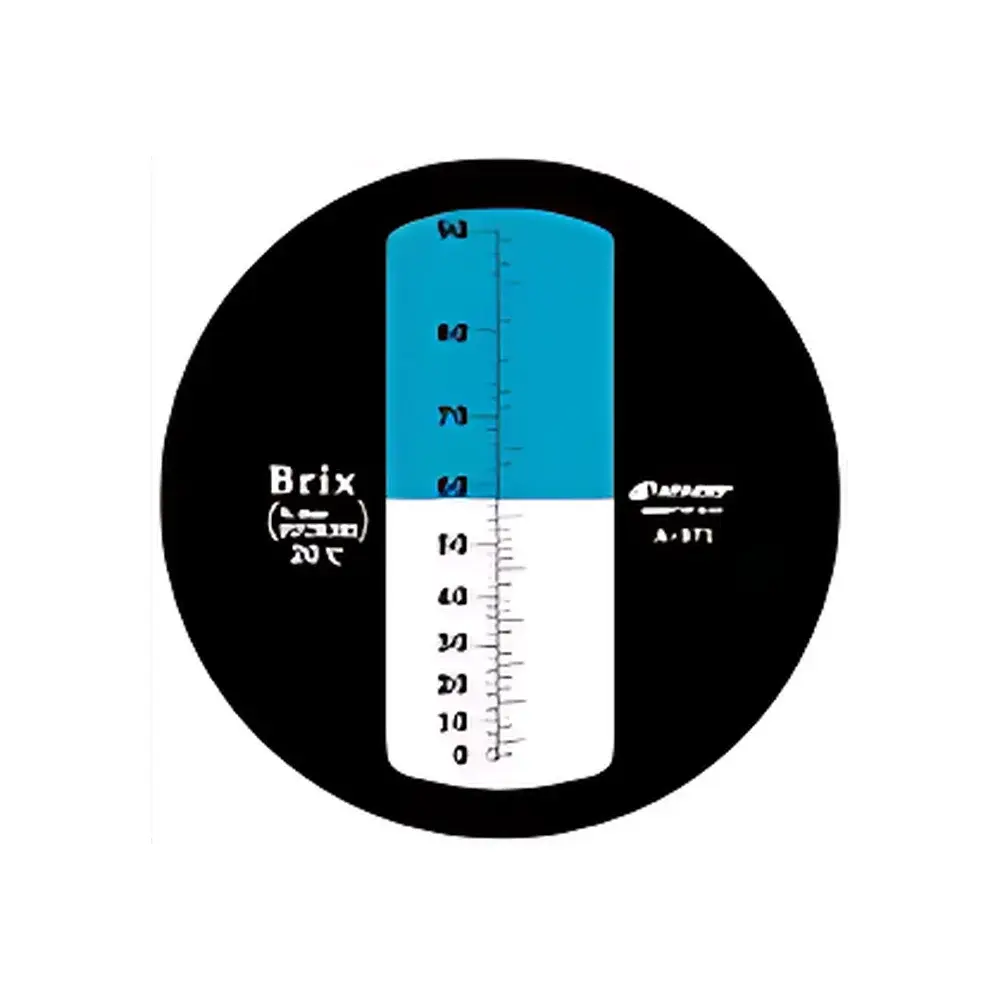
| Measurement Range | Brix 0.0–90.0% |
| Resolution | 1.0% Brix |
| Accuracy | ±1.0% Brix (±0.5% Brix repeatability) |
| Dimensions | 3.2 × 3.4 × 16.8 cm |
| Weight | 130 g |
| Instrument Type | Destructive Sampling Refractometer |
| Compliance | Designed per JIS K 0071 and ISO 2173 for refractometric sugar analysis |
Overview
The ATAGO MASTER-500 Jam-Specific Handheld Refractometer is an optical precision instrument engineered for rapid, field-deployable Brix concentration measurement in high-solids, viscous food matrices—particularly jams, jellies, marmalades, fruit preserves, and concentrated syrups. Unlike general-purpose handheld refractometers, the MASTER-500 incorporates a custom optical path geometry and temperature-compensated prism system optimized for samples with elevated viscosity and suspended particulates. It operates on the fundamental principle of Abbe refractometry: measuring the critical angle of total internal reflection at the sample-prism interface to determine refractive index, which is then converted to % Brix using the internationally accepted ICUMSA sucrose calibration curve. Its 0.0–90.0% Brix range accommodates both undercooked preparations and fully concentrated products, supporting process validation, quality release, and regulatory documentation in production environments where real-time decision-making is essential.
Key Features
- Specialized optical design with high-refractive-index borosilicate glass prism and anti-stick surface treatment for reliable contact with sticky, non-homogeneous jam samples
- Automatic temperature compensation (ATC) calibrated to 20 °C reference, covering operational range from 10 °C to 40 °C without external correction tables
- Destructive sampling mode enables direct measurement of unfiltered, hot-fill jam batches—minimizing preparation time and eliminating dilution errors
- Compact ergonomic form factor (130 g, 16.8 cm length) with rubberized grip and IP54-rated housing for use in humid, high-temperature processing areas
- Mechanical scale with parallax-free eyepiece and illuminated reticle for consistent visual reading under variable ambient lighting conditions
- No battery or electronics required—ensures intrinsic reliability, zero drift, and compliance with explosion-proof or ESD-sensitive zones
Sample Compatibility & Compliance
The MASTER-500 is validated for use with thermally stable, aqueous-sugar systems containing pectin, citric acid, and fruit pulp up to 5% w/w solids content. It is not suitable for low-Brix beverages, oil-based emulsions, or highly turbid suspensions requiring centrifugation or filtration. The instrument conforms to JIS K 0071:2021 (Methods of test for sugar content of fruit juices and related products) and aligns with ISO 2173:2003 (Fruit and vegetable products — Determination of soluble solids content — Refractometric method). While not electronic, its mechanical traceability supports GLP-aligned documentation when paired with standardized SOPs for sample application, cleaning, and calibration verification using certified sucrose standards (e.g., NIST SRM 84d). Routine verification against ATAGO-certified 10.0%, 45.0%, and 75.0% Brix control solutions is recommended prior to each shift.
Software & Data Management
As a purely optical-mechanical instrument, the MASTER-500 does not incorporate digital output, Bluetooth, or software interfaces. This architecture eliminates firmware vulnerabilities, data integrity risks, and validation overhead associated with electronic instruments—making it inherently compatible with FDA 21 CFR Part 11-compliant workflows when used within documented manual data capture procedures (e.g., paper logbooks or validated LIMS entry protocols). Users may integrate readings into enterprise quality systems via structured transcription using ATAGO’s optional MASTER-500 Logbook Kit (PN: LB-M500), which includes pre-printed templates aligned with ISO/IEC 17025 record retention requirements.
Applications
- Real-time endpoint determination during jam boiling and vacuum concentration cycles
- In-process verification of pectin-sugar ratio stability in small-batch artisanal production
- Receiving inspection of inbound fruit purees and concentrated sweeteners
- QC release testing for shelf-life studies involving water activity–Brix correlation
- Educational demonstration of colligative properties in food science curricula
- Audit-ready measurement support for BRCGS Food Safety Issue 9 Clause 4.9.2 (Process Control Monitoring)
FAQ
Is the MASTER-500 suitable for measuring honey or maple syrup?
Yes—its extended 0.0–90.0% Brix range and high-viscosity prism coating make it appropriate for undiluted honey (typically 78–86% Brix) and maple syrup (66–67% Brix), provided samples are cooled to ≤40 °C before measurement.
Does it require calibration with distilled water?
No—distilled water (0.0% Brix) is not a valid zero-point reference for high-Brix refractometers. Calibration must be performed using ATAGO-certified sucrose standard solutions matching the expected operating range.
Can it be used for regulatory submission data?
Yes—when operated per ATAGO’s published Standard Operating Procedure (SOP-M500 Rev.3) and supported by instrument-specific calibration records, readings meet evidentiary requirements for HACCP CCP monitoring and USDA/FDA label claim verification.
How often should the prism surface be cleaned?
After every sample—using lint-free tissue and ATAGO Prism Cleaning Fluid (PN: CLN-PRISM) to prevent crystalline residue buildup that compromises optical contact and measurement reproducibility.



