
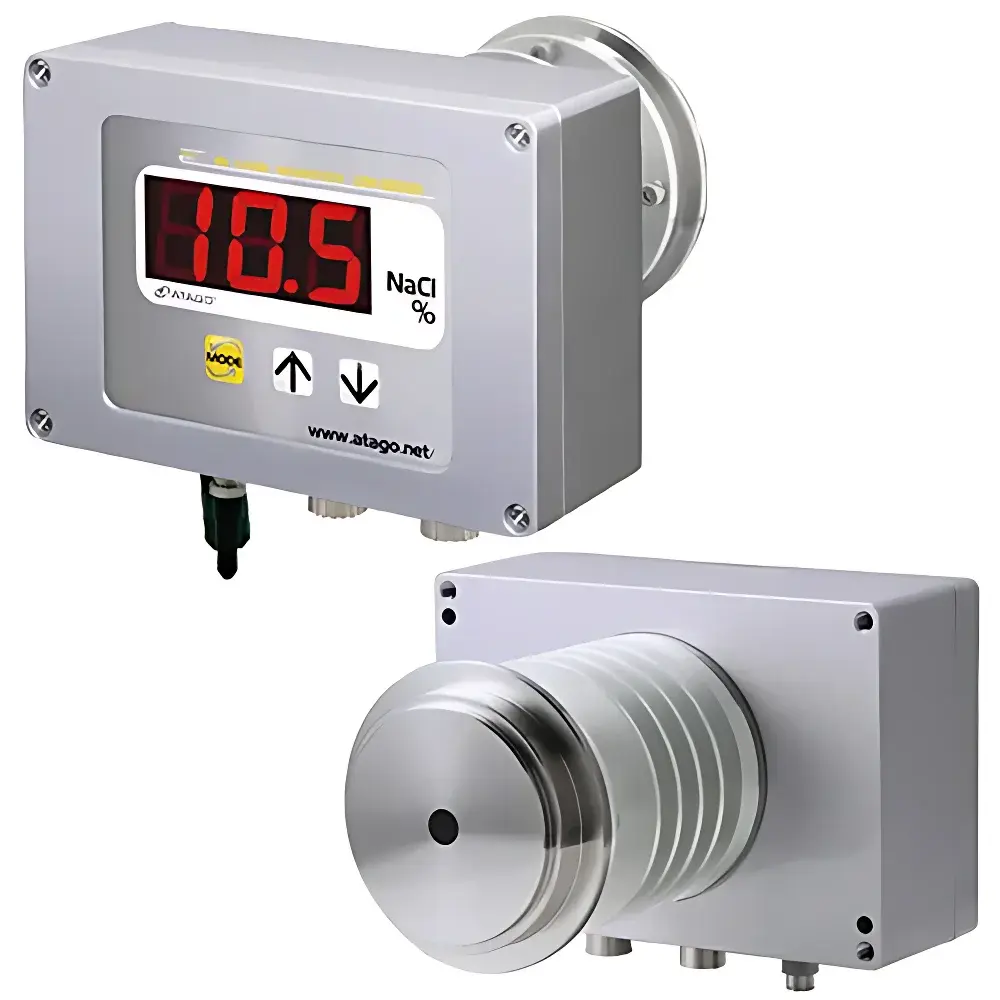
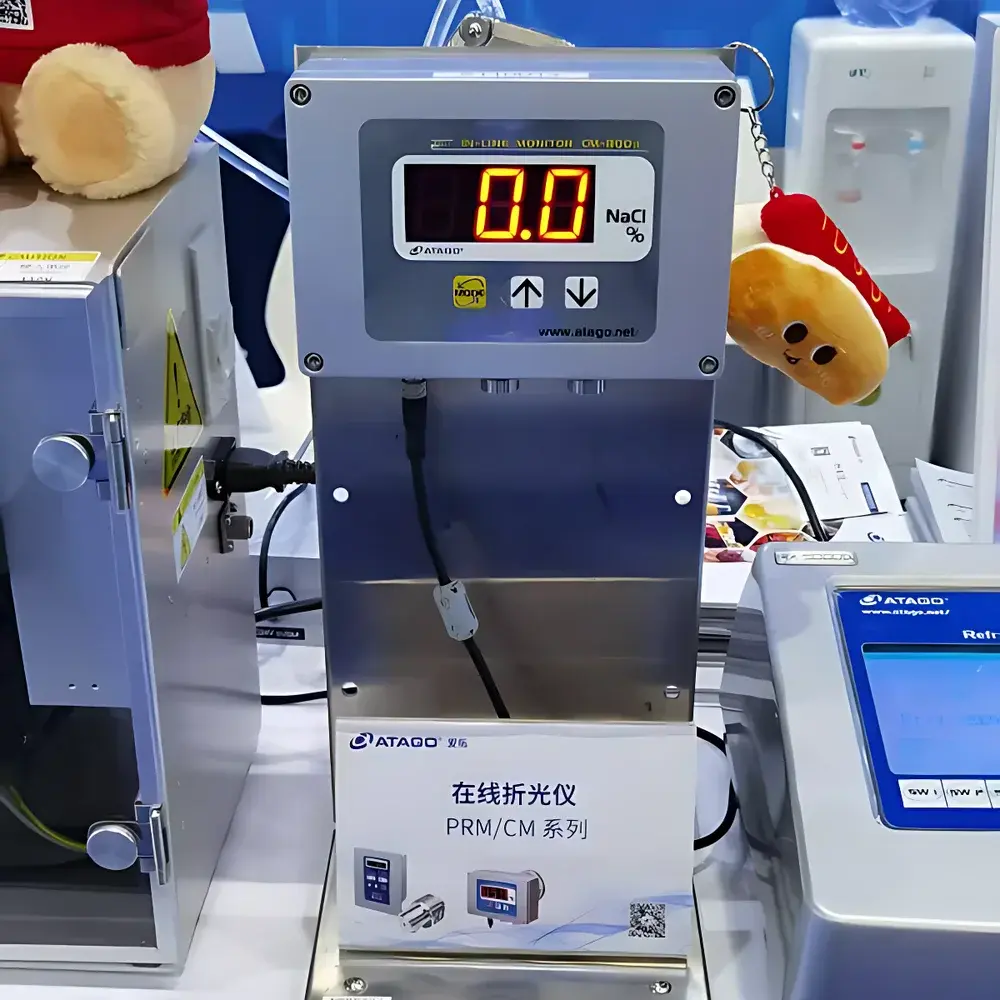
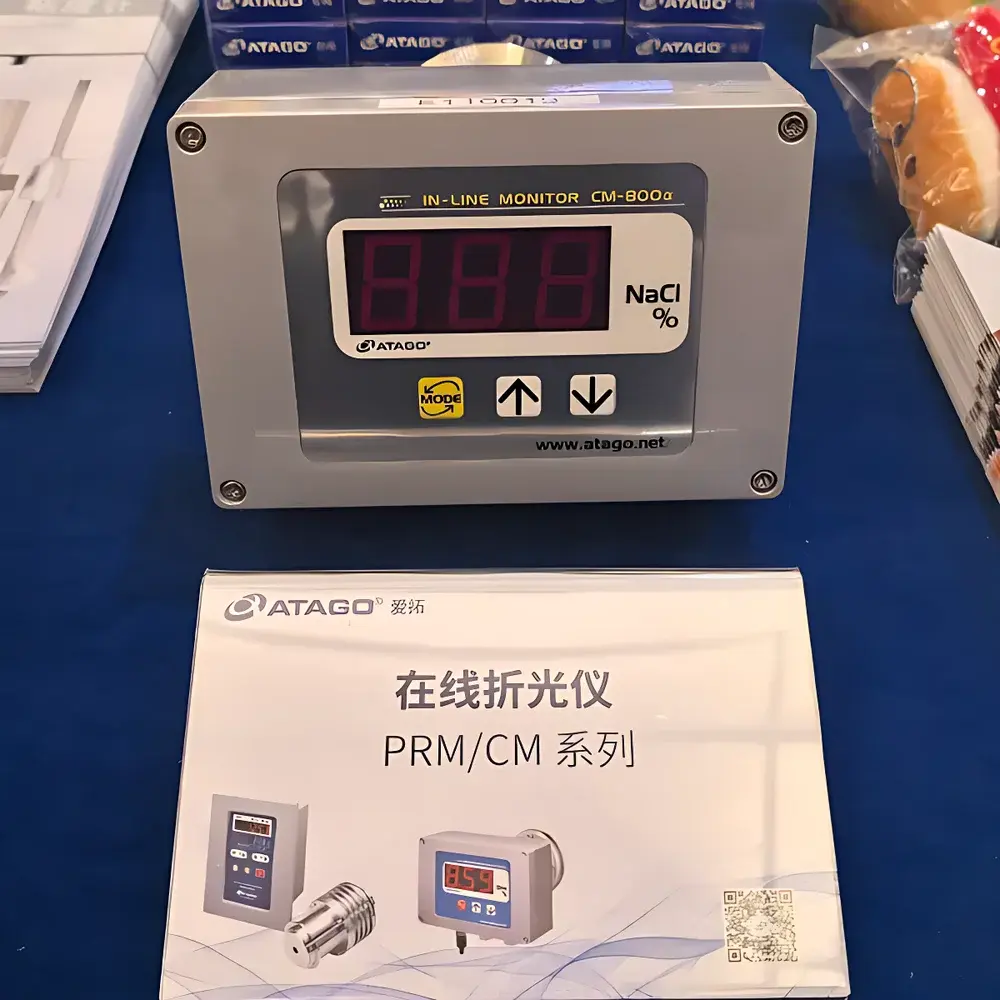
ATAGO CM-800α-SW In-Line Salinometer for Chlor-Alkali Process
| Brand | ATAGO |
|---|---|
| Origin | Japan |
| Model | CM-800α-SW |
| Measurement Principle | Refractometry (LED light source, ~589 nm D-line equivalent) |
| Measurement Range | Salt Concentration (NaCl): 0.00–28.0% w/w (Brix-equivalent scale, ATC) |
| Accuracy | ±0.1% salt concentration, ±1°C/°F temperature |
| Temperature Compensation Range | 5–100°C (Automatic Temperature Compensation, ATC) |
| Operating Temperature | −15–160.0°C |
| Environmental Operating Range | 5–40°C |
| Resolution | 0.01% (0.00–9.99%), 0.1% (≥10.0%) |
| Temperature | 1°C/°F |
| Output Signals | DC 4–20 mA (linear), RS-232C (refractive index or concentration data, user-selectable) |
| Sampling Interval | Default 1 s (configurable to 5 preset intervals) |
| IP Rating | IP67 |
| Light Source | LED (D-line approx.) |
| Prism Material | Synthetic Sapphire |
| Housing Material | SUS316L stainless steel |
| Dimensions | 160 × 167 × 110 mm |
| Weight | 2.4 kg |
| Power Supply | DC 24 V (AC 100 V optional with AD-32 adapter) |
Overview
The ATAGO CM-800α-SW is a purpose-engineered in-line salinometer designed specifically for continuous, real-time monitoring of sodium chloride (NaCl) concentration in chlor-alkali process streams. It operates on the principle of critical-angle refractometry—measuring the refractive index of aqueous NaCl solutions and converting it to mass concentration (%) using a factory-calibrated, temperature-compensated algorithm traceable to NIST-standard reference materials. Unlike offline titration or conductivity-based methods, refractometry provides direct, non-invasive, and interference-resistant measurement of total dissolved solids (TDS) dominated by NaCl, making it ideal for saturated brine feed streams where ionic strength, pH drift, and electrode fouling compromise alternative techniques. The instrument integrates seamlessly into process piping via sanitary or flanged mounting options and delivers stable, high-reproducibility readings under dynamic flow conditions typical of electrolytic cell feed systems operating at temperatures up to 160°C and pressures compatible with standard industrial piping.
Key Features
- Optical core built with synthetic sapphire prism and SUS316L wetted parts—resistant to corrosion from hot, concentrated brine and caustic carryover.
- True automatic temperature compensation (ATC) across 5–100°C, eliminating manual correction and ensuring accuracy across wide thermal gradients in brine preheating and recirculation loops.
- Dual-output capability: analog 4–20 mA signal for PLC/DCS integration and digital RS-232C interface for direct PC logging or SCADA communication (refractive index or % NaCl output selectable in firmware).
- IP67-rated housing ensures reliable operation in humid, splash-prone environments common in electrolysis cell rooms and brine purification areas.
- LED light source centered near the sodium D-line (589 nm) ensures spectral consistency with classical refractometric standards and minimizes wavelength-dependent drift.
- Configurable sampling interval (1 s default; five programmable options) enables optimization for rapid control response or long-term trend analysis without overloading data infrastructure.
Sample Compatibility & Compliance
The CM-800α-SW is validated for use with clarified, filtered saturated NaCl brine solutions containing ≤ 300,000 mg/L total dissolved salts—covering standard commercial brine (≈25–28% w/w NaCl), diluted regeneration streams, and post-purification electrolyte feeds. It is not intended for slurries, emulsions, or highly turbid media requiring inline filtration. The instrument complies with IEC 60529 (IP67), conforms to CE marking requirements for electromagnetic compatibility (EMC Directive 2014/30/EU), and supports audit-ready operation under GLP and GMP frameworks when integrated with compliant data acquisition systems. While not intrinsically safe, it may be deployed in Zone 2 classified areas when installed per ATEX/IECEx guidelines using appropriate barrier systems.
Software & Data Management
No proprietary software is required for basic operation—the device functions autonomously as a 4–20 mA transmitter. For advanced configuration and diagnostics, ATAGO’s CM-Series Configuration Utility (Windows-compatible, USB-to-RS232 cable included) allows users to set output mode (refractive index or % NaCl), adjust ATC parameters, define sampling intervals, and perform zero/span verification using certified NaCl standards. All configuration changes are stored in non-volatile memory. When connected to a validated historian or LIMS, the RS-232C output supports time-stamped ASCII records compatible with FDA 21 CFR Part 11–compliant systems when paired with electronic signature and audit trail functionality at the host level.
Applications
- Real-time control of saturated brine concentration upstream of membrane electrolysis cells to maintain optimal current efficiency and minimize chlorine gas impurities.
- Monitoring brine recirculation loops to detect dilution events caused by water ingress or valve misalignment.
- Automated feedback control of NaCl dissolution tanks and saturator vessels in continuous brine preparation systems.
- Cross-application utility in caustic soda (NaOH) concentration monitoring when used with the CM-800α-NaOH variant—enabling coordinated control of both anolyte and catholyte streams.
- Supporting quality assurance in downstream chlorine derivative synthesis (e.g., PVC, chlorinated solvents) where brine purity directly impacts catalyst lifetime and product spec compliance (ASTM D1127, ISO 9001 Clause 8.5.1).
FAQ
Does the CM-800α-SW require periodic recalibration?
Yes—ATAGO recommends annual verification against traceable NaCl reference standards (e.g., NIST SRM 999b) or in-house prepared solutions verified by gravimetric analysis. Zero-point checks with deionized water should be performed daily or per shift in critical applications.
Can it measure seawater or low-concentration brine?
It is optimized for high-salinity ranges (0.00–28.0% w/w). While technically capable down to 0.00%, detection limits and relative uncertainty increase below 3%—making it less suitable for seawater (≈3.5%) unless configured for enhanced low-range resolution.
Is the sapphire prism susceptible to scratching or chemical attack?
Synthetic sapphire (Al₂O₃) exhibits Mohs hardness of 9 and exceptional resistance to hydrolysis, halides, and alkalis up to 160°C. Mechanical abrasion from suspended solids remains the primary wear mechanism—hence upstream filtration is advised for abrasive brines.
How does refractometry compare to conductivity-based salinity sensors in chlor-alkali service?
Conductivity sensors drift with temperature, electrode polarization, and scaling; they also respond non-linearly to multi-ion mixtures. Refractometry measures bulk optical density, offering superior stability in high-ionic-strength, high-temperature NaCl solutions with minimal maintenance.
What documentation is provided for regulatory validation?
ATAGO supplies a Factory Calibration Certificate (traceable to JCSS standards), material compliance declarations (RoHS, REACH), electrical safety reports (EN 61010-1), and mechanical installation drawings—all available upon request for IQ/OQ protocol development.




