
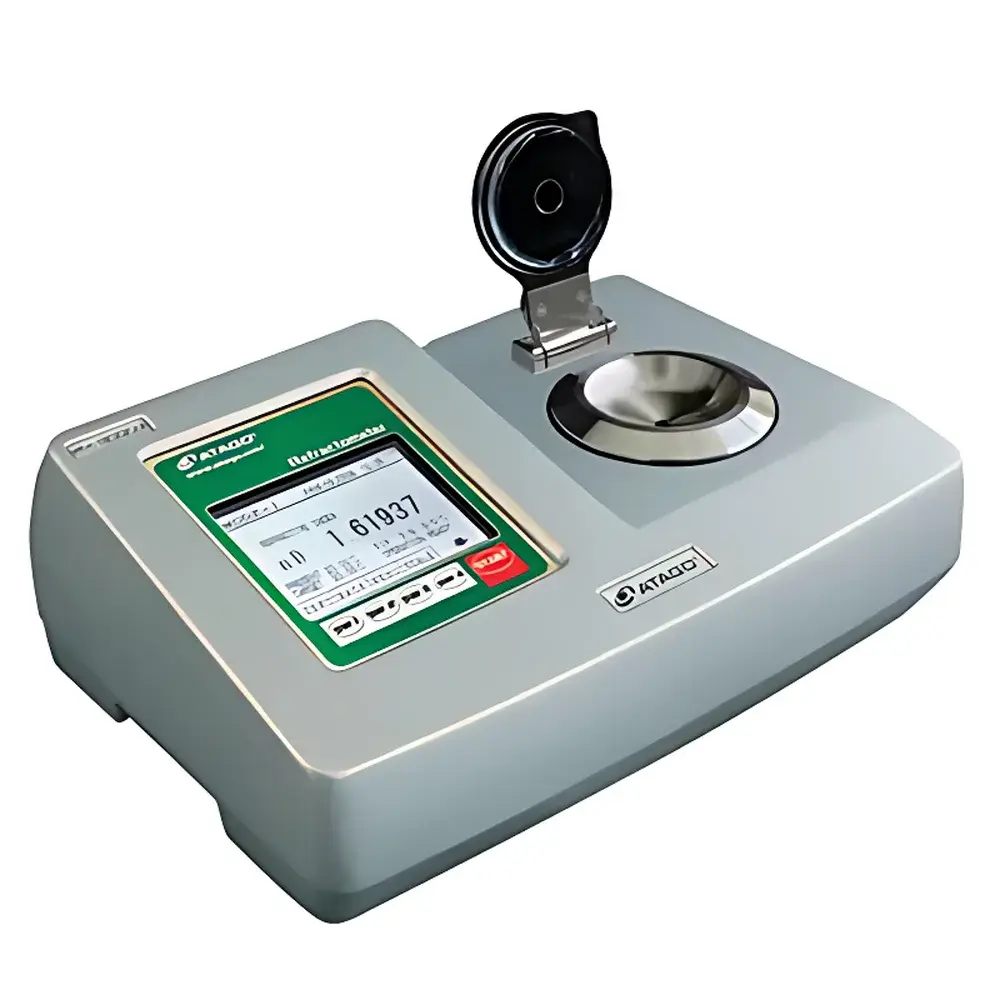
Atago RX-9000α High-Precision Digital Abbe Refractometer
| Origin | Japan |
|---|---|
| Manufacturer Type | Authorized Distributor |
| Origin Category | Imported Instrument |
| Model | RX-9000α |
| Pricing | Upon Request |
| Refractive Index (nD) Range | 1.32500–1.70000 |
| Brix Range | 0.00–100.00% (ATC: 5–70°C) |
| nD Resolution | 0.00001 / 0.0001 |
| Brix Resolution | 0.01% / 0.1% |
| Temperature Resolution | 0.01°C |
| nD Accuracy | ±0.00004 (1.33299–1.42009, 10.00–30.00°C) |
| Brix Accuracy | ±0.03% (0.00–50.00%, 10.00–30.00°C) |
| nD Repeatability | ±0.00002 (1.33299–1.42009, 10.00–30.00°C) |
| Brix Repeatability | ±0.01% (0.00–50.00%, 10.00–30.00°C) |
| Temperature Control Range | 5–70°C |
| Power Supply | AC 100–240 V, 50/60 Hz |
| Dimensions & Weight | 37 × 26 × 14 cm, 6.9 kg |
| Power Consumption | 65 VA |
| Interface Options | RS-232C, optional thermal printer (DP-RX / DP-RD) |
Overview
The Atago RX-9000α High-Precision Digital Abbe Refractometer is a benchtop optical instrument engineered for laboratory-grade refractive index (nD) and Brix concentration measurements with metrological rigor. Based on the classical Abbe principle—where the critical angle of total internal reflection at the prism-sample interface is optically detected via a high-resolution CCD array—the RX-9000α delivers traceable, temperature-compensated results across an extended refractive index range (1.32500–1.70000). Its integrated Peltier-controlled thermostatic system maintains sample temperature within ±0.01°C over a 5–70°C operational span, enabling precise measurement of thermally sensitive or high-boiling-point materials including essential oils, aromatic solvents, polymer precursors, and high-viscosity lipid systems. Designed for compliance-critical environments, the instrument supports ASTM D1218, ISO 287, ISO 1042, and USP refractometry standards, and its measurement traceability aligns with NIST-traceable sucrose reference solutions (RE-111001 through RE-115002).
Key Features
- Extended refractive index range (1.32500–1.70000) accommodating high-nD organic solvents and molten fats
- Peltier-based active temperature control (5–70°C) with real-time monitoring and ±0.01°C resolution
- Three selectable measurement modes: standard nD, Brix (sucrose-equivalent), and user-defined concentration calibration
- Manual offset correction function for alignment with certified reference instruments or master standards
- High-stability Abbe prism assembly with anti-reflective coated optics and infrared-transparent lens option for specialized applications
- RS-232C serial interface compliant with FDA 21 CFR Part 11 requirements when paired with validated data acquisition software
- Robust aluminum alloy chassis with ESD-safe housing, designed for continuous operation in QC laboratories and production environments
Sample Compatibility & Compliance
The RX-9000α accommodates liquid, semi-liquid, and low-volatility samples—including edible oils, glycerin-based formulations, pharmaceutical syrups, and industrial solvents—with minimal sample volume (≥0.5 mL). Optional accessories such as the volatile sample converter (RE-56152) and precision dispensing funnel (RE-56155) extend usability to evaporation-prone or viscous matrices. All factory calibration and verification procedures follow ISO/IEC 17025 principles. The instrument’s measurement uncertainty budget is documented per ISO/IEC Guide 98-3 (GUM), and its Brix accuracy specification (±0.03% for 0.00–50.00% range) satisfies GLP and GMP process validation requirements for food, beverage, and biopharmaceutical manufacturing.
Software & Data Management
Data output is supported via RS-232C to LIMS-compatible systems or Atago’s proprietary PC software (optional), enabling automated report generation, audit trail logging, and electronic signature capture. When configured with time-stamped, user-authenticated data export, the system meets 21 CFR Part 11 criteria for electronic records and signatures. Thermal printer options (DP-RX and DP-RD models) provide hard-copy documentation with embedded date/time stamps, operator ID, and calibration status—essential for ISO 9001-certified quality management systems. All firmware updates are digitally signed and version-controlled to ensure integrity and regulatory defensibility.
Applications
- Quality control of edible oils and fats: determination of iodine value proxies, adulteration screening, and thermal stability assessment
- Concentration monitoring in sugar refining, juice processing, and dairy product standardization (e.g., soy milk Brix verification pre-coagulation)
- Pharmaceutical excipient characterization: glycerol, propylene glycol, and polyethylene glycol concentration verification
- Chemical synthesis: real-time tracking of reaction progress in condensation or esterification processes via refractive index drift
- Essential oil authentication: differentiation of natural vs. synthetic terpenoid blends using nD fingerprinting
- Electrolyte solution preparation for battery R&D and fuel cell testing
FAQ
What standards does the RX-9000α comply with for pharmaceutical use?
The instrument supports USP , EP 2.2.2, and JP 2.05 refractometry methods; its calibration traceability and data integrity features enable compliance with FDA 21 CFR Part 11 and EU Annex 11 when integrated into validated workflows.
Can the RX-9000α measure samples above 70°C?
No—the maximum controlled temperature is 70°C. For elevated-temperature measurements, external thermostatic sample cells with compatible optical coupling may be used, though accuracy specifications apply only within the instrument’s built-in temperature range.
Is manual calibration verification required before each analysis?
While daily verification using NIST-traceable sucrose standards (e.g., RE-111001–RE-115002) is recommended for regulated environments, the instrument’s ±0.00002 nD repeatability allows extended calibration intervals under stable laboratory conditions per ISO/IEC 17025 clause 5.5.2.
Does the RX-9000α support custom calibration curves for non-sucrose solutes?
Yes—via the user-defined concentration mode, operators can input polynomial or linear equations derived from empirical density or concentration data, enabling direct reporting of % w/w for acids, alcohols, or salts.
How is temperature uniformity ensured across the prism surface?
A dual-zone Peltier module with feedback-controlled thermal regulation and platinum RTD sensing ensures ≤0.02°C spatial gradient across the 25 mm² measurement area, minimizing thermal artifact-induced refractive index error.




