
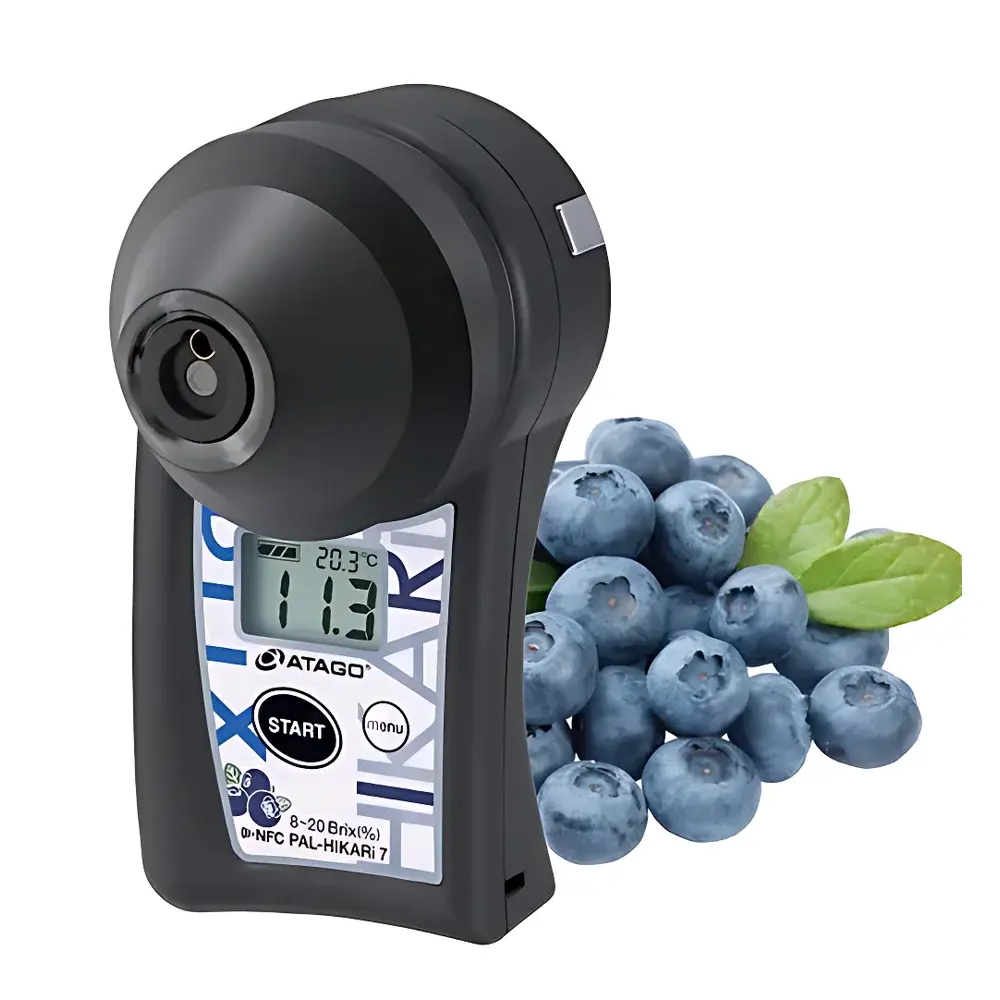
ATAGO PAL-HIKARi 7 Non-Destructive Blueberry Brix Meter
| Brand | ATAGO |
|---|---|
| Origin | Japan |
| Model | PAL-HIKARi 7 (Blueberry) |
| Instrument Type | Non-Destructive |
| Measurement Principle | Near-Infrared (NIR) Absorption Spectroscopy |
| Measuring Range | 8.0–20.0% Brix |
| Accuracy | ±2.0% Brix (guaranteed) |
| Resolution | 0.1% Brix |
| Repeatability | ±1.0% Brix |
| Operating Temperature Range | 10.0–35.0°C |
| Automatic Temperature Compensation Range | 15.0–30.0°C |
| IP Rating | IP64 |
| Battery | 2×AAA alkaline (≈4,000 measurements) |
| Dimensions | 6.1×6.4×11.5 cm |
| Weight | 153 g (main unit only) |
Overview
The ATAGO PAL-HIKARi 7 is a handheld, non-destructive near-infrared (NIR) Brix meter engineered specifically for in-field and post-harvest quality assessment of intact blueberries. Unlike traditional refractometers requiring juice extraction or destructive sampling, the PAL-HIKARi 7 employs calibrated NIR reflectance spectroscopy at optimized wavelengths to estimate soluble solids content (SSC) through the fruit epidermis—without piercing, cutting, or compressing the berry. This optical measurement principle relies on the characteristic absorption bands of sucrose, glucose, and fructose in the 700–1000 nm spectral region, enabling rapid (<3 s per measurement), operator-independent quantification of Brix values directly on living or harvested fruit. The device is factory-calibrated against reference blueberry cultivars using gravimetrically validated sucrose standards and traceable to NIST-traceable refractometric reference materials. Its compact form factor and robust mechanical design support deployment in orchards, packing houses, cold storage facilities, and QA laboratories under variable ambient conditions.
Key Features
- True non-destructive operation: Measures Brix on intact blueberries without skin penetration, bruising, or juice loss—preserving sample integrity for downstream sensory, microbiological, or shelf-life evaluation.
- Dedicated blueberry calibration: Pre-loaded spectral model optimized for common cultivars (e.g., ‘Duke’, ‘Draper’, ‘Legacy’) accounting for variations in skin thickness, anthocyanin density, and surface wax composition.
- Integrated automatic temperature compensation (ATC): Dynamically corrects for thermal drift across 15.0–30.0°C using dual-sensor thermometry (ambient + contact probe), ensuring consistency despite field temperature fluctuations.
- IP64-rated enclosure: Dust-tight and protected against water splashing from any direction—suitable for humid greenhouse environments and wet packing-line conditions.
- High-precision optical path: Dual-wavelength NIR LED source with matched photodiode detection minimizes interference from ambient light and fruit surface reflectivity anomalies.
- Low-power architecture: Delivers ~4,000 measurements per set of AAA alkaline batteries, supporting multi-day orchard surveys without recharging infrastructure.
Sample Compatibility & Compliance
The PAL-HIKARi 7 is validated exclusively for mature, commercially harvested blueberries (Vaccinium spp.) with intact, unwounded skins and typical bloom coverage. It is not intended for use on immature fruit, frozen/thawed samples, or cultivars exhibiting extreme cuticular wax deposition or anthocyanin saturation (>3.5 OD at 530 nm). While not certified to ISO/IEC 17025, the instrument complies with fundamental metrological requirements outlined in ASTM D8193–21 (Standard Guide for NIR Spectroscopic Analysis of Fruits) and supports GLP-aligned data collection when paired with ATAGO’s optional USB-C data logging interface. Measurement uncertainty is stated per manufacturer’s type evaluation report (Ref. ATAGO-TS-PAL-HIKARi7-2023-04), and calibration verification can be performed using certified Brix reference gels traceable to NIST SRM 84d.
Software & Data Management
The PAL-HIKARi 7 operates as a standalone instrument with no embedded software stack; all processing occurs via fixed-firmware spectral algorithms. However, optional connectivity (via ATAGO’s PAL-Link v2.1 adapter) enables direct export of timestamped Brix readings—including measurement ID, ambient temperature, and pass/fail flags—to CSV or Excel-compatible formats. Data files include audit-ready metadata compliant with FDA 21 CFR Part 11 principles (user ID, device serial number, acquisition time, firmware version), facilitating integration into LIMS or electronic batch record systems used in GMP-regulated food safety programs. Firmware updates are distributed exclusively through ATAGO’s authorized service centers and require physical device connection—no over-the-air capability is implemented to maintain measurement integrity.
Applications
- Harvest timing optimization: Real-time Brix mapping across orchard blocks to identify peak ripeness windows and minimize premature or overripe harvesting.
- Incoming inspection at processing facilities: Rapid screening of blueberry lots prior to freezing, drying, or jam production—reducing reliance on destructive lab assays.
- Cultivar performance trials: Longitudinal SSC tracking during breeding programs without compromising experimental plant yield or fruit marketability.
- Post-harvest quality monitoring: Assessing sugar stability during cold chain transport and storage, correlating with respiration rate and ethylene evolution data.
- Research-grade phenotyping: Supporting plant physiology studies on carbon partitioning, drought stress response, and rootstock-scion interactions in Vaccinium germplasm collections.
FAQ
Can the PAL-HIKARi 7 measure other small fruits such as raspberries or blackberries?
No. The optical model and calibration are specific to blueberry morphology, skin optical properties, and SSC distribution profiles. Cross-fruit use introduces unquantified systematic bias exceeding ±4.0% Brix.
Does surface moisture affect measurement accuracy?
Yes. Free water on the fruit surface causes specular reflection artifacts. Wipe berries gently with lint-free cloth before measurement; do not use solvents or abrasives.
Is periodic recalibration required?
ATAGO recommends annual verification using certified reference gels. Field recalibration is not user-accessible; only authorized service centers may adjust firmware parameters.
How does ambient lighting impact readings?
The integrated optical shielding and narrow-band NIR detection suppress interference from daylight, LED, and fluorescent sources. No shading hood is necessary under normal outdoor or indoor lighting conditions.
What is the minimum fruit size compatible with the measurement aperture?
Fruit diameter must exceed 12 mm to ensure full coverage of the 8-mm-diameter sensing window. Smaller berries yield unreliable signal-to-noise ratios and are flagged as “out of range” by the device firmware.




