
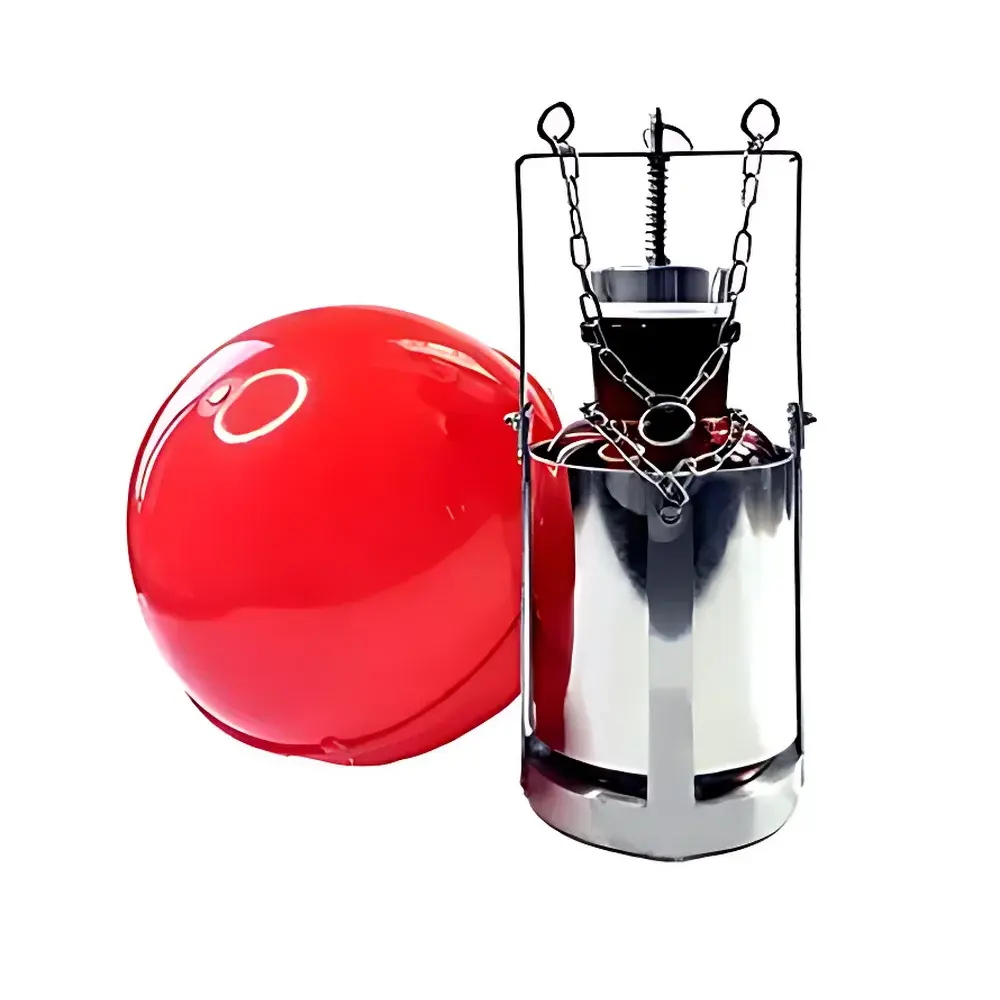
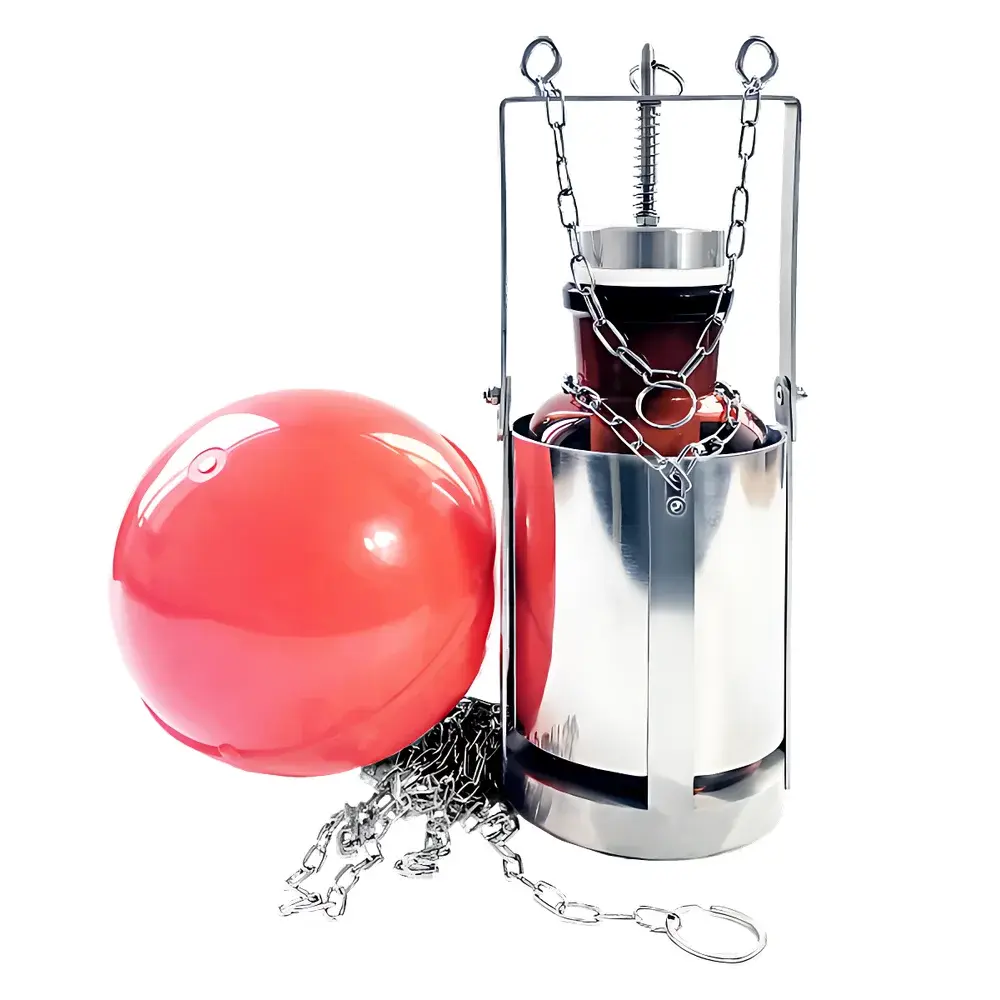
Online Instrument OL-P0103 Portable Petroleum-Targeted Water Sampler
| Brand | Online Instrument |
|---|---|
| Origin | Shanghai, China |
| Manufacturer Type | Direct Manufacturer |
| Product Category | Domestic (China-Made) |
| Model | OL-P0103 |
| Instrument Type | Manual Portable Water Sampler |
| Sampling Method | Quantitative Sampling |
| Single Sample Volume | 500 mL |
| Sampling Volume Accuracy | ±2% |
| Sampling Depth | 0.5 m below water surface |
| Bottle Material | Borosilicate Glass (500 mL Wide-Mouth) |
| Bottle Cap | 1 cm-thick PTFE Septum with Inlet Port |
| Actuation Mechanism | Manual Pull-Chain for Septum Opening/Closing |
| Chain & Pull Cord Length | ≥3.5 m |
| Compliance | HJ/T 91–2001, HJ 970–2018, HJ 637–2018 |
Overview
The Online Instrument OL-P0103 Portable Petroleum-Targeted Water Sampler is a manually operated, field-deployable sampling device engineered specifically for the collection of representative water samples intended for petroleum hydrocarbon analysis. Designed in strict accordance with Chinese environmental monitoring standards—including HJ/T 91–2001 (Technical Specifications for Surface Water and Wastewater Monitoring), HJ 970–2018 (Determination of Petroleum Hydrocarbons in Water by UV Spectrophotometry), and HJ 637–2018 (Determination of Petroleum and Animal/Fat Oils in Water by Infrared Spectrophotometry)—the OL-P0103 ensures sample integrity during acquisition from rivers, lakes, and reservoirs. Its operational principle relies on depth-controlled, single-point quantitative sampling via mechanical septum actuation: the sampler is lowered to a fixed depth of 0.5 m beneath the water surface with the PTFE septum sealed; upon reaching target depth, manual upward traction of the stainless-steel pull chain opens the septum, allowing ambient water to enter the 500 mL borosilicate glass bottle through a dedicated inlet port. Air displacement is visually confirmed by bubble release; once effervescence ceases, the chain is released to reseal the septum, preserving the sample under closed-system conditions prior to retrieval. This method minimizes contamination risk, prevents volatilization loss of light hydrocarbons, and maintains phase stability—critical prerequisites for accurate downstream UV or FTIR-based quantification.
Key Features
- Stainless-steel construction for corrosion resistance and long-term field durability
- PTFE septum cap (≈1 cm thickness) with precision-machined inlet port to ensure leak-tight sealing and inert sample contact surface
- 500 mL wide-mouth borosilicate glass sampling bottle—chemically inert, low extractables, compatible with EPA Method 1664 and ISO 9377-2 workflows
- Manual pull-chain actuation system with ≥3.5 m stainless-steel lifting chain and matching draw cord—enabling reliable operation from banks, piers, or small vessels
- ±2% volumetric accuracy verified per batch against NIST-traceable calibrated cylinders under static immersion conditions
- No electronic components or power requirements—ideal for remote, low-infrastructure field campaigns and emergency response scenarios
Sample Compatibility & Compliance
The OL-P0103 is validated for use in regulatory-compliant sampling of surface freshwater matrices where petroleum hydrocarbon determination is required. Its design satisfies the physical sampling criteria outlined in HJ 970–2018 (UV method) and HJ 637–2018 (infrared method), particularly regarding avoidance of surface film disruption, minimization of air entrainment post-collection, and maintenance of sample containment integrity during transit. The PTFE/glass interface meets US EPA SW-846 compatibility guidelines for hydrophobic analyte preservation. While not an automated or multi-depth platform, the OL-P0103 supports GLP-aligned field documentation when used with chain-of-custody logs and depth-verified deployment records. It is not intended for wastewater influent/effluent with high suspended solids or viscous emulsions without prior filtration or settling per HJ/T 91–2001 Section 5.3.
Software & Data Management
The OL-P0103 operates entirely without embedded firmware, connectivity, or software dependencies. All sampling parameters—including deployment depth (0.5 m), volume (500 mL), and timing—are established manually and recorded externally using standardized field logbooks or LIMS-integrated mobile data capture tools. Users are advised to document chain tension verification, bubble-release observation timestamps, and cap resealing confirmation as part of auditable sampling metadata. For laboratories operating under 21 CFR Part 11 or ISO/IEC 17025, this manual workflow necessitates procedural controls such as dual-operator verification, pre- and post-sampling blank validation, and traceable bottle lot tracking—practices fully supported by the instrument’s mechanical simplicity and physical reproducibility.
Applications
- Routine monitoring of petroleum hydrocarbon levels in inland surface waters per national environmental quality standards
- Emergency spill response sampling where rapid, contamination-minimized acquisition at defined depth is critical
- Method validation studies requiring reference-grade manual sampling for comparison against automated systems
- Academic and research fieldwork involving hydrocarbon partitioning, biodegradation kinetics, or sediment-water interface flux estimation
- Quality assurance sampling in drinking water source protection zones with known upstream petrochemical activity
FAQ
Is the OL-P0103 suitable for seawater sampling?
Yes, provided the stainless-steel components are thoroughly rinsed with deionized water after each use to prevent chloride-induced pitting.
Can the sampler be used at depths greater than 0.5 m?
No—it is calibrated and validated exclusively for 0.5 m submersion; deeper deployment may compromise volumetric accuracy and septum actuation reliability.
What bottle cleaning protocol is recommended between uses?
Rinse thrice with methylene chloride, followed by acetone, then ultrapure water; air-dry inverted in a particle-controlled environment; verify cleanliness via GC-FID blank analysis.
Does the device comply with ISO 5667-10:2017?
It fulfills the core physical sampling requirements of ISO 5667-10 for manual grab sampling of non-turbid surface waters, though full conformance requires integration into a documented QA/QC framework including personnel training and equipment calibration records.
Is the PTFE septum replaceable?
Yes—spare septa (part number OL-PTFE-SEPTUM-10) are available as consumables and should be replaced after every 20 deployments or upon visible compression set or cracking.
Related Products







