
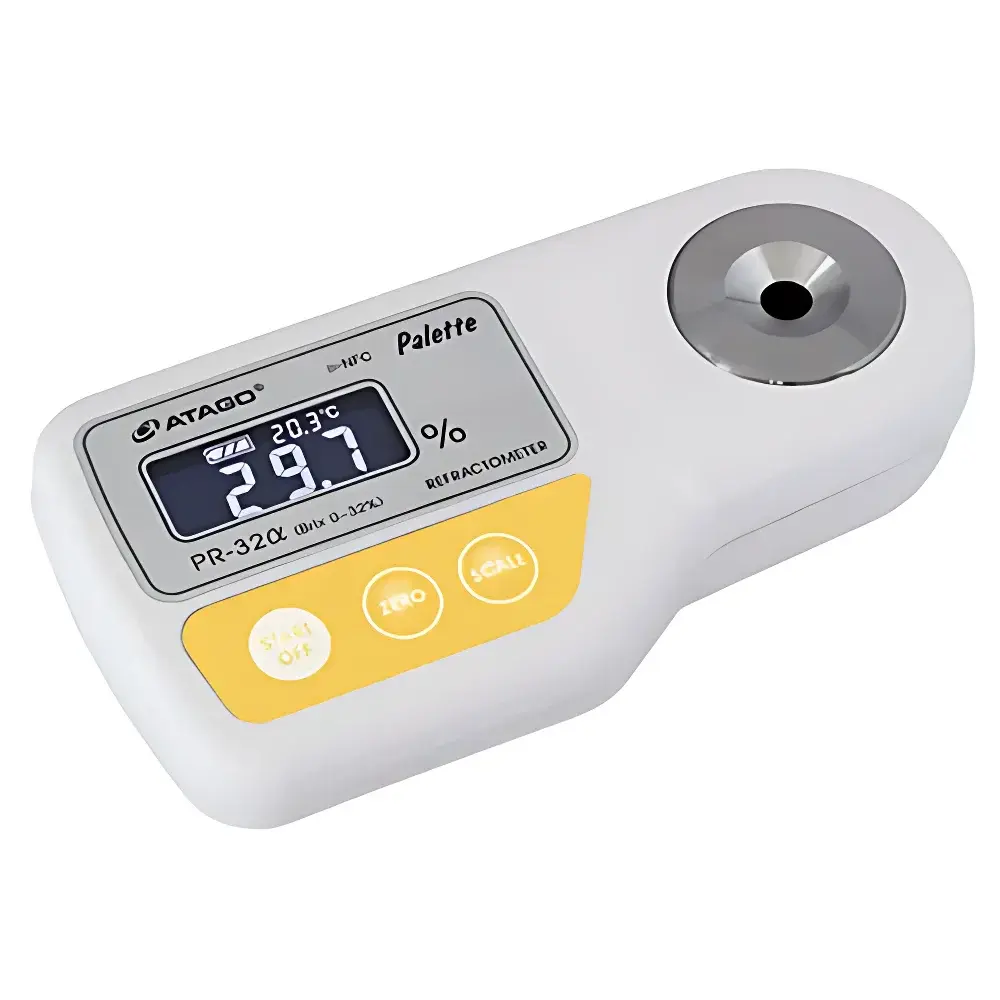
ATAGO PR-32α Digital Handheld Refractometer
| Brand | ATAGO |
|---|---|
| Origin | Japan |
| Model | PR-32α |
| Product Type | Handheld Refractometer |
| Measurement Range | Brix 0.0–32.0% |
| Minimum Display Resolution | 0.1% Brix |
| Accuracy | ±0.1% Brix |
| Temperature Compensation | Automatic (5–40°C) |
| Environmental Operating Range | 5–40°C |
| Power Supply | 9V Alkaline Battery (006P) |
| Ingress Protection Rating | IP64 |
| Dimensions | 170 × 90 × 40 mm |
| Weight | 300 g (instrument only) |
| Display | EL-backlit LCD with External Light Interference (ELI) suppression |
| Connectivity | NFC (Android only) |
| Custom Scale Support | Up to 3 user-defined scales with linear conversion coefficients |
Overview
The ATAGO PR-32α Digital Handheld Refractometer is an optically engineered, portable instrument designed for rapid, field-deployable concentration measurement based on the principle of total internal reflection. It determines refractive index and converts it to Brix (°Bx) — a standardized unit representing percent sucrose by mass — using built-in temperature-compensated optical calibration. Engineered for precision in variable ambient conditions, the PR-32α incorporates ATAGO’s proprietary ELI (External Light Interference) function to maintain measurement stability under non-controlled lighting environments, a critical feature for production-floor or outdoor use. Its automatic temperature compensation (ATC) algorithm corrects readings across the full operational range (5–40°C), eliminating manual correction tables and ensuring consistency without external thermostatic control. As a dedicated handheld refractometer, it does not require sample dilution, solvent handling, or complex setup — delivering repeatable results in under three seconds after sample application.
Key Features
- Precision optical system with high-stability Abbe-type prism assembly, optimized for aqueous and semi-aqueous solutions
- Automatic temperature compensation (ATC) calibrated to ISO 21748 and ASTM D1152 standards for refractometric measurements
- ELI (External Light Interference) suppression technology — actively filters ambient light noise to preserve signal integrity during measurement
- NFC-enabled data transfer (Android-compatible) for direct export of timestamped Brix values to mobile devices; supports CSV export for traceability
- Three programmable user-defined scales (Scale 2, 3, and 4) with linear coefficient input (factory default: 1.00); ideal for non-sucrose solutes such as glycols, sodium chloride, or organic acids
- IP64-rated enclosure — dust-tight and protected against water splashes from any direction, suitable for industrial hygiene-critical zones
- Low-power design with auto-off and battery status indicator; compatible with standard 9V alkaline (006P) cells offering >10,000 measurements per set
Sample Compatibility & Compliance
The PR-32α is validated for use with clear to mildly turbid liquid samples including fruit juices, soft drinks, syrups, coolants, cutting fluids, antifreeze (ethylene/propylene glycol solutions), cleaning agents, and pharmaceutical excipient solutions. It is not intended for highly viscous, opaque, or volatile solvents (e.g., acetone, ethanol >40% v/v) due to evaporation-induced reading drift and prism wetting limitations. The instrument complies with IEC 61010-1 for electrical safety and meets CE marking requirements for portable measuring instruments. While not FDA 21 CFR Part 11–certified out-of-the-box, its NFC logging capability — when integrated with validated third-party Android applications — supports ALCOA+ principles (Attributable, Legible, Contemporaneous, Original, Accurate) for basic GMP/GLP documentation in QC laboratories.
Software & Data Management
The PR-32α operates autonomously without embedded firmware-based software but interfaces via NFC with Android mobile applications (e.g., ATAGO’s official companion app or custom enterprise-grade QA tools). Each measurement includes embedded timestamp, scale identifier, and raw Brix value. Exported data retains audit trail metadata, enabling integration into LIMS or Excel-based quality records. No cloud synchronization or remote configuration is supported; all calibration, scale definition, and coefficient adjustment occur locally via physical keypress sequences — ensuring data sovereignty and compliance with air-gapped facility requirements.
Applications
- Quality assurance in beverage manufacturing: real-time Brix verification pre-bottling and post-blending
- Metalworking fluid management: monitoring coolant concentration to prevent microbial growth and maintain lubricity
- Automotive maintenance: antifreeze freeze-point estimation via glycol-Brix correlation curves
- Fruit harvesting and processing: rapid field assessment of ripeness and harvest readiness
- Pharmaceutical excipient preparation: verification of sucrose or dextrose stock solution concentrations
- Academic teaching labs: demonstration of refractive index–concentration relationships and temperature dependence effects
FAQ
Does the PR-32α support calibration verification with certified reference standards?
Yes — it accepts standard NIST-traceable sucrose solutions (e.g., 10.00% and 25.00% w/w) for periodic verification; ATAGO recommends annual verification using two-point checks.
Can custom scales be exported or backed up externally?
No — user-defined scale parameters are stored in non-volatile memory but cannot be exported or duplicated across units; reprogramming is required for each device.
Is the prism surface chemically resistant to common industrial solvents?
The sapphire-coated prism resists scratching and mild corrosion; however, prolonged exposure to strong acids (pH 12), or halogenated hydrocarbons is not recommended.
What is the minimum sample volume required per measurement?
Approximately 0.3 mL — sufficient to cover the prism surface uniformly without overflow; excess fluid should be wiped prior to measurement.
How is measurement repeatability verified under routine use?
Repeatability is maintained within ±0.05% Brix over 10 consecutive measurements on homogenous samples at stable temperature, per ATAGO’s internal validation protocol PR-32α-VP-2023.



