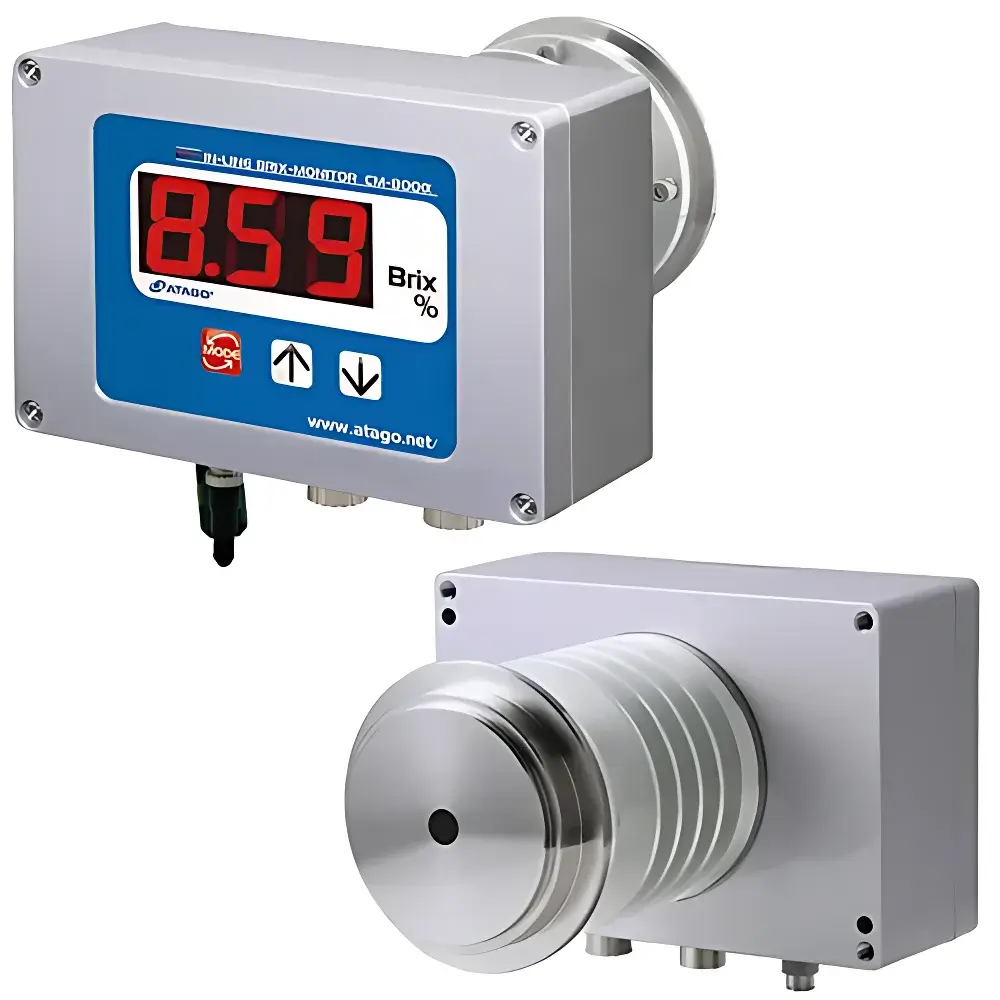
ATAGO CM-800α Online Refractometer for Electrolyte & Polishing Solutions
| Brand | ATAGO |
|---|---|
| Origin | Japan |
| Model | CM-800α (for Electrolyte & Polishing Liquids) |
| Measurement Range | 0.00–80.00% Brix (ATC) |
| Accuracy | ±0.1% Brix, ±1°C/°F Temperature |
| Temperature Compensation Range | 5–100°C |
| Operating Temp. | −15–160.0°C |
| Resolution | 0.01% Brix (≤9.99%), 0.1% Brix (≥10.0%) |
| Output | DC 4–20 mA, RS-232C (refractive index or Brix selectable) |
| Measurement Interval | 1 s (configurable to 5 intervals) |
| IP Rating | IP67 |
| Light Source | LED (≈589 nm, sodium D-line equivalent) |
| Prism Material | Synthetic Sapphire |
| Housing Material | SUS316L Stainless Steel |
| Dimensions | 160 × 167 × 110 mm |
| Weight | 2.4 kg |
| Power Supply | DC 24 V (AC 100 V optional with AD-32 adapter) |
Overview
The ATAGO CM-800α Online Refractometer is an industrial-grade, in-line process analyzer engineered for continuous, real-time concentration monitoring of aqueous electrolyte and polishing solutions used in precision metal surface finishing—particularly in semiconductor wafer fabrication, engine component machining, and electrochemical polishing lines. It operates on the principle of critical-angle refractometry: a collimated LED beam (spectrally centered near 589 nm, approximating the sodium D-line) passes through a sapphire prism in direct contact with the process stream; the resulting refraction angle is measured optically and converted into Brix concentration (%) with Automatic Temperature Compensation (ATC) across 5–100°C. Unlike manual handheld units or offline titration methods, the CM-800α eliminates sampling delay, operator variability, and contamination risk—delivering stable, traceable measurements at one-second intervals under harsh factory conditions.
Key Features
- High-stability sapphire prism (Mohs hardness ≥9) and 316L stainless steel wetted parts ensure long-term resistance to aggressive acids (e.g., phosphoric, nitric, sulfuric) and abrasive polishing slurries.
- True ATC functionality compliant with ISO 21748 and ASTM D1074, enabling accurate Brix-to-concentration correlation even during rapid thermal transients in recirculating baths.
- Dual-output architecture: simultaneous analog (4–20 mA) for PLC/DCS integration and digital (RS-232C) communication supporting configurable data output—including refractive index (nD), Brix %, and temperature—with user-selectable resolution modes.
- IP67-rated enclosure guarantees reliable operation in high-humidity, coolant-splashed, or washdown environments typical of CNC machining cells and electrochemical processing bays.
- Factory-calibrated optical path with no consumables or reagents; zero routine maintenance beyond periodic prism cleaning per SOP.
Sample Compatibility & Compliance
The CM-800α is validated for continuous flow measurement of transparent to mildly turbid aqueous solutions with viscosity ≤500 mPa·s and suspended solids <0.5 wt%. It is routinely deployed in monitoring H3PO4/HNO3-based electrolytes, cerium oxide or alumina-based CMP slurries, and alkaline nitrate/nitrite coolants. The instrument meets IEC 61000-6-2 (immunity) and IEC 61000-6-4 (emissions) for industrial electromagnetic compatibility. Its analog output supports integration into SIL-2-capable safety loops when paired with certified barrier systems. While not intrinsically safe, it complies with ATEX Zone 2/IECEx Class I Division 2 requirements when installed outside hazardous areas per EN 60079-14.
Software & Data Management
No proprietary PC software is required for basic operation; configuration and diagnostics are performed via terminal emulation (e.g., PuTTY) over RS-232C. For enterprise-level deployment, the CM-800α supports Modbus RTU protocol via optional RS-485 converter (AD-485), enabling seamless ingestion into SCADA, MES, or LIMS platforms. All measurement logs—including timestamps, raw nD, compensated Brix, and temperature—can be archived with audit-trail capability. When integrated into FDA-regulated environments (e.g., medical device polishing validation), its fixed calibration algorithm and non-volatile memory support 21 CFR Part 11 compliance when paired with validated electronic record systems.
Applications
- Semiconductor manufacturing: Real-time control of electrolyte concentration in electropolishing baths for silicon wafers and copper interconnects.
- Aerospace & automotive machining: Closed-loop adjustment of nitrate-based passivation solutions for aluminum and stainless steel components.
- Electrochemical metal finishing: Monitoring of phosphoric acid concentration in anodizing lines to maintain consistent oxide layer thickness (per MIL-A-8625).
- Quality assurance labs: Cross-validation against reference methods (e.g., density hydrometry per ASTM D1298 or titration per ISO 6353-2) for GMP-compliant documentation.
- Preventive maintenance: Trend analysis of Brix drift to detect coolant degradation or contamination before surface finish defects occur.
FAQ
Can the CM-800α measure non-aqueous solvents such as IPA or acetone?
No. It is calibrated and optimized exclusively for aqueous solutions exhibiting linear Brix–concentration relationships; organic solvents require dedicated refractometers with solvent-specific calibration curves.
Is field recalibration possible without returning to ATAGO service centers?
Yes—using certified sucrose standard solutions (e.g., 10.00% and 40.00% w/w) and the built-in two-point calibration mode, following procedures outlined in the Operation Manual Rev. 4.2.
Does the unit support PROFIBUS or Ethernet/IP protocols natively?
Not natively; however, third-party protocol gateways (e.g., HMS Anybus Communicator) enable conversion from RS-232C/RS-485 to PROFIBUS DP, EtherNet/IP, or Modbus TCP with deterministic latency <50 ms.
What is the maximum allowable pressure rating for inline installation?
The flow cell is rated for continuous operation up to 1.0 MPa (10 bar) at 25°C; derating applies above 80°C per ASME B31.3 process piping guidelines.
How does ATAGO verify long-term optical stability?
Each unit undergoes 168-hour thermal cycling (−10°C ↔ +70°C) and 500-hour continuous LED aging test pre-shipment; spectral drift is limited to <0.0002 ΔnD over 12 months under nominal conditions.
Related Products